You don’t have to rewrite the good parts

My wife is my initial beta reader. Like me, and in a strange coincidence, she also has three young children. Together with her many jobs and responsibilities, these children make it as difficult for her to find time to read as they make it for me to find time to write – probably more so. Consequently, I must be patient and find something else to work on while awaiting the initial feedback on the latest work.

Lacking a suitable idea for a new project, I am left with the daunting notion of revisiting some old projects. I have four unpublished novels in completed draft form. That is to say there are four that come to mind; there may be others my subconscious finds too painful to contemplate.

Of the four, one can probably be fixed to meet my standards for publication. Another might have potential, but needs serious structural work. The other two are long shots. All four need lots of attention.

It’s difficult to get motivated to do the amount of rewriting that even the best of them would require. Rewriting doesn’t touch the good and the fun parts very much. The peaks are fine; it’s the dark, grimy, stinky valleys that beg rewrites. Your brain gets dirty and sweaty at the very bottom of the pit.

I know I eventually have to put on my overalls and get down into the dirt of the salvageable novel, but I’ll still find excuses to put it off. As for the others, I may just save those for when I’m famous, and also dead.

The After I’m Dead (AID) novels will be my last embarrassing legacy. My money-grubbing great-grandchildren will bring them to light for a quick payday. People will shake their heads at the poor quality, but do so quietly out of respect for the departed. Since I will be famous (play along with me) and also dead (couldn’t have happened to a nicer guy), morbid curiosity will turn these into my best-selling books.
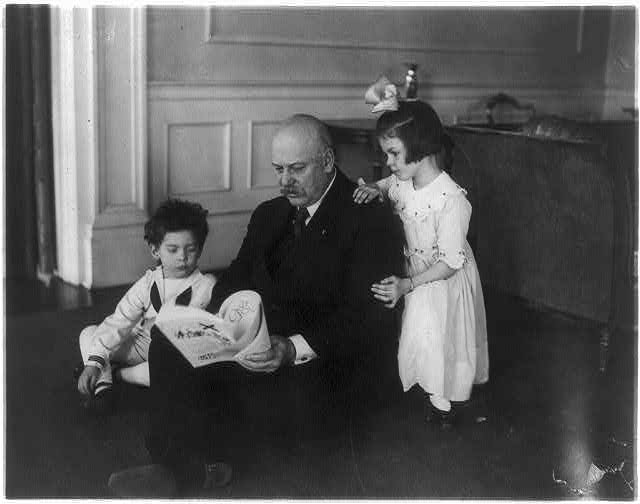
-"And now, sweet grandchildren, you must promise that you will never bring this sub-par manuscript to light." -"We won't. We swear on our grandfather's grave."

-“And now, sweet grandchildren, you must promise that you will never bring this sub-par manuscript to light.”
-“We won’t. We swear on our grandfather’s grave.”

My great-grandchildren will buy 10,000 square-foot homes in Malibu and I’ll roll over in my 12 square-foot grave.

Perhaps I should really get to work on rewriting the AID novels after all. I like to keep still when I’m sleeping.

I guess I should start with the salvageable novel first, because nobody gets to live in Malibu if I don’t get famous before I croak. On the other hand, I don’t want to live in Malibu and, at this rate, my great-grandchildren don’t deserve to.

So maybe I’ll just keep procrastinating. Maybe I’ll even write some more meandering blog posts as an excuse to avoid the hard work waiting for me.

Maybe I’ll spend the time with my kids, teaching them lessens they can pass on to their children and grandchildren about how not to be mooching, greedy bastards.

Who knows what I’ll do. At any rate, I most likely won’t become famous.

That’ll teach ‘em.
Moby Dick – Part II: I’m with the whale on this one

The following is Part II of my critique of Moby Dick from my old web site. At this point, I had finished the book, which was quite a relief to me. Last week I posted Part I, written when I was only half way through the novel. If you want to read Part I first, click here.

Part II: Finished with Moby Dick

Previously, I shared some thoughts formed while reading the first half of Moby Dick. Though I was not thrilled with the story, I was determined to finish it. I had seen a faint glimmer of potentially smooth storytelling and was really hoping this potential would blossom into an engaging second half.

Having finished the book, I am here to report that my hopes were dashed upon the rocks of long-winded meandering. The novel peaked somewhere between the 10 and 13 percent marks (as read on Kindle), and never came near reaching those heights again.

Moby Dick is bereft of likable characters. If I had to choose, I would say my favorite (i.e. the least annoying) character was Moby Dick himself. He is my favorite because he shows up for only the last 10% or so of the book, which is also good advice for any potential reader. Unlike Ahab, Starbuck, and all the other prominent, hard-bitten sea-farers, he doesn’t talk too much. I appreciate good dialog in a novel, but these sailors are forever spouting some drivel that means next to nothing. Even when they are not speaking, they are thinking pointless drivel. I wonder if Melville attended the same writing workshops as James Fenimore Cooper.

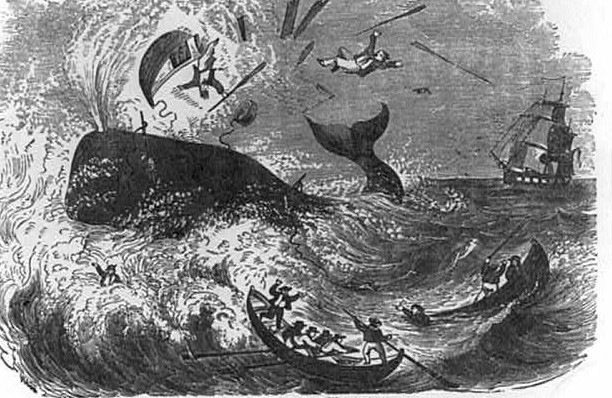
Moby Dick shows up for the climactic final scene, takes care of his business, wagging his jaw no more than necessary to crush a few boats, and then goes home. He wastes no time tripping over insipid attempts to make himself sound intellectual. If only the author could have been half as efficient.

The whale's not much for dialogue. He just takes care of business and goes home.

The whale’s not much for dialogue. He just takes care of business and goes home.

Instead, Melville wanders. At the beginning, it seemed like a major part of the plot would be the unlikely friendship between the Yankee narrator and a partially-civilized cannibal. Yet, by the time the ship shoves off from the dock, the cannibal has become no more noteworthy to the narrator than any other of the harpooners. This may be a blessing in disguise, for if nothing else, it prevented the cannibal from indulging in drawn-out soliloquies.

The author’s focus drifts in the wind throughout the book. Even at the very end, it is still drifting. Melville seems to forget, until it is nearly too late, that the narrator must actually live if we are to put any credence in the story he has just spent way too long relating to us. The narrator is almost certainly floating toward the light when Melville hastily yanks him back into the mortal world with an afterthought of a tale about his unlikely survival of the final battle.

It turns out that the great whale was efficient, but not completely thorough in his actions. He left one man alive to tell the tale. I wonder if he regrets this oversight as much as I do.

Moby Dick – Part I: Somebody should make a story out of this

Having had my mental energy usurped by a recent upswing in the intensity of my day job, it seems the perfect time to reintroduce my critique of Moby Dick from my former web site. It is a two-parter; the first part is impressions of the first half of the book. The second part was written after finishing the novel.

Part I: Half way through Moby Dick

I found a free Kindle version of Moby Dick. Since I am a sucker for finding out what’s going on with the classics, this was a clear incentive to give it a try. I should make it plain that I am only half-way through at present.

Most people think Moby Dick is a long book, but it is actually three long books. The first is a whaling primer, complete with whale classifications, history, and even a couple of chapters on how whaling is depicted in the fine arts. The second book is a defense of the occupation against other mariners, and general society, who may be inclined to look down upon the whaling trade. The third, and smallest, book is a novel, generally touching upon the subject of whaling.

There may be an audience for each of these three books. Unfortunately, the books are all mixed up, hodgepodge, into one. At the beginning of each chapter, the reader takes a spoonful of whale-product pot luck without knowing into which of the three books he is delving.

Three books in one, what a bargain!

Three books in one, what a bargain!

It is common among pieces of 19th century literature to meander into unfortunate asides that interrupt the narrative. Consequently, I am willing to give some leeway on this point. But Melville takes the inch I give and turns it into a mile, educating me on many topics about which I would just as soon remain ignorant, if I could save an hour by doing so. He spent a chapter explaining what’s wrong with the color white.

The storytelling itself (when it can be unearthed) suffers from a major point-of-view problem that would brand any modern author an untutored novice. Moby Dick is narrated by Ishmael, one of the crew of the ship. It does not take long for Ishmael to flee his own skin and flit about as a fly on the wall in places where his body is not present. The narrator describes scenes that Ishmael is in no position to see. Heartened by this omnipotent superpower, the narrator jumps into the heads of Ahab and his three ship’s officers to give us a glimpse of their most intimate thoughts.

You may be asking yourself, “Why has this dolt kept reading, if he finds so many problems with this book?” The answer is that there is one truly bright spot I hope will blossom in the second half.

In the actual narrative portions, when the story is really being told from the first-person, the prose is rather engaging. Melville’s style can be quite charming, as it was for almost three chapters in a row, in between sessions of Whaling 101 class. I’m hoping the last half of the book contains more of this type storytelling and less instruction and thought-reading.

I will continue reading, hoping that Ishmael is satisfied I’m now trained to competently follow the story of a fictitious whaling expedition. If I can also satisfy him that I want a chronicler of events as he experiences them, rather than a mind reader who presents me with every character’s thoughts, we may just be able to get along until the end.

It depends on your definition of Horror

I haven’t written about my Work In Progress in a while. And since I’ve got some time to kill while I wait for my last book to become a Best Seller, this might be a good time for an update.

My WIP is a collection of three novellas. It’s probably more accurate to call them two novelettes and a novella, but that takes more words to say, and who’s counting anyway? The genre is horror, kind of. It’s more psychological horror than anything revolving around chain saws and slack-jawed yokels. There’s really not much bloodshed in it at all, which is why I put the “kind of” after horror. I might call the novellas psychological thrillers, except I always think of spies or mobsters when I think psychological thriller, and there are neither of those, so I’m back to horror, kind of.

Poe. Not really his style of horror story.

Not really Poe’s style of horror story.

Then again, genre confusion is nothing new for me.

Whatever they are, I’ve finished the first drafts of all of them.

Yay!

Okay, party’s over; let’s get serious.

I had my first chance to read through them.

The two shorter pieces are entertaining, I think. They are not earth-shattering additions to the genre, whichever genre they happen to be, but I can see readers enjoying them as quick reads.

Definitely not Lovecraft's kind of horror.

Definitely not Lovecraft’s kind of horror story.

When it comes to the longer story, the feature presentation, if you will, I feel as if I’ve provided myself with good news and bad news. The good news is there are parts I think are quite good. The bad news is good parts are not enough to make a good story.

It’s not that the story is bad. It’s not, but as is, it’s not good enough.

What’s wrong with it? Well, for one thing, it’s probably too confusing. Confusing your readers is never good, unless you are an established post-modernist or something like that. In that case, confusing everyone just makes you a greater genius.

But I am neither a post-modernist nor a genius. At best, I am an adventuresome writer, playing with supernatural subject matter for the first time, and I may have gotten the Play-Doh colors all mixed up.

More in line with du Maurier's type of horror . . . but not really.

More in line with du Maurier’s type of horror story . . . but not really.

The fun thing in writing about unknown forces is that you get to make your own rules for what’s possible. Nothing is bound by the laws of physics we know. The trouble can be in remembering your new rules and applying them consistently. Plus, you’ve got to let the reader know the rules; they can be difficult to convey, without explicitly explaining them, when they are counter-intuitive to commonly known laws of nature.

Can this book be saved? I don’t know. I may be going too hard on myself, or too easy. I’ll have to get a second opinion, and then a few more after that.

All I know for sure is that I won’t even consider publishing it until I’m confident it’s a good quality, entertaining book, all the way through. How I get there from here will be my own horror story.