Book release: A Housefly in Autumn

Since I began this blog, last September, I’ve been talking about my forthcoming book, A Housefly in Autumn. Before I started this blog, I owned a traditional web site. There, I talked about my forthcoming novel for even longer. Altogether, I’ve spent a long time talking about something happening in the future. If you saw any of these mentions, you may have begun to wonder if the future would ever get here. I know there were times when I did.

It took its sweet time, but the future has arrived.
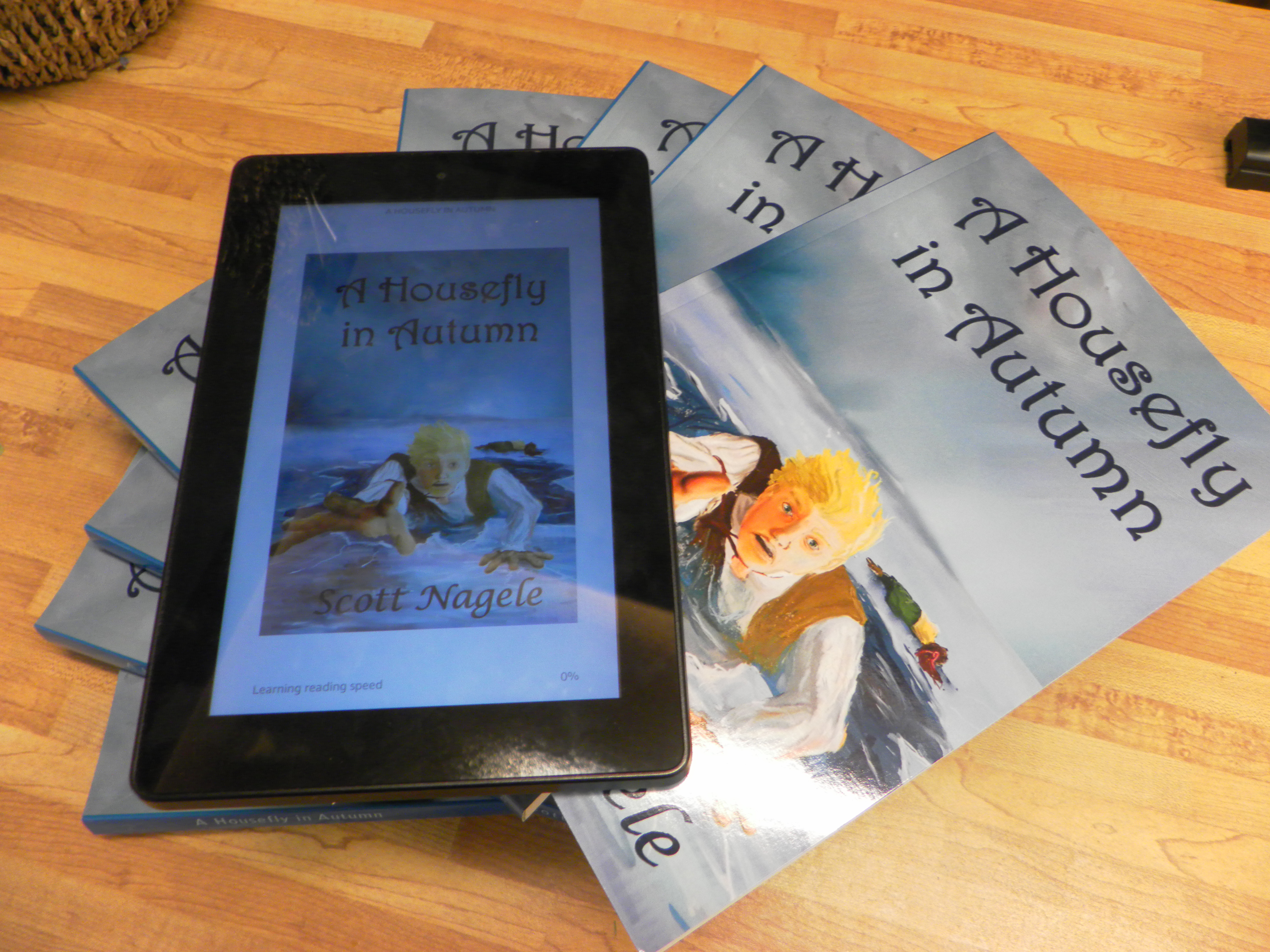
Available in Kindle and paper

If you buy the paperback at Amazon, you can download the Kindle version for free. Just in case you can’t decide which you like best.

Today is that day. I can finally hold a real live copy of A Housefly in Autumn in my hands. I can download the e-book to my Kindle. In fact, I have already done both of these things, and now so can you.

A Housefly in Autumn is available in paper and Kindle formats.

Where to buy:

Amazon Barnes & Noble Createspace
Paperback Paperback Paperback
Kindle

This book has taken longer to publish than my previous ones. The editing, the proofing, the cover art, it’s all been a longer trek. That’s why this day is sweeter to me than past release days. It’s the culmination of more investment, more sweat and toil.

That also may be part of the reason there’s more trepidation than before. There’s more toil at risk. But the toil can’t be undone so it might as well be pushed with all the other chips into the pot.

I’m all in. Now I get to see what kind of hand I’ve dealt myself.

Introducing:

A Housefly in Autumn

                Book Description

A Housefly in Autumn is intended for Young Adults and up. A historical novel, set in 19th century Europe, it follows the life of a young man whose dreams have crumbled down around him. In an act of heroism, he sacrifices his own promising future to save the life of another. Now he must decide whether to cling to the unlikely hope of regaining his old life, or aim his efforts toward making the most of the life fate has dealt him. Though it is difficult to let go of the rewards that life once promised, perhaps the greatest rewards are the ones earned by building new hope from the bits and pieces of wrecked dreams.

                Synopsis

At 17, Anders Christiansen was a young man overflowing with potential. All his teachers believed he was destined to blossom into a leading man of letters, enjoying a life of rich rewards.

That was before the accident.

Now, Anders’s great talent lies fallow. He can’t produce the complex ideas he once did. His thoughts are slow and his words simple. The world holds little promise for him anymore.

Struggling to build a meaningful life out of the wreckage of his dreams, Anders learns the value of simple treasures. Loyalty, devotion, and even sacrifice hold rewards of their own to renew hope after tragedy. Love can cause hurt, but he who gives love when he hurts the most will reap a joy outweighing the pain.

Anders gives meaning to his life in the way he spends it. He will face grave danger to spare those he loves, and though his gifts be diminished, he will share them freely with even the humblest of children. Though never sought, Anders’s reward is immense and enduring, showing the millions of reasons to go on sharing even the simplest of gifts.


So now I guess I have to find some new future event to start talking about. Fortunately, my future is full of things that probably will happen but might take longer than I expect. There will be plenty to talk about.

Kindle publishing: the mostly good, the little bad, and the none too ugly

Kindle publishing is amazing. The idea that you or I, or anyone, can upload a manuscript at no cost and have people all over the world be able to buy and read it in a matter of hours is truly a mind-blowing concept. That’s the thing to keep in mind as I regale you with my Kindle publishing frustrations.

After all the hard work putting a print version of a new novel together, I yearned for a moment to sit back and enjoy a sense of accomplishment. Resting on my laurels would have been a fine thing, if I had any laurels, and if I weren’t concerned about exposing the other half of the reading public to my book.

So, after four years of forgetting everything I had once learned about Kindle publishing, it was time to dive back in.

It’s incredibly easy to get 95% of the presentation of a book right on Kindle. If you’re fine with 95%, you can likely publish to Kindle in your sleep. If 95% isn’t good enough, the other 5% can make you lose a good deal of that sleep.

Here are some lessons I’ve learned from my recent bout with Kindle Direct Publishing (KDP).

The online previewer doesn’t preview for older Kindles

I uploaded a file that looked great on the previewer. It looked fine on the Fire, but when I downloaded the file to my old Kindle reader, some spaces had disappeared from between special characters. You don’t really know what it looks like until you read it on an actual Kindle.

Special fonts may not convert

I have a few instances in which I use special fonts. It seems like Kindle used to be able to handle these, but now they are changed to a common font.

Functionality may not be the same on different Kindle devices

I wanted to have a Table of Contents location to help readers navigate. The TOC location is recognized beautifully on my old 2nd Generation Kindle Reader, but is a dead end on my kids’ Kindle Fire.

Kindle evolution

Both are Kindles, but they are very different devices.

Kindle books may not open where you want them to

When I downloaded the free sample and opened it, it began at the place where the Kindle gods guessed the story began: Chapter 1. Unfortunately there was text important to the story prior to Chapter 1. It got skipped, leaving the reader lacking context. Yes, it’s only the free sample, but how many people use free samples to decide what to buy? And would the full book open at the same spot? (I decided to get the sample right before I even bothered downloading the whole book.) I solved this problem by uploading a new file in which I bookmarked and labeled the text preceding Chapter 1 as ‘Prologue’ and linked to it in the Table of Contents. It still doesn’t open exactly where I’d like, but at least it opens before the story begins.

Email notifications that your updates are published sometimes jump the gun

I got an email that my new files were published. I then downloaded a new free sample. It was still the old file. A day later, I downloaded the free sample again. This time it was the new file. At the very bottom of the email it mentions something about 24-48 hours. This is an important note that should probably be more prominent.

Kindle publishing has changed in the past four years

Mostly, they’ve made it easier. But if you were expecting it to run like it used to, you could be in for some surprises. I updated the file for an old book only to discover I had uploaded an image link that was no longer necessary and had thus created a book with two covers. This was an easy fix, once I figured out what I’d done wrong.

Your experience could be completely different than mine

That’s just the nature of uploading files and having them automatically converted to a different format. It leaves room for a lot of trial and error. The good news is you only have to buy the book once. Then, if you want to see a later update live, you can email KDP and they will send the new file to your device. They are very responsive to emails and have answered all of mine with 24 hours.


Even having learned these lessons, I am far from a Kindle publishing expert. I’m working hard to conquer that last 5%, but I’m beginning to understand that 100% right, across all devices, might be a pipe dream.


The 5 stages of self-publishing

This book is going to happen. I’ve approved the final proof, and more importantly, I’ve entered the last psychological stage of self-publishing.

Some might claim self-publishing is nothing but grief. I wouldn’t go that far, though it does bring its fair share of grief with it. Looking back over the years it’s taken me to produce A Housefly in Autumn, I realize I’ve gone through at least five stages self-publishing. If you are familiar with self-publishing, you may recognize some of these emotions.

Denial

This thing will never come together. You’ve rewritten it over and over, and it’s still not right. You don’t know why you spend so much time on this project. If you ever get a decent book out of it, it won’t be worth all this aggravation. Maybe you should just start something else. But what? You’ll just work on this until you come up with an idea for something totally kickass that writes itself.

Anger

Why do you have to have this compulsion to write? Why couldn’t you have been a painter? Then, you’d just paint a picture and be done with it. Now, you’ve got to locate beta readers, editors, a cover artist, and God knows who else. Too bad writing doesn’t involve more writing and less coordinating. If you wanted to run a business, you’d open a coffee shop.

Bargaining

Okay, you may not agree with all the beta readers’ criticisms, but you have to address them. They are representative readers and you can’t afford to ignore their suggestions. You’ll address their concerns, but only to the point that it doesn’t turn the story into something you don’t mean it to be. It should appeal the greatest possible number of readers, but it still has to be the story you want to tell.

Depression (mostly simple anxiety)

This is getting to the point of no return. It’s a new genre for you. You wonder if you did it right. Does it even fit into a genre? Have you come up between genres? Is the tone right? Are the characters likeable enough? Are they too likeable? Do they need a harder edge? Is the writing style universal enough? Is there enough emotion? Is the emotion over the top? Too many commas?

Acceptance

It’s done. Some will like it; some won’t. You could toil over it for 20 more years and it would still be the same: some will like it; some won’t. There’s no point in worrying anymore. You wanted to be a writer didn’t you? This will give you a good chance to see how that whole thing is working out for you. If you want to be a success, you’ve got to take the risk and put yourself out there. If worst comes to worst, with all your self-publishing experience, you could probably open a coffee shop.


Author anxiety

“Don’t worry about it, James. You put lots of unnecessary words into the novel, didn’t you? Then I’m sure people will love The Back Woods Guy who Couldn’t Resist Giving Long-winded Speeches to the Last of the Mohicans.”

Cold feet and self-publishing

These are probably the cold feet I should have had before my wedding. But I was fairly secure in what I was getting into that day. I was more worried about something embarrassing happening at the ceremony than any of the ever after part.

The cold feet I avoided at my wedding have come to me over a book. This month, I will be releasing my third self-published book, A Housefly in Autumn. You’d think I would worry less about my third than my first two, but I don’t. I worry more.

Why doesn’t it get easier? It probably would get easier if I could stick to one genre. If I wrote the same kind of book every time and knew what to expect from the audience of that single genre, I’d likely feel more comfortable. But I’m trying something different. This is the first non-humor novel I’ve published. It’s not the first one I’ve written, but nothing hits the fan until you publish.

One of the benefits of self-publishing is you get to take risks. Nobody in a corner office is going to stop you from pissing away the firm’s money, because there is no firm, and more to the point, there is no money. It’s only your own blood, sweat, and tears you are potentially pissing away, and you can make more soon enough. Even so, risk can be daunting when it has your name attached to it.

the corner office

Some early self-publishers enjoying the freedom to take risks. Or maybe they’re just some guys building a corporate corner office.

Switching genres is a risk. The bigger risk is living between genres. This new book falls somewhere between Young Adult and General Fiction. Some books have succeeded very well in this gray area. Many more have failed.

There are some other little risks built into the story and the telling of it, but the little risks wouldn’t be extraordinarily frightening if not coupled with aforementioned, larger risks. In combination, each little risk has the potential to break the camel’s back.

Still, any worthwhile undertaking should be daunting. There comes a time when you have to damn the torpedoes, in spite of the risk. Yeah, I’ll fret over the release of this book, because that’s the nature turning your art toward the public eye. But I will also find confidence in recalling how much time and hard work went into producing it. Time and hard work might not be enough to claim success, but it’s enough to take a shot at it.

I’m taking this shot, regardless of my slightly chilly feet. My feet and I will do our best to make a success of this book while brewing up some new blood, sweat, and tears for the next one, which will be of yet another new genre. I guess it’s a good thing I don’t have any corner offices, or corporate money, to stop me from taking risks. All I’ve got is a pair of light blue feet, and having stood firm before the altar, they can stand behind a little old book.

Read more about A Housefly in Autumn here.