The fifth time’s the charm. Maybe.

It’s down to me now. All the others are done with their work. It’s time for me to get it done and get it right. I’ll get it as right as can. I’ve invested too much to not give the final stretch my best shot.

The fifth proof copy of A Housefly in Autumn hit my mailbox yesterday. That’s right, the fifth proof. As I said, I’ve invested a lot.

The beginning of the end?

Will the fifth proof be the last? Cross your fingers.

This copy is mine and mine only. All the skilled people I’ve been fortunate to have help me have done what they could. It’s just me and my book.

There’s something liberating in this. I’m back in control of the pace of things. I don’t have to wait for anyone else. The people who’ve helped me have been more expeditious than I had any right to ask, but waiting any length of time is hard when you’re eager to get on.

There’s also something daunting in it. I’m the last line of defense against little errors hidden in the text. Whatever gets past me this time becomes dirty laundry hung out for the public to see.

Thus begins the first of the “pins and needles” readings. If I find no more errors, I am free to release the book for sale. That would be a happy accomplishment, marred only by nagging doubt about the one I missed. Or the two, depending upon how susceptible I feel to nagging from the back of my mind.

The even more intense pins and needles will happen the first time I look at the book after it has been published, when every page holds a potential embarrassment, despite all my efforts to eliminate them.

My goal as a self-publisher is to produce books that deserve a spot on the same shelf as those published by Random House or any of the other big names. I haven’t reached this goal yet, but with each book, I think I get a little closer. But I still make mistakes, and in self-publishing you don’t get to blame mistakes on your publisher; you can only blame yourself.

I do blame myself, but then I do my best to fix it, learn something, and move on. There’s another story to write. And if that story turns out to be worth publishing, there’s another book to produce.

This means more hard work writing, more tedious work editing, more finding the right people to help, more waiting while those people do what they do, more frustration at getting it all to fit together, and more pins and needles at the end when the skivvies are hung out to dry before the eyes of all who wish to look.

But all that is for tomorrow. For today I have a fifth proof to make as right as I possibly can, so I can inch a little closer to Random House and to saying I know what I’m doing as a writer and a publisher. Wish me luck.
He was a good bear before Hollywood got to him

As a child, I never took interest in Winnie-the-Pooh. My only exposure to what seemed a hopeless band of anthropomorphic misfits was television. TV convinced me Pooh was merely a chubby ne’er-do-well with no sense or self-discipline, who would accidentally strangle himself if left to his own devices.

His friends were no more interesting. There was some kind of mule with chronic fatigue syndrome, whose pity parties wore thin. There was a pig in a sleeveless jumpsuit, and a boy who looked like he needed to eat some meat and potatoes.

I don’t remember all the characters because I never enjoyed the films. I began avoiding Winnie and his crew. I avoided them without a backward glance for about 40 years.

Then a thoughtful person gave my son a Winnie-the-Pooh storybook. I had never consider Pooh as literature because I’d been turned off by him as television. Having seen what Hollywood did to Tarzan and The Little Mermaid this isn’t surprising.

When my son asked me to read from his Winnie-the-Pooh treasury, I winced. I wanted to make up the story instead of reading it. I wanted to say, “Once upon a time there was this ridiculous bear who only wanted honey, and since he had no sense and he could not control his desires, he got his head stuck in a pot of honey and had to live with his head inside the pot for the rest of his pitiful life. The end. And let that be a lesson to you, young man.”

I did not say this; that would have been lazy parenting, and the boy’s mother was sitting within earshot. I did the honorable thing: I tried persuading the boy he would prefer Green Eggs and Ham. When that failed, I sighed and began reading.

To my surprise, the literary Winnie-the-Pooh is quite well done. This Milne fellow knew how to tell a story with charm. Winnie is not nearly so vacuous as in his films. He makes up witty little songs, and though he possesses less forethought than is to be hoped, he does spend some time on afterthought.

Humble Winnie

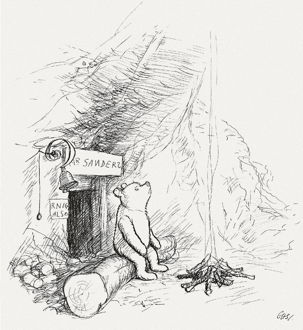
They were simple times, before all the glamor and glitz, but they were good times. (Image: E. H. Shepard)

Rabbit’s desire to keep his home free of unwanted visitors is relatable to any middle-aged man. The only thing that would make him more perfect is if he came to the door waving an 80-year-old shotgun he never owned shells for.

I remember Piglet to have been portrayed as cowardly on TV. TV didn’t uncover the real depth of Piglet. Piglet has a keen sense of discretion. He is willing to accompany Pooh in pursuit of a couple of potentially hostile Woozles, but when he and Pooh are outnumbered he reads the writing on the wall. Piglet knows how to count and when to cash out. Now, if only he would cash out of that 1920s bathing suit.

We haven’t met Eeyore yet. No doubt, he will turn out to be a grizzled veteran of the Boer War, suffering from a tail wound and in constant pain from a bullet lodged in his hip. What once seemed like incessant complaining will surely be words of wisdom from a hero of the siege of Kimberley.

Though we got off to a rocky start, I like Pooh now. I like the way his stories are written. There is a unique talent for storytelling in the books. I hope it doesn’t take my boys 40 years to appreciate that.

Discovering the magic of Story

I mentioned last December that I was reading A Christmas Carol to our six-year-old at bedtime. Until then, we’d been reading children’s books. I could knock off a children’s book in under five minutes, kiss him, tuck him in, and be back downstairs without missing too much action from whatever sporting event I was watching.

It was great for me as a sports fan, and it kept up the routine of a bedtime story, but there wasn’t much else to it. Meanwhile, the boy was progressing as a reader in his own right, but he viewed reading as a chore.

As I read him the original version of A Christmas Carol, I noticed he paid more attention, rather than just counting it as time spent with Daddy, and more importantly, a precious delay in bedtime.

Maybe he needed something more engaging than the average children’s book when not doing the hard work of reading himself. Maybe he didn’t enjoy reading because he’d never been hooked on the idea of Story. He’d never been bitten by the bug that makes a person need to know what happens next.

After Christmas, instead of going back to children’s books, we moved on to Grimm’s Fairy Tales. As with Dickens, we stayed away from watered-down versions. We went full-strength, with all its violence and villainy. If you think this is too much ugliness for an innocent first-grader, just listen to a few of them have a conversation or look at what they’re watching on TV.

Admittedly, the lessons of Grimm’s are sometimes questionable. In the story about the shoemaker’s elves, the elves do wonderful favors for the shoemaker, right up until the shoemaker shows his gratitude by leaving them presents. His presents motivate the elves to abandon him, leaving the impression he would have been better off as an ingrate.

But these iffy morals lead to questions. They let us talk about the story, which the children’s books seldom did. They make us think.

I bought a kids’ version of Grimm’s for him to read to me. For a while, reading it was something he wanted to be rewarded for. The other day, he told me he’d read ahead, on his own – something he’s never done before. He’s started reading to me at bedtime.

Grimm's for all ages.

Nighttime reading for father and son.

Maybe he’s just naturally maturing, or maybe he’s discovering the magic of Story; maybe both.

I’m saving Hans Christian Andersen for when we’re done with Grimm’s. I want him to be a practiced listener when we get to Andersen. While many of the lessons of Grimm’s boil down to “Don’t be stupid” or “Watch your back,” Andersen’s morals are often less ambiguous, while at the same time, more complex. There are tales of self-sacrifice, which is not only a good thing to hear once in a while, it usually makes for an interesting story.

Hans

Give us a little magic to dream on, Mr. Andersen.

Hans Christian Andersen resides in my personal Pantheon of Storytellers. I’m not sure how comfortable he is there, wedged between Twain and Thurber, but that’s his problem. I’m hoping he can foster a love of Story in my son, and maybe even get him to like reading a little. You’ve got to admire anybody who’s still giving out gifts 140 years after his death.

Are you trying to tell me my research stinks?

Skunks happen for a reason. I’m convinced of that now.

In February, my family was left reeling from the noxious fumes of a skunk using the area under our deck as a late-night rendezvous location to get her groove on with the boy skunks in the region. We all hated that skunk more than anything, but I’ve developed a new appreciation for her since then.

Why have I softened toward her, and how does this have anything to do with writing?

She provided me with another thrilling adventure for my fatherhood blog (read it here). This alone did not make her visit worth it. It’s only in the last few days I truly appreciated her visit.

I’m preparing a new novel, A Housefly in Autumn, for publication. It’s set in 19th century Europe.

When you write a story about a different place and time, you research as much as you can, but some things are too obscure to discover. In these cases, you get things as nearly correct as possible and keep vague about details you can’t nail down. You avoid the impossible and keep to situations that, if not historically provable, are at least historically plausible.

In doing this, you make assumptions. Sometimes, you don’t even realize you are making an assumption, and this assumption is the idea you fail to research.

This is where the skunk comes in.

In A Housefly in Autumn, there is a scene in which the protagonist mentions a skunk as if that would not be a surprising animal to see in a garden. At my house, it’s common.

I wrote this scene years ago, and have edited it many times, without giving the skunk a second thought.

On my fatherhood blog, I’ve mentioned skunks several times. People from other continents have commented, showing a perfect understanding of the hazards presented by the animal. This reinforced my assumption about the universality of skunks.

Back in February, I found myself extensively researching skunks, trying to find the right solution to our infestation, and one image stuck in the back of my mind, waiting.

A few days ago, I was scouring one of the last proofs of my novel. I came to the aforementioned scene for the thousandth time. On the thousandth time, the latent image from my skunk research rushed to the front of my mind. My jaw dropped.

I hurried online to verify the image. It was a map of skunk habitat, and it was correct.

Skunks are an American animal.

Never would I have guessed there are no wild skunks in Europe. Pepe Le Pew is French, right?

Maybe there are wild skunks in Europe by now, because those exotic animals from other continents rarely turn out the awesome pets promised, and they’ll probably survive in the woods behind the neighbor’s house. But in the 19th century, I doubt it.

Needless to say, A Housefly in Autumn is now a skunk-free novel. Most readers may never have noticed, but I do hope to sell two or three copies in Europe. And who knows how many other naïve assumptions I’ve made?

Just like every other part of a novel, the detail accuracy will never be perfect, but mine is now a little better, and I owe it to a real skunk.

skunk lunch

For my European, African, Asian, Australian, and Antarctican friends: this is what a skunk digging for insects on your lawn looks like.