The odd couple in my head

I was working out the logic for a database project at work when it hit me that it probably wasn’t normal for a fiction writer to be engaged in such a left-brain activity. I’m not supposed to be concerned with logic, or numbers, or any of the stuff I do at work. I’m supposed to wrap myself in flowery prose and serenade the world with my cute, yet impractical, idealism.

Fiction writers are supposed to be some minor tribe of artists. We should be ruled by that beautiful, playful, cursive hemisphere on the right. We’re supposed to ignore any straight-laced, know-better-what’s-good-for-you meddling by that block-style left half. That’s how it’s supposed to be, but until my fancy-pants right brain starts kicking in his share of the rent, it seems like the left brain is determined to make old Righty keep his poetic clutter tucked away in his own room.

I don’t know how writers who really are ruled by their right brains actually function. If that were me, I would not be a writer. I wouldn’t be a writer because I wouldn’t write anything. Righty has touching sentiments, and sometimes he has hilarious gags. But none of them would make it to paper if Righty were allowed to rule himself.

Righty likes to play too much; he’ll write down those profound thoughts later. Later would never come if not for steadfast Mr. Left’s incessant pounding on Righty’s bedroom door, demanding to know when something concrete is going to come of all his lofty thoughts. Righty lacks organization. His room would be a wonderland of wasted potential if not for Mr. Left’s iron heel.

perception

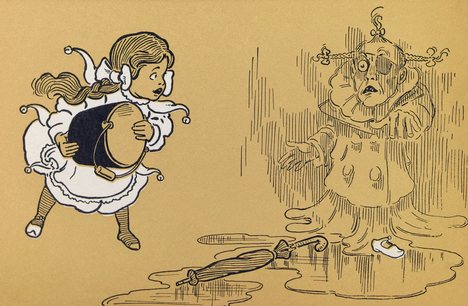
Exhibit b is the Left side of my brain. The right side of my brain is illustrated also by exhibit b, except with a V-neck and a flower on his chest instead of an Iron Cross. Exhibit a is a random human male we’ve never met. (Image: Oliver Herford)

Righty is always getting ready to write something really good. When Mr. Left is not busy securing income, he tunnels his way through the stacks of old newspapers in Righty’s room and makes his flakey roommate actually start. Left pins Righty down at his desk until Left has to go off and do some math somewhere else, whereupon Righty drifts away to gambol through the hoarder’s paradise that is his side of the skull.

You might think Righty and Mr. Left would make for unhappy roommates, but this is hardly the case. Righty secretly craves Mr. Left’s structure. Once in a while, Righty will actually come over to Left’s land of right angles and ask Left to help him organize his thoughts, because Righty wants the world to see his art, and he knows he cannot make this happen by himself.

Riding Righty’s back is hard work, but Mr. Left doesn’t complain. Mr. Left is no fool; he pays the bills, but he knows Righty has great potential. If he can impose discipline on Righty, maybe, just maybe, Righty will realize his unlikely dreams. If that were ever to happen, Mr. Left wouldn’t have to work so hard every day to make sure the rent gets paid. He might even go on a little vacation with Righty and find out how it feels to have some fun.

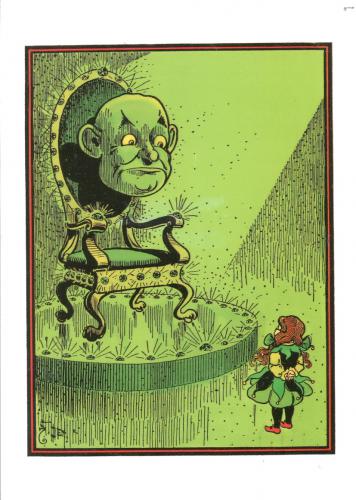
That time the Wonderful Wizard put out a hit on the Wicked Witch

Ever since becoming a family man, I’ve discovered myself lacking funds with which to buy books. I just finished reading The Wonderful Wizard of Oz, mostly because it was a free Kindle download and it’s too cold to go out to the library.

It’s a quick read, which, with three young children, means I can read it in a month. Books that aren’t quick reads I can’t read at all.

You may recall a movie of a similar title. All movies take liberties with the original text, and this movie took its fair share.

In the book, there is no mean schoolmarm, out for Toto’s blood. There are no farm hands and no traveling sideshow man. The good witch of the North is an old lady. Glinda represents the South. The Munchkins are as tall as Dorothy and don’t glow Technicolor. The shoes Dorothy loots from the dear departed feet of the Witch of the East are silver, not ruby.

Dorothy

Or maybe it’s just that Dorothy is shorter than we’ve been led to believe.

I’ve always thought there must be more to recommend the character of the flying monkeys than was depicted in the film. I was right. The monkeys only do the witch’s bidding because they are duty-bound to obey. When their required submission to the witch ends, they become helpful little fellows.

The most surprising difference is that the Wicked Witch plays only a minor role. The Wizard plays a larger role, and is perhaps worse than the witch. Rather than merely giving Dorothy a difficult time about her request to go home, as everyone knows is a Wonderful Wizard’s prerogative, this one demands that she kill the Wicked Witch if she ever wants to see Kansas again. He doesn’t just want the witch’s broom, or anything else that might be merely swiped from her, he wants that hag D. E. A. D.

Marching orders

“Make it look like an accident. And when you’re done with her, I want to talk to you about a job on a guy named Hoffa.”

Having given Dorothy her homework, he insists that her companions help her in order to get hearts and brains and stuff. But it is clear that he expects Dorothy, among all her adult associates, to lead the operation.

The Wizard was wise in picking Dorothy to lead the hit. She makes short work of the witch, without much help from her team. As in the film, the witch is taken down with water and Dorothy claims it was an accident; in the film, you are disposed to believe her.

I'm melting!

Fact: 99% of all melting accidents occur in the victim’s own home.

Book and film agree, the Wizard is a fraud – an old man from Omaha whose hot air balloon got away from him. Unable to hand over the promised rewards, he plies Dorothy’s companions with platitudes, which satisfies them since they unwittingly had everything they sought all along.

He accomplishes nothing on Dorothy’s behalf. She must rely upon Glinda to get her home.

The silver shoes take Dorothy home and the conspiracy to murder the Wicked Witch shouldn’t haunt Dorothy’s conscience, because it was all a dream.

Well, in the film it was all a dream.

*Illustrations by W. W. Denslow, from the original edition.

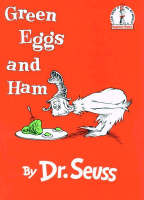
Green Eggs and Ham: the first one’s free

Having young children means I’ve read a lot of Dr. Seuss. Rather, I’ve read a limited amount of Dr. Seuss many times over. Reading a Seuss book too many times makes you start thinking more deeply about the story than is good for you.

I’ve already shared my over-analysis of The Cat in the Hat, but so far I’ve spared you my deep thoughts about Green Eggs and Ham. That grace period is over; here I go again.

On the surface, Green Eggs and Ham captures every parent’s frustration with the reluctance of their children to try new foods. The message we hope kids are getting is that just because a food is different doesn’t mean it can’t be delicious. Though most parents would not put green meat into their own mouths, it has the potential to be a helpful message.

Green ham

Yes, I’d like my kids to try new things, but I’m a little skeptical of this meal myself.

But considering the lengths to which Sam I Am goes to deliver this message, one must wonder if the ends justify the means.

We have no idea why Sam is so determined to have the unnamed character try green eggs and ham. He doesn’t indicate any parental relationship. Lacking that, his incessant nagging takes on the flavor of peer pressure, or worse, outright stalking. The pursuit ends only with a frightful train accident that might easily have spelled tragedy for both Sam I Am and his quarry.

Why would Sam I Am go to such lengths to persuade a character, who seems to be a mere acquaintance, to taste green eggs and ham? Try offering an oddly-colored foodstuff to a friend of a friend. When he declines, chase him around town with it and suggest rhyming pairs of common nouns whose presence might make him more amenable to your strange offering.

Sam’s peculiar persistence calls into question the nature of his goods. Is it really ham and eggs? My faith in Dr. Seuss persuades me it really is about ham and eggs, but it’s not hard to imagine it as a euphemism for something else. If I told you there was a book, published in 1960, about one guy pressuring another guy to try some freaky, new stuff, would you think of ham and eggs?

I don’t want to think that Sam was pushing something he shouldn’t have been, but why on earth would he suppose that a hunk of green ham would make for better eating in a box with a fox? Aside from the lack of dining ambiance inside a box, how would being cooped with a wild carnivore enhance anyone’s ham-eating pleasure?

Sam nearly makes sense when he asks about the possibility of his tarried acquaintance eating his ham and eggs in a house, but then he goes right back off the deep end by introducing a mouse into the equation. If he really wants to make the sale, he should quit blurting out the name of whatever creature he happens to be hallucinating about.

Only when Sam’s hectoring has brought the other character face to face with death does the latter agree to do whatever Sam asks, so long as it will get that suffocating monkey off his back. He tries green eggs and ham. His eyes light up and he professes, quite credibly, to liking the sample very much.

This resolution of the conflict is either a well-deserved triumph for focused, dedicated parents everywhere or it is a tragic loss of innocence. It depends upon how you look at it, which very likely depends upon how many times you’ve been compelled to read the book in a single evening.


The Third Novella: a horror story about writing a Horror story

Writing a book is a solitary sport. Publishing a book is anything but solitary. You need a lot of people to help you. Even when you are lucky to have diligent people helping you, everything takes time, which means you will wait through various periods for them to do their work before you can get the thing published.

About 18 months ago, while I was waiting for some beta readers to go through A Housefly in Autumn, I decided that starting a new book would be more productive of my time than twiddling my thumbs.

I envisioned a book consisting of three novellas of a genre very different from A Housefly in Autumn. These stories would be contemporary and not suited to young adults. They are my nightmares, the ground where parenthood meets horror.

Though not horror in a gory sense, they are dark enough to put them into a genre in which I have not written since high school. Back then, I was completing creative writing assignments, not contemplating an eventual published book.

I finished the first two novellas in accordance with the vague plan in my head. The third came third because it was less well-developed in my mind, so I let it marinate while I finished drafts of the other two. When the third’s turn came, I had sat on it long enough to know that it would not develop further until I started to write it.

As I waited to get the cover art for Housefly, I began the third novella. Little by little, it picked its way through the forest of words until it found its trail of plot. It began to come together, the story itself inspiring new elements to fill in its missing pieces.

The ending still floated on the mist, but as I got closer, I began to see outlines of solid shapes in that mist. I was fitting it all together in my mind.

Then I got some really fantastic artwork for Housefly. It was time to start laying out the actual book that had always just been a manuscript. The new project got pushed to the back burner. When you have three little boys at home and a full-time day job, the back burner is off.

The third novella stopped cold. What time I could muster was applied to getting Housefly through the next steps.

I don’t outline. This works for me, except when it doesn’t.

Waiting for help on the last proofing of Housefly, I went back to that third novella. After six months, I didn’t recall which i was undotted and which t uncrossed.

I’d have to go back and read it. I didn’t like to because I prefer to get through the first draft before I read, and I was afraid of what I would find in my first mature attempt to write horror, even watered-down horror.

So far, I’ve read through about one-third of it. It’s not as bad as I feared. Now if I can only re-figure out how it ends, I might actually start to like it. Horror doesn’t scare me so much anymore.

the third novella

The Third Novella. That could be the title of a horror story. Anyway, this third novella is waiting to be finished.