The Ghost of Storytelling Past

I’m reading A Christmas Carol to my six-year-old at bedtime every night. I could have picked up a children’s version for him, but I’m going with the original, even though much of it will fly over his head.

I made this decision for three reasons:

  1. I’m cheap and didn’t want to buy another version of a book I already own.
  2. I’m not a fan of watered down versions of books. If the boy opts for a children’s book, we’ll choose one that began as a children’s book.
  3. I think one of the parts that is the first to be cut in the children’s versions is one of the parts I most want my children to hear.

Reasons 1 and 2 are self-explanatory. Let me explain reason 3.

A Christmas Carol is a brilliant story. It wouldn’t have been made into a million different movies if it weren’t. There’s so much to love about it, and so much to like in many of its offspring films. But there is one thing that the original text has that nothing else does.

Dickens

The beautifully illustrated edition we read.

The original has Dickens himself as the storyteller.

I’m not just talking about his genius with words. I’m not just talking about his ability to set a tone or his command of the narrative. I’m talking about those instances when the narrator comes onto the page and speaks directly to the reader. This is an ancient form of magic, all but lost to us now.

It is a relic of the time when children heard stories at their elders’ knees, when stories were enriched by the personality of the storyteller.

You can’t do that today. We won’t stand for it. We want our stories delivered anonymously, not chuckled to us by a narrator who presumes to refer to himself in the first person. We don’t want it to smell of grandpa’s after shave; we want an antiseptic story to be beamed through the vacuum of space, like it is on TV.

We want to be shown, not told.

Now, I will be the first admit that some of the old fellows did too much telling. I will also agree that showing is far more effective than telling in our time, when much of the art of storytelling has been lost. But I will argue that there is a mix that includes both showing and telling that is the rarest treasure in the unveiling of a story.

Dickens was a master at the mixology of show and tell. And who could appreciate show and tell more than a first grader? Okay, maybe a kindergartener, but what’s done is done.

I want to offer my children the chance to hear the storyteller’s voice — to appreciate when a story is even better because of who is telling it and what his character adds to the telling.

Maybe they won’t catch it this year, but there’s always the next. And besides Dickens, we’ve got lots of Hans Christian Andersen to get to.
Valet parking: annoying in real life, worse in fiction

I once read a novel in which Character A was driving to a meeting with Character B. They had a lot of very important things to discuss that would greatly advance the plot. I was eager to arrive at this meeting, because I am all about advancing the plot.

I was all ready to meet Character B and see what fascinating revelations he had for us. I think Character A was all hyped for it too, but what we wanted didn’t matter. The author stepped in to block our way until we had parked the car. We parked in a specific space, in a specific lot, a specific distance from the meeting place.

The spot where we parked the car had no bearing on the outcome of our meeting with Character B. It had no effect upon the story whatsoever. The fact that we drove to the meeting was of no importance. Yet, instead of beginning the chapter discussing juicy topics with Character B, we were made to suffer through parking the car. It made me sad.

It made me sad because I have far less reading time than I would like, and I don’t want to spend it parking cars when there are mysteries to solve – mysteries that have nothing to do with where certain cars are parked. My reading time is precious to me; please don’t make me your literary valet.

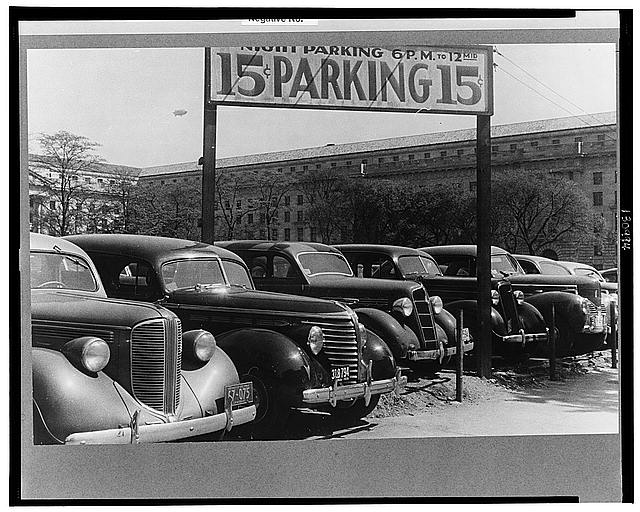
Don't park your plot

Save yourself 15 cents and a bunch of unnecessary words. Forget about parking and get on with the story. (Image: David Myers/US Farm Security Administration)

Parking cars, ordering coffee, having a particular eye color—these are fine things for characters to do, if they are relevant to the plot or show some insight into the character. Otherwise, they are just more words that are likely to block my path and divert my attention before I finish the book.

My rant is not against a particular book or author. Superfluous activities crop up often in fiction. They are a pet peeve of mine, especially because I am not immune to them in my own writing. The vast majority of writers probably have them in their beginning drafts. Part of the work of polishing a manuscript is locating meaningless actions and destroying them.

It may be impossible for the author to identify all the wasted actions in his own book, but it is crucial that he make a whole-hearted attempt. Each wasted action makes the story less intriguing, or to be blunt about it, more boring. It should be ample motivation for an author to know that every time he crosses one of them out, he makes his story better. Nothing should make hard work more palatable than that.

So, here’s the deal: I won’t make you park my cars, unless it’s crucial to your enjoyment of the story, if you don’t make me park yours. Hell, let’s not even drive if we don’t have to. Fiction is a kind of magic; we can just show up at our meetings when we need to. It will save gas, the environment, and maybe even our respective novels.


Let the suckers write while you get rich

I was scrolling through the updates of friends on Facebook. You know, the odd bits that show up occasionally, between all the ads and the updates by people you don’t recall knowing. Posts by people I don’t think I know perplex me, but I don’t usually pay attention to the ads. Months ago, I clicked on one for a chance to win five bottles of premium scotch. It countered my tradition of not clicking ads, but come on, scotch!

This time, my eye was drawn to an ad about Kindle publishing, a topic of interest to me.

It touted a how-to guide for getting rich publishing on Kindle.

I didn’t click the ad, so I can’t say exactly what was being offered. Based on the image of two guys who looked like they could also teach you how to count cards in Vegas, I doubt it was about how to increase Kindle sales for the book you poured your heart and soul into.

For the self-published author, who wants to write, publish, and sell a quality product that he has invested countless hours into making as good as he can make it, ads like this are a problem.

There aren’t gatekeepers on Kindle (Nook, iTunes, etc.). On balance, this is a good thing. It creates a truly free market, with no one standing in the way of anybody else’s success. But it is also a land of opportunity for those who would make a quick buck without regard to how their actions affect the rest of the market.

Just sell it.

“Chief Talking Bull’s miracle elixir will make any trash you publish on Kindle worth its weight in gold.” (Image: Marion Post Wolcott/US Farm Security Administration)

People using Kindle as a get-rich-quick scheme are not pursuing the dream of making a name for themselves in the literary world. They are pursuing easy money. By throwing up on Kindle whatever comes to hand and using marketing tricks to sell it, they cheapen the brand. Customers looking for satisfying reading experiences are likely to become skeptical of the medium and unwilling to trust any author who is unknown to them.

I don’t know how Amazon feels about these make-a-quick-buck publishers. In the short run, Amazon profits from their sales. In the long run, they could turn Kindle publishing into a wasteland. It is Amazon’s right to allow whatever they want on their system. It is everyone’s right to get rich by whatever legal means they choose. I would not abridge either of those rights.

Yet, I’m disappointed when I hear Kindle customers say they will only download content from familiar authors or well-known publishing companies. That cuts out a lot of authors who have worked hard toward their goals. We’re just looking for a shot, and we’re probably not as slick at sales as the hit and run content providers. When their material gets chosen we lose, and when it turns a customer off to independently published material, we lose again.

Maybe the ad I saw really was for authors who take their work seriously. I hope so. Even if it was, there are many that aren’t.

What can we do about it? Not much. Not anything besides working to put out the best quality product we can, in hopes of winning one more customer over to independently published books.

What happens when you trust a fish to babysit

Having small children, my reading has taken on a flavor not known for 40 years. As an adult, I find myself plagued by disturbing questions as I re-read some childhood favorites.

Kids love Dr. Seuss, and rightfully so. His delightful rhymes spark young imaginations. But reading The Cat in the Hat makes me wonder what kind of parenting world he lived in.

First, the children’s mother trots off to God-knows-where, leaving her two small children home unattended. Not that it would have mitigated her negligence, but she could have set them up with some activities so they had something better to do than stare at the rain during her absence. An idle mind is the itinerant, talking cat’s playground.

Perhaps she left the fish in charge of her darlings. If so, we quickly discover how well that arrangement worked. At minimum, a babysitter must be able to sustain himself in the same fluid as his charges. Let that be a lesson to us all.

meet the new sitter

We don’t own any goldfish, but we do have this lady. It’s helpful to know she can be called upon to babysit in a pinch.

Knowing that she was leaving her children home alone, or in the care of a being confined to a bowl, you’d think that Mom would lock the door on her way out. The Cat just waltzed right in, without the least hindrance from the deadbolt. While the children reported hearing a loud bump before the Cat’s appearance, a woman so obsessed with the state of her home would have noticed any damage to her front door upon her return, which she did not.

The Cat himself has some disturbing attitudes. Did he scout out the house in order to ascertain that children were alone? That’s creepy. And who bursts into a strange house in order to mentor unfamiliar children in the art of having fun? That’s not anything I want happening in my neighborhood.

The Cat’s attire gives me no comfort. I don’t trust people who, post-Victorian Era, wear tall hats. Neville Chamberlain wore a tall hat; ask a Czech if he could be trusted. The red and white stripes don’t dissuade my mistrust.

The uninvited Cat takes numerous liberties without the consent of the children, and with the positive disapproval of the fish. He caps his libertine antics with the introduction of two feral children he calls Things One and Two. While these creatures may be of scientific interest, one must wonder why they are in the custody of a cat and why they are forced, in this enlightened age, to live in a crate.

Fortunately, the Cat is a relatively benign intruder. He does nothing worse than leave the children in mortal fear of having their mother return to a messy house. This fear is well placed. Their mother appears the type to take no responsibility for the consequences of her own injudicious decisions. The children understand that they will be scapegoated and punished severely.

Luckily, the little boy is good with a net. His capture of the first of the feral Things is a turning point, upon which all hope of the children escaping their mother’s wrath depends. Only after the Things have been re-boxed is there any hope of cleaning the mess they created.

This brings us to the thrilling conclusion, and most suspect part of the story. The fish sees the mother approaching through the front window. Then, the Cat exits through the front door; returns with his fantastic cleaning machine, through the front door; has time to put the house in order; and drives his machine out again, through the front door. Meanwhile, there is no indication that the mother did anything but continue to approach the house, which she enters through the front door.

Even at an extremely leisurely pace, it is hard to believe that Mom did not reach the door before the Cat passed through it for the third time since her ankle was spotted by the fish. It is inconceivable that she did not notice a cat driving an ATV through the door.

These circumstances cast suspicion upon this delinquent mother. One must call her motives into question. While I don’t have enough evidence to piece together what she is up to, I would not object to Child Protective Services keeping an eye on her.

You could postulate that the Cat and his Things were figments of the children’s imaginations. This may be true, but if children are having these sorts of vivid hallucinations, one must wonder what stimulus is causing such sensory overload.

We can only hope that, in the ensuing years, everyone received the help they needed.