Are you trying to tell me my research stinks?

Skunks happen for a reason. I’m convinced of that now.

In February, my family was left reeling from the noxious fumes of a skunk using the area under our deck as a late-night rendezvous location to get her groove on with the boy skunks in the region. We all hated that skunk more than anything, but I’ve developed a new appreciation for her since then.

Why have I softened toward her, and how does this have anything to do with writing?

She provided me with another thrilling adventure for my fatherhood blog (read it here). This alone did not make her visit worth it. It’s only in the last few days I truly appreciated her visit.

I’m preparing a new novel, A Housefly in Autumn, for publication. It’s set in 19th century Europe.

When you write a story about a different place and time, you research as much as you can, but some things are too obscure to discover. In these cases, you get things as nearly correct as possible and keep vague about details you can’t nail down. You avoid the impossible and keep to situations that, if not historically provable, are at least historically plausible.

In doing this, you make assumptions. Sometimes, you don’t even realize you are making an assumption, and this assumption is the idea you fail to research.

This is where the skunk comes in.

In A Housefly in Autumn, there is a scene in which the protagonist mentions a skunk as if that would not be a surprising animal to see in a garden. At my house, it’s common.

I wrote this scene years ago, and have edited it many times, without giving the skunk a second thought.

On my fatherhood blog, I’ve mentioned skunks several times. People from other continents have commented, showing a perfect understanding of the hazards presented by the animal. This reinforced my assumption about the universality of skunks.

Back in February, I found myself extensively researching skunks, trying to find the right solution to our infestation, and one image stuck in the back of my mind, waiting.

A few days ago, I was scouring one of the last proofs of my novel. I came to the aforementioned scene for the thousandth time. On the thousandth time, the latent image from my skunk research rushed to the front of my mind. My jaw dropped.

I hurried online to verify the image. It was a map of skunk habitat, and it was correct.

Skunks are an American animal.

Never would I have guessed there are no wild skunks in Europe. Pepe Le Pew is French, right?

Maybe there are wild skunks in Europe by now, because those exotic animals from other continents rarely turn out the awesome pets promised, and they’ll probably survive in the woods behind the neighbor’s house. But in the 19th century, I doubt it.

Needless to say, A Housefly in Autumn is now a skunk-free novel. Most readers may never have noticed, but I do hope to sell two or three copies in Europe. And who knows how many other naïve assumptions I’ve made?

Just like every other part of a novel, the detail accuracy will never be perfect, but mine is now a little better, and I owe it to a real skunk.

skunk lunch

For my European, African, Asian, Australian, and Antarctican friends: this is what a skunk digging for insects on your lawn looks like.
 

Got all the gaps worked out of your story? What about the gaps in your text?

I’m justifying this post. By that I mean I’m aligning it to both right and left margins, as opposed to proclaiming a valid reason for its existence. Whether its existence has a valid reason I leave to its readers to decide.

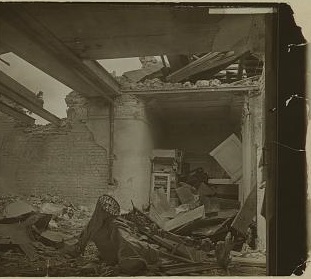
I don’t usually justify posts. It’s an extra button to click, and what blogger has time for that? More to the point, justifying makes the edges of the text look nice, but it can leave the interiors of lines looking like they’ve withstood an artillery barrage. Look closely at the lines of this text and you will probably see some in which there appears to be extra space between words. If it’s just a little extra space, it shouldn’t be a big deal, but congregations of longer, inflexible words do create distracting instances of overabundant space.

Justification?

Incautious justifying can make text feel as cozy as this attractive, war-zone home.

I’m justifying this text to illustrate one of the more tedious parts of self-publishing. For those who have never formatted the layout of a book, it may be enlightening. For those planning to dip their feet into self-publishing, it may be something to consider.

Publishing is not all about telling a great story with proper grammar. Those things will get you off to a good start, but you also want an aesthetically pleasing product. No doubt, the cover should be attractive, but the interior’s visual appeal can’t be ignored.

I’ve never opened a book and thought, “Wow, this interior layout is gorgeous!” But I have seen books where the layout’s ugliness is a distraction. One common distraction is large gaps between words.

I know of three ways to avoid gaps. The first is to not justify the text. I would never do this; blog posts are one thing, but in books I think it looks disorganized. The second is to allow your writing program to auto-hyphenate. This breaks up big words so everything fits better. Some experts suggest this, but I don’t do it. One thing I stunk at in grade school was hyphenating. I don’t trust Word to do it for me, mostly because I doubt my ability to double-check it. It’s merely opening up another Pandora’s box of grammar issues.

The third way, my way, is to endure a round of tedium beyond normal editing. Editing is not fun, and this, if possible, is even less fun. I scan the proof copy for unacceptable gaps. Then I play a little puzzle game with that line and the adjacent ones, rearranging, cutting, or substituting words until the gaps are squeezed out.

It takes time, but it makes me take a closer look at the words I use. It helps me eliminate unnecessary words and say things in a clearer way. The key is to avoid ruining sentences to make them fit better. It wouldn’t be such a vexing game if this were allowed.

This should only be done once all the major editing is completed. New editing could create new gaps.

Gaps in some lines will still be greater than gaps in others, but if the gaps don’t resemble bomb craters it will be easier for the reader to focus on the words instead of the holes.

Ending obsession

Here we go again. It’s phase three of the A Housefly in Autumn remodel. As I predicted, between rewriting the middle and obsessing over the beginning, I’ve come to that time when I feel compelled to tweak the ending.

The good news is that it’s only the last couple of paragraphs I want to redo. The bad news is that those last two paragraphs contain a mother lode of tone. That’s not bad news in itself; it’s only bad news when you want to change them. It’s like changing whole pages at the beginning or whole chapters in the middle.

For the beginning, the concern is drawing readers in. At the middle, the worry is keeping them. The finale needs to hit just the right note. I think my previous note was a little flat and I’m trying to sharpen it up a bit.

When they are the last two paragraphs, two paragraphs can seem like a mountainous rewrite. It certainly has taken me more time than any two other paragraphs ever have. I’m still not completely satisfied, but at least I’m moving in the right direction.

On the bright side, I don’t have to count this late alteration as a self-induced delay to publication. This time I got smart and started obsessing about something while I was still waiting for my expert proofers to finish reviewing their copies. By the time they are done, this behemoth, two-paragraph rewrite should be complete.

At that point, I can feel good that I’ve given beginning, middle, and end their fair shares of obsessing and overthinking. The book will be as good as I can make it, lacking another 20 years’ worth of wisdom, for which I am not willing to wait.

What I'd look like after 20 more years of wisdom. Looks like I'd have a great story to tell doesn't it? Should we just wait?

What I’d look like after 20 more years of wisdom. Looks like I’d have a great story to tell, doesn’t it? Should we just wait?

It may seem like I’ve been talking about this book for 20 years already, but that’s just not true. I’ve been working on this book for 20 years (probably a mere 18, but who’s counting?). I’ve only been talking about it publicly for, well, far shorter than that.

Even so, I realize it may seem like I’ve been posting about this book for a long time without actually producing something like a book. No one feels this incongruity more keenly than I do. But no one sees the light at the end of the tunnel more clearly than I do. I am two short paragraphs away from concluding that it is what it is. Then all who are so inclined may judge for themselves whether I should have waited for 20 years more wisdom.

At that point, I can turn all my worries toward marketing. Marketing has been known to make me whine like a first grader with liverwurst on pumpernickel in his lunch box. Now that’s something to look forward to. Stay tuned.

The Third Novella: a horror story about writing a Horror story

Writing a book is a solitary sport. Publishing a book is anything but solitary. You need a lot of people to help you. Even when you are lucky to have diligent people helping you, everything takes time, which means you will wait through various periods for them to do their work before you can get the thing published.

About 18 months ago, while I was waiting for some beta readers to go through A Housefly in Autumn, I decided that starting a new book would be more productive of my time than twiddling my thumbs.

I envisioned a book consisting of three novellas of a genre very different from A Housefly in Autumn. These stories would be contemporary and not suited to young adults. They are my nightmares, the ground where parenthood meets horror.

Though not horror in a gory sense, they are dark enough to put them into a genre in which I have not written since high school. Back then, I was completing creative writing assignments, not contemplating an eventual published book.

I finished the first two novellas in accordance with the vague plan in my head. The third came third because it was less well-developed in my mind, so I let it marinate while I finished drafts of the other two. When the third’s turn came, I had sat on it long enough to know that it would not develop further until I started to write it.

As I waited to get the cover art for Housefly, I began the third novella. Little by little, it picked its way through the forest of words until it found its trail of plot. It began to come together, the story itself inspiring new elements to fill in its missing pieces.

The ending still floated on the mist, but as I got closer, I began to see outlines of solid shapes in that mist. I was fitting it all together in my mind.

Then I got some really fantastic artwork for Housefly. It was time to start laying out the actual book that had always just been a manuscript. The new project got pushed to the back burner. When you have three little boys at home and a full-time day job, the back burner is off.

The third novella stopped cold. What time I could muster was applied to getting Housefly through the next steps.

I don’t outline. This works for me, except when it doesn’t.

Waiting for help on the last proofing of Housefly, I went back to that third novella. After six months, I didn’t recall which i was undotted and which t uncrossed.

I’d have to go back and read it. I didn’t like to because I prefer to get through the first draft before I read, and I was afraid of what I would find in my first mature attempt to write horror, even watered-down horror.

So far, I’ve read through about one-third of it. It’s not as bad as I feared. Now if I can only re-figure out how it ends, I might actually start to like it. Horror doesn’t scare me so much anymore.

the third novella

The Third Novella. That could be the title of a horror story. Anyway, this third novella is waiting to be finished.