What happens when you trust a fish to babysit

Having small children, my reading has taken on a flavor not known for 40 years. As an adult, I find myself plagued by disturbing questions as I re-read some childhood favorites.

Kids love Dr. Seuss, and rightfully so. His delightful rhymes spark young imaginations. But reading The Cat in the Hat makes me wonder what kind of parenting world he lived in.

First, the children’s mother trots off to God-knows-where, leaving her two small children home unattended. Not that it would have mitigated her negligence, but she could have set them up with some activities so they had something better to do than stare at the rain during her absence. An idle mind is the itinerant, talking cat’s playground.

Perhaps she left the fish in charge of her darlings. If so, we quickly discover how well that arrangement worked. At minimum, a babysitter must be able to sustain himself in the same fluid as his charges. Let that be a lesson to us all.

meet the new sitter

We don’t own any goldfish, but we do have this lady. It’s helpful to know she can be called upon to babysit in a pinch.

Knowing that she was leaving her children home alone, or in the care of a being confined to a bowl, you’d think that Mom would lock the door on her way out. The Cat just waltzed right in, without the least hindrance from the deadbolt. While the children reported hearing a loud bump before the Cat’s appearance, a woman so obsessed with the state of her home would have noticed any damage to her front door upon her return, which she did not.

The Cat himself has some disturbing attitudes. Did he scout out the house in order to ascertain that children were alone? That’s creepy. And who bursts into a strange house in order to mentor unfamiliar children in the art of having fun? That’s not anything I want happening in my neighborhood.

The Cat’s attire gives me no comfort. I don’t trust people who, post-Victorian Era, wear tall hats. Neville Chamberlain wore a tall hat; ask a Czech if he could be trusted. The red and white stripes don’t dissuade my mistrust.

The uninvited Cat takes numerous liberties without the consent of the children, and with the positive disapproval of the fish. He caps his libertine antics with the introduction of two feral children he calls Things One and Two. While these creatures may be of scientific interest, one must wonder why they are in the custody of a cat and why they are forced, in this enlightened age, to live in a crate.

Fortunately, the Cat is a relatively benign intruder. He does nothing worse than leave the children in mortal fear of having their mother return to a messy house. This fear is well placed. Their mother appears the type to take no responsibility for the consequences of her own injudicious decisions. The children understand that they will be scapegoated and punished severely.

Luckily, the little boy is good with a net. His capture of the first of the feral Things is a turning point, upon which all hope of the children escaping their mother’s wrath depends. Only after the Things have been re-boxed is there any hope of cleaning the mess they created.

This brings us to the thrilling conclusion, and most suspect part of the story. The fish sees the mother approaching through the front window. Then, the Cat exits through the front door; returns with his fantastic cleaning machine, through the front door; has time to put the house in order; and drives his machine out again, through the front door. Meanwhile, there is no indication that the mother did anything but continue to approach the house, which she enters through the front door.

Even at an extremely leisurely pace, it is hard to believe that Mom did not reach the door before the Cat passed through it for the third time since her ankle was spotted by the fish. It is inconceivable that she did not notice a cat driving an ATV through the door.

These circumstances cast suspicion upon this delinquent mother. One must call her motives into question. While I don’t have enough evidence to piece together what she is up to, I would not object to Child Protective Services keeping an eye on her.

You could postulate that the Cat and his Things were figments of the children’s imaginations. This may be true, but if children are having these sorts of vivid hallucinations, one must wonder what stimulus is causing such sensory overload.

We can only hope that, in the ensuing years, everyone received the help they needed.
I was just too young to love you

Like many American teens, I was the victim of a well-meaning society that used high school English classes to pound an appreciation of classic literature into my head. Like many American teens, I rebelled against this attempt to pry open my mouth and pour culture down my throat. Unlike many who endured this experience, I went back to the well of literature, in my own good time.

I’m lucky. Some unexplainable motivation drove me back into the arms of the people to whom I had been so rudely introduced in high school. The clumsy way these folks were pushed into my face might have put me off reading altogether, as I’m sure it did to some.

Fortunately, I had friends like Edgar Rice Burroughs, who kept me entertained with his less-than-classic adventures. While school was doing all it could to sour me on reading, Tarzan, and an assortment of Martians, kept my nose in books.

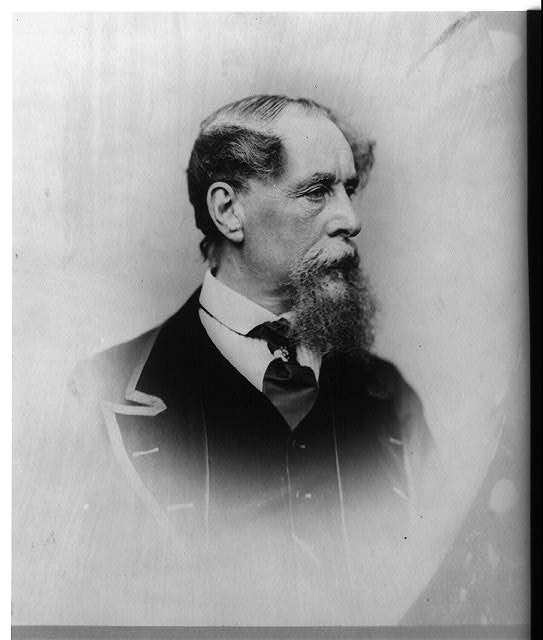
Charles Dickens

He looks so stern and boring, but he’s a little Dickens on the inside.

This still doesn’t explain why I came back to the “classics.” That was dumb luck. Without luck, I still wouldn’t have a good word to say about John Steinbeck. In school, I hated Steinbeck; I hated that little dog of his; I hated the cob-job of travel trailer he supposedly tooled around America in; and I hated the arrogance that made him think I had the least bit of interest in his vacation. These fires of hatred burned so brightly that they blinded me to the merits of The Red Pony or Of Mice and Men.

Years later, I picked up East of Eden, and read it with actual pleasure – something I had no right to expect, from my past dealings with its author. I re-read Of Mice and Men, a great story, even though I can’t quite put my mind into George’s way of thinking at the end. I’ve never returned to Travels With Charley though, and I doubt I ever will. I’m afraid it would stoke up that dormant hatred again. It was a horrible choice for introducing a young reader to Steinbeck. I get angry just thinking about it.

High school prejudiced me against people I’d never met. Somehow, I got through those years without having been made to read Dickens. This was my great escape. I was sure that Dickens would make me gag, just the same as the other old timers had. It was years before I got brave enough to pick up A Christmas Carol, mostly by accident. For all those years, I had counted a man among my enemies who should have been among my dearest friends. But I suffered from an extended case of Dickens-phobia, along with Shakespeare-phobia, and all the other phobias associated with my forced exposure to books heavier than my immature attention span.

The phobia I’ve never overcome is the one about Shakespeare. Every English teacher in school was determined to make my class appreciate Shakespeare. There was no reprieve from Shakespeare; his ghost haunted every grade level.

william shakespeare

I’m still wary of him after all the kids he humiliated in front of the entire class.

What made Shakespeare so insufferable was the demonic idea that his plays must be read aloud in class. If you can’t despise a piece of literature enough, reading it silently to yourself, just have your 10th grade classmates stumble over the text until even the teacher can endure no more and calls upon someone else to stumble. To this day I cannot read Shakespeare for fear that I will hear a teenager’s tortured voice as he stammers and stutters, banging his shins against those hurdles of words, arranged in an order completely nonsensical to everything he has ever read before.

How many more readers of classic literature would there be if only our teachers had respected the literature a little more, rather than spraying it at us from a fire hose? If a teacher had given me Hamlet and said, “I think you’ve earned this,” I would have put more effort into understanding it. Even if they had said, “You’re not ready for this yet,” I would have wanted to figure out why not. That’s the way I got interested in beer.

My peers and I became devotees of beer, mostly because nobody in authority thought we deserved it. We showed them. Maybe I’ve reached the point where I’ve earned another crack at Shakespeare, but I’m haunted by traumatic memories. Even though I don’t deserve it any more than I ever did, I’ll probably crack a beer instead.

Books I can’t remember

I can’t quite pull off blaming my inability to remember the overwhelming majority of what I read on the French. Even though the French are not doing a single thing to help me with this problem, they are not to blame. I can’t remember what happened in books written by Americans either.

It’s not uncommon to forget what happened in books you didn’t enjoy. Do I have the slightest idea why Mr. Darcy came to visit the Pride and Prejudice gang? No, I do not. But I was forced to read that book at some point during my schooling. I didn’t want to read it, and I was happy to forget about Mr. Darcy and his visit to the sorority house right after I failed the pop quiz.

But am I normal in forgetting the plots of books I enjoyed? My overall memory is no worse than average, so why can’t I remember anything I read? The one hypothesis I have concocted (the French are to blame) does not stand up to the scientific method, so I am at a loss.

This affliction wouldn’t be bad if there were only 100 books in existence. Then, it would be a pleasure to forget all the plots, once I had burned through the library. I could read the books over again for the first time. But there are far too many books in the world to have to go back and redo the ones forgotten.

I don’t even get to come off as “well-read” in literary conversations. I have to say things like, “Yeah, that was a great book, but I’ll be damned if I could tell you why.” If you ever get into a literary conversation with me, you might as well start off assuming I’m a poser.

Here are four books I really enjoyed reading, and the sum totals of what I remember about them.

The Count of Monte Cristo – Some guy (presumably, The Count of Monte Cristo) is jailed unjustly. He escapes, possibly by playing dead (that might be the movie version, or some completely different book – not sure). Somehow, he works his way back into high society and formulates a precise list of all the other high society folks who have wronged him. He plans a specific revenge for each of them, and then I don’t know what happens after that. My guess is that he works his plans to perfection and reveals his true identity to rub it in. Honestly though, he might just as well fall down the stairs and break his neck. I really don’t remember him doing anything specific.

NOTE: This is the French not lifting a finger to help me with my troubles. What I remember most about this book is the overabundance of characters with similar French names. I couldn’t understand how one character was so ubiquitous until I figured out that he was actually three different guys.

Dumas

Dumas: A Frenchman who confounded me by giving all his characters French names. What nerve!

Ethan Frome – A farmer type guy brings home a young girl to live with him and his wife. That doesn’t even really sound right, but I’m going to go with it. Anyhow, the farmer starts to like the new girl, and that becomes a strain on his marriage. This might have happened in winter, because I have this image of a horse-drawn sleigh. There may even have been some kind of sleigh wreck, but I’m probably just making stuff up now. I remember I was pleasantly surprised at how much I enjoyed this one. I don’t remember why.

The Hunchback of Notre Dame – This hunch-backed dude works as the bell ringer in a big church. He falls in love with a beautiful gypsy girl who is out of his league. The priest, or some other big-wig of the church is also there, and he’s not such a good guy. The hunchback ends up taking a header off the bell tower, or something terrible like that, and I don’t know what happens to anybody else. I remember being impressed with the storytelling in this book, with the exception of one miserable chapter that described the city of Paris, in whichever century the story took place, to excruciating detail. The names of the French people in this story didn’t vex me at all, which puts another nail in the coffin of my sole hypothesis.

Uncle Tom’s Cabin – There’s a cruel slave owner in Kentucky (?) who owns Tom as well as some others. There’s a little girl involved in some way, and she has to cross over the river on broken ice, which is considered somewhat dangerous. Whether or not she makes it is anybody’s guess. Also, the final disposition of the other characters is unknown. I remember being pleasantly surprised that this book read much less like a political tract than I’d expected. It was actually an entertaining story. I cannot begin to tell you why.

Stowe

Harriet Beecher Stowe: Not as preachy as she looks.

I wonder if there’s a name for my disease. How can I enjoy reading certain books so much, and then not remember a thing about them? It’s discouraging, especially now that I am resigned to exonerating the French and leaving my own mind to shoulder the blame. I would love to be able to tell you why The Hunchback of Notre Dame is such a great story; I just can’t. But after this, I’m sure you will have the confidence in me to just take my word for it.

Am I the only one with this condition? Are there books you’ve enjoyed but can’t remember? Did my hazy recollection come close to the plots of any of these novels?