A book in the hand is worth four waiting for edits

The last time I wrote a post here about my writing projects, and I’m ashamed to say how long ago that was, I wrote about a four-book series in which I was knee-deep at the time. The good news is that I finished writing that series. The bad news is all the post-writing difficulties. Professional editing alone represents a prohibitive cost to the production of the set. And that’s just one of the things that needs to happen to the adolescent manuscripts before they can grow up to be big, strong books.

While considering how to embark upon that transition (i.e. banging my head against a wall), I have not been completely idle in other areas, except for blogging, in which pursuit I have been near completely idle. While I have not been blogging, or producing a marketable series, I have been working on this:
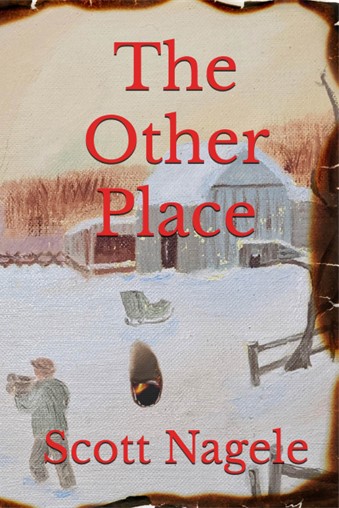
Granted, it’s not a series. It’s just a solitary novel. But on the plus side, it has been professionally edited. More to its credit, it has a cover, front and back. It’s even formatted in an easily-readable fashion. It may be a little thing (compared to a multi-book saga), but it’s very nearly done. That is to say, it’s almost an actual book, the kind people could buy and read if the fancy so struck them. And as Hans Christian Andersen was wont to say, “That is certainly something.” (Disclaimer: I don’t really know what Hans said in Danish; but the English translations usually amount to the quote above.)

If I click all the right buttons on the right web pages, this book will be released in May, 2023. If I don’t, it’s off to remedial button-clicking class for me. Anyway, enough about my technology issues, here’s the marketing blurb.

Emma and her parents share recurring dreams, in which they are a different family, living 100 years ago in an unfamiliar place, and heading toward tragedy. When Emma’s parents discover their dream family actually existed, it becomes clear that these visits to the past are more than mere dreams—they are playing an unseen role in this historical family’s lives. As the century-old history of this troubled family materializes, it reveals the truth that the impending tragedy spells doom for both families. Only five-year-old Emma has the power to avert disaster, but it will require extraordinary courage against overwhelming evil for Emma to save both families from destruction in The Other Place.

I will post more updates about this book through its publication. In theory, this will serve the dual purposes of building awareness about the book and making me back into the sort of active blogger I used to be. It may also give me something better to do than bang my head against the wall trying to discover a way to manage the production of four hefty novels in succession. That would be the icing on the cake, but a good cake without any icing would be enough for me right now.

Your blog’s not so pretty once your domain name expires

You might think that because I don’t post to this blog as often as I used to, it’s not as valuable to me anymore. I might have thought the same thing, until I almost lost it. There’s nothing like having something go away to show you how much it means to you. It turns out I value this blog as much as I ever did, maybe more. I think it has provided entertaining and amusing content. Once in a while, it even contains information that could be considered useful. It’s not a widely-viewed blog, but I believe those who visit get something for their time. That matters to me.

Last week, when I clicked on my bookmark for this site, the browser timed out. I switched to a different browser and was met with the horrifying info that my domain name had expired.

That awkward moment you realize your domain has expired.

How does a blogger let his domain name expire? I mean, seriously?

That is a good question that merits a feeble answer.

This blog began life as a self-hosted web site. When I switched to WordPress, I couldn’t transfer the domain name to them, so I left it with its original registrar and paid WordPress a yearly fee to map the blog to the domain name. Simple enough – not really, but that’s another story.

My domain name was on auto-renew with the original registrar, which was joyously convenient since I never had to manually make a renewal payment. I never had to have any contact with that company at all. It was automated bliss, until it wasn’t.

The credit card used for auto-renew was stolen and subsequently canceled. You know how you have to update all your online payment methods when you get a new card? Well, you might forget about updating it with the company you haven’t had to think about in three years. You might. I don’t know, maybe you have a better system than I do. If you have a system at all, you have a better system than I do.

Anyhow, I learned I hadn’t auto-renewed my domain name at the same time I learned it had expired. This was around the same time I learned I no longer had a functioning blog.

You know how you realize something still matters to you? When you panic at the thought that you’ve lost it. Fortunately, the domain name had expired only the day before, which means it hadn’t yet been auctioned off to the domain name speculators. It only took about four days’ worth of frantic phone calls, an equal number of emails, and an extra reactivation charge to bring my baby home.

Now that I’ve got my domain name back and my blog visible again, I can rest easy and spend my time wondering which other service will quietly fade into cancellation next time I have to replace a credit card.


Tombs of the ancient dreams

It seems appropriate that my last post was about the people in olden times who wrote novels before the age of word processing.  I made a discovery since then that makes me feel closer to them.

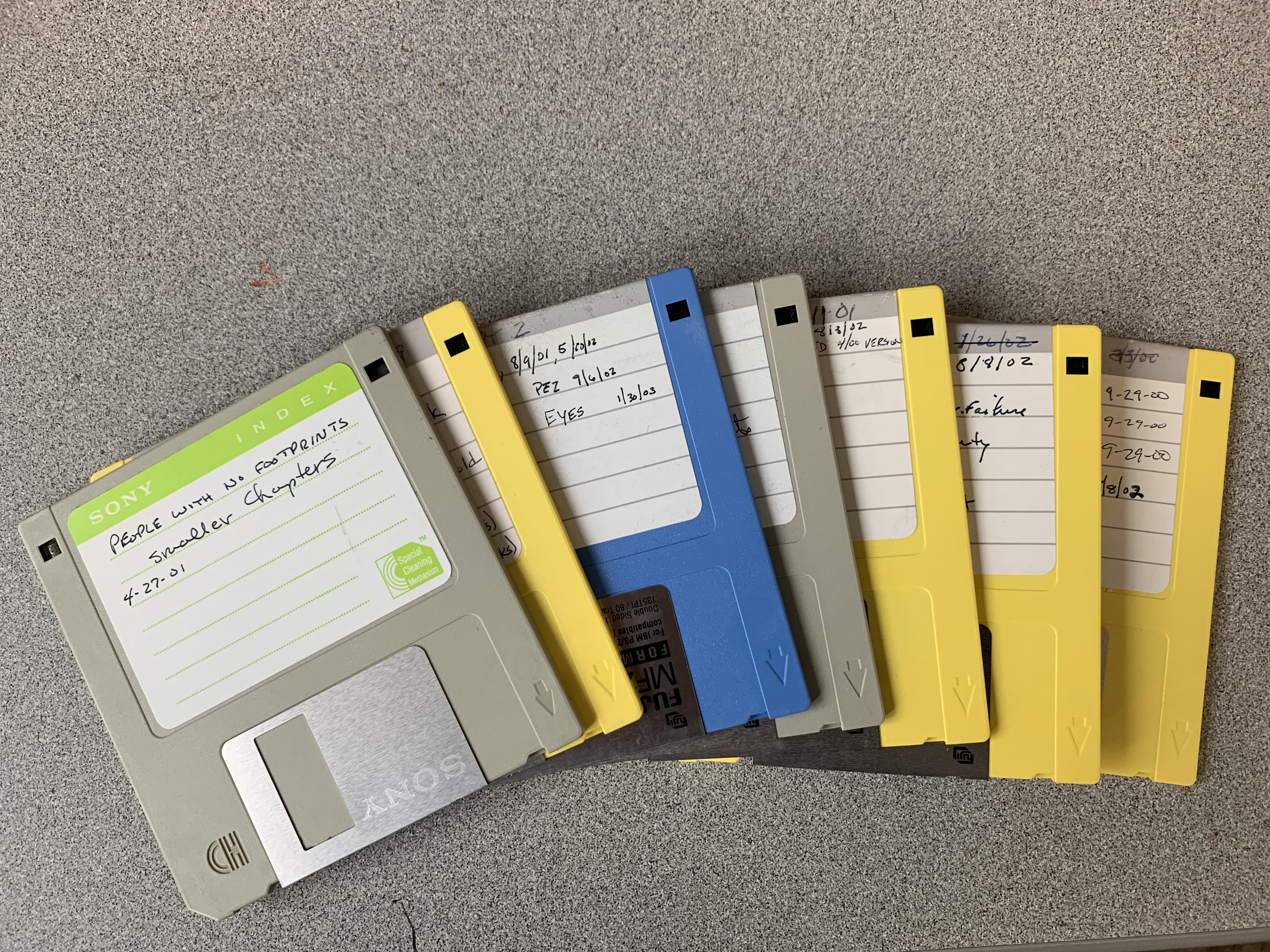
I was searching through a drawer, looking for some object of modern usefulness when I came across a stack of these, tucked into the back corner.

A trove on ancient parchments.

For those too young to recognize this object, it is a floppy disk. It is an object used to store electronic data before the advent of thumb drives and the Cloud.

It is not floppy. Its predecessors were wider, thinner, and floppy. I remember using them too. This ultramodern version is much more durable than the floppy floppies, and likely holds a lot more data, upwards of .1% of what our smallest storage devices hold now, I would guess.

The handwritten notes on my disk labels indicate this group was used between 1999 and 2003. Knowing me, this was probably long after civilized society had given them up. It doesn’t seem like these artifacts could belong to this century at all.

Maybe someday somebody will invent a machine to read these things.

Even though they don’t hold much by today’s standards, words don’t take up much electronic space, so they represent a fair amount of work from a young writer seeking his way. Some of the files they hold were eventually published, but only after years of rewrites. Other files represent work relegated to storage as bits and bytes.

I think I have versions of all these files saved in more accessible places, even though I may never revisit them. I do this for my descendants, in case I become posthumously famous and they need to use my discarded scraps to raise income. With a little industry they may discover these files: “Look, here’s some crap Gramps wrote when he was young. He clearly never meant it to be made public, so we should sell it to a publisher.”

I adore my enterprising great-great-grandchildren, but they should know, before they start counting their chickens, all these novels and stories were written in WordPerfect. My sharp eye for the future of technology determined this format would drive MS Word to extinction as it became the dominant platform with its many advantages.

But I’m sure, in the genius future, there will be a way to convert immature writing from WordPerfect files into cash money.

In the present, I’m not famous, which proves I don’t know how to convert any writing from any file into money. These disks harken me back to those heady days when I thought maybe someday I would figure that out. The amazing thing is I’m still trying to solve that puzzle. It seems some of us don’t know how to let it go and grow old gracefully.

Why you shouldn’t write a novel series backward

For starters, you probably shouldn’t write a single novel backward. Novels are kind of long for that sort of jiggery-pokery. Short stories are fine. I’m all for writing them backward. They are small enough to see from all angles in your mind. A novel series is like a train of trailers hitched behind a truck – tricky to drive backward.

I’ve documented how I got in the awkward spot of writing a series backward, or at least from the inside out, in previous posts. Here’s the back story for those who missed them.

I had a novel that was too long, so I decided to divide it into two books. This seemed like a good idea for a while, until it became clear that my two books would have to be three.  The third book would need to consist of a bulk of new storytelling in between the other two. At the time of my last update, I had finished drafts of the two outside books and was staring at the daunting prospect of building a bridge book that would fit together with the books on either end.

The whole story:    Update1    Update2    Update3

Now that I’ve got the support beams in place, to the tune of about 130 pages of new middle, I’m staring at the prospect (and you may have guessed this if you read the previous updates) of splitting the middle book in two, giving me a total of four books.

This is not what I wanted, and it’s possible that I may be able to hold it to three, but with each passing chapter, four becomes more likely. After 130 pages, I still have lots of ground to cover. If I could do it in another 130, that would wrap things up in three books. I begin to doubt I can.

Make sure the bridge is finished before you drive your series backward over it.

Why is four books bad? In a perfect world, it’s not. But in a perfect world, I would be writing these books in order. In a perfect world, I might even have the resources of a publishing company behind me.

From the writing standpoint, four books is no problem. As I progress, my confidence in my ability to tie four books together into a viable series grows. I can tell the story.

The headache comes after the writing. Taking a single novel from manuscript to book is a difficult task for an independent author. By the time I am done with all my patchwork writing, I could have four books to shepherd through that journey. Because I am not writing them chronologically, they must all be written before any one of them is finished.

Arranging for editing, covers, layout, etc. of four books in quick succession is crazy daunting. True, I would have to eventually do all that, even if I wrote them in order, but in that case the production pieces would be more staggered, with writing time in between.

I know it amounts to the same thing in the end, but it looks like a huge wall to get beyond, rather than four separate, manageable walls.

Nevertheless, I’m the one who put this train into reverse gear, so I ‘m the one who has to bear down and figure out how to keep it on the tracks.