Valet parking: annoying in real life, worse in fiction

I once read a novel in which Character A was driving to a meeting with Character B. They had a lot of very important things to discuss that would greatly advance the plot. I was eager to arrive at this meeting, because I am all about advancing the plot.

I was all ready to meet Character B and see what fascinating revelations he had for us. I think Character A was all hyped for it too, but what we wanted didn’t matter. The author stepped in to block our way until we had parked the car. We parked in a specific space, in a specific lot, a specific distance from the meeting place.

The spot where we parked the car had no bearing on the outcome of our meeting with Character B. It had no effect upon the story whatsoever. The fact that we drove to the meeting was of no importance. Yet, instead of beginning the chapter discussing juicy topics with Character B, we were made to suffer through parking the car. It made me sad.

It made me sad because I have far less reading time than I would like, and I don’t want to spend it parking cars when there are mysteries to solve – mysteries that have nothing to do with where certain cars are parked. My reading time is precious to me; please don’t make me your literary valet.
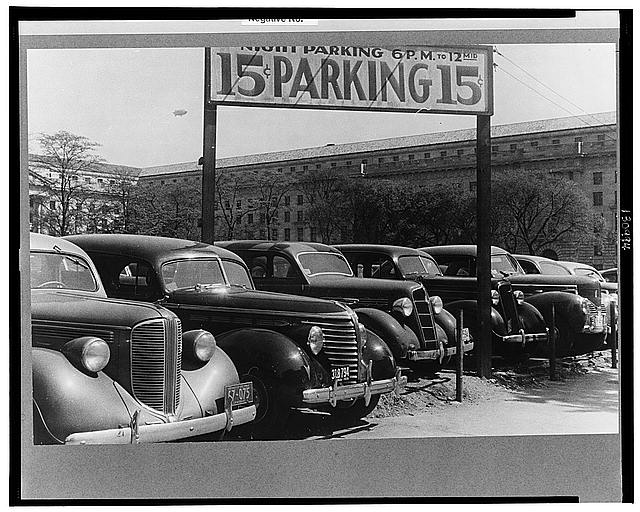
Don't park your plot

Save yourself 15 cents and a bunch of unnecessary words. Forget about parking and get on with the story. (Image: David Myers/US Farm Security Administration)

Parking cars, ordering coffee, having a particular eye color—these are fine things for characters to do, if they are relevant to the plot or show some insight into the character. Otherwise, they are just more words that are likely to block my path and divert my attention before I finish the book.

My rant is not against a particular book or author. Superfluous activities crop up often in fiction. They are a pet peeve of mine, especially because I am not immune to them in my own writing. The vast majority of writers probably have them in their beginning drafts. Part of the work of polishing a manuscript is locating meaningless actions and destroying them.

It may be impossible for the author to identify all the wasted actions in his own book, but it is crucial that he make a whole-hearted attempt. Each wasted action makes the story less intriguing, or to be blunt about it, more boring. It should be ample motivation for an author to know that every time he crosses one of them out, he makes his story better. Nothing should make hard work more palatable than that.

So, here’s the deal: I won’t make you park my cars, unless it’s crucial to your enjoyment of the story, if you don’t make me park yours. Hell, let’s not even drive if we don’t have to. Fiction is a kind of magic; we can just show up at our meetings when we need to. It will save gas, the environment, and maybe even our respective novels.


Let the suckers write while you get rich

I was scrolling through the updates of friends on Facebook. You know, the odd bits that show up occasionally, between all the ads and the updates by people you don’t recall knowing. Posts by people I don’t think I know perplex me, but I don’t usually pay attention to the ads. Months ago, I clicked on one for a chance to win five bottles of premium scotch. It countered my tradition of not clicking ads, but come on, scotch!

This time, my eye was drawn to an ad about Kindle publishing, a topic of interest to me.

It touted a how-to guide for getting rich publishing on Kindle.

I didn’t click the ad, so I can’t say exactly what was being offered. Based on the image of two guys who looked like they could also teach you how to count cards in Vegas, I doubt it was about how to increase Kindle sales for the book you poured your heart and soul into.

For the self-published author, who wants to write, publish, and sell a quality product that he has invested countless hours into making as good as he can make it, ads like this are a problem.

There aren’t gatekeepers on Kindle (Nook, iTunes, etc.). On balance, this is a good thing. It creates a truly free market, with no one standing in the way of anybody else’s success. But it is also a land of opportunity for those who would make a quick buck without regard to how their actions affect the rest of the market.

Just sell it.

“Chief Talking Bull’s miracle elixir will make any trash you publish on Kindle worth its weight in gold.” (Image: Marion Post Wolcott/US Farm Security Administration)

People using Kindle as a get-rich-quick scheme are not pursuing the dream of making a name for themselves in the literary world. They are pursuing easy money. By throwing up on Kindle whatever comes to hand and using marketing tricks to sell it, they cheapen the brand. Customers looking for satisfying reading experiences are likely to become skeptical of the medium and unwilling to trust any author who is unknown to them.

I don’t know how Amazon feels about these make-a-quick-buck publishers. In the short run, Amazon profits from their sales. In the long run, they could turn Kindle publishing into a wasteland. It is Amazon’s right to allow whatever they want on their system. It is everyone’s right to get rich by whatever legal means they choose. I would not abridge either of those rights.

Yet, I’m disappointed when I hear Kindle customers say they will only download content from familiar authors or well-known publishing companies. That cuts out a lot of authors who have worked hard toward their goals. We’re just looking for a shot, and we’re probably not as slick at sales as the hit and run content providers. When their material gets chosen we lose, and when it turns a customer off to independently published material, we lose again.

Maybe the ad I saw really was for authors who take their work seriously. I hope so. Even if it was, there are many that aren’t.

What can we do about it? Not much. Not anything besides working to put out the best quality product we can, in hopes of winning one more customer over to independently published books.

Watch your backstory

I mentioned before the modern requirement that novels begin with a hook. This is the opening bang that grabs the reader’s attention so that he stands a chance of getting to the rest of the book in this age of the short attention span.

Most real stories don’t start with a bang. The stories we hear at parties don’t begin with a crescendo; they build to it (if we are lucky). Jokes don’t begin with a punch line. But we have to look party acquaintances in the face, making it awkward to walk away from their stories after the first sentence.

Nobody thinks you are rude if you walk away from a novel because it doesn’t hook you right away. That’s the advantage polite society has over novels.

The good news for novels is that the hook doesn’t have to be explosions and frantic action. It can be an unusual situation. It doesn’t have to make the reader’s heart race, so long as it makes him curious. The example I used before was that of a character burying a dead body.

Opening with an unusual situation can be more appropriate than actual fireworks for many novels, but it comes with its own baggage. The unusual situation has to be given context; it’s baggage needs to be unpacked. Inside its baggage is a very harmless-looking bundle called backstory.

Backstory never looks, to the author, like something that could blow up on him. There are no lit fuses or open flames. Backstory merely needs to be explained, but if it feels, to the reader, like it is being explained, the result is an explosion of boredom. That’s the anti-hook. Goodbye reader.

Not all backstories are created equal. Some are easier to finesse than others. If the person burying the dead body is a serial killer, the unusual scene can be explained by his future actions. Less background information is necessary.

minimal backstory required

The professional grave digger doesn’t require a great deal of backstory to put his actions into context, and he is probably a more sympathetic character than the serial killer. (Photo: John Vichon)

The situation doesn’t have to be unusual for the character, only for the reader. If the situation is unusual for the character, it will likely require more backstory.

If the character burying the body is someone who never imagined themselves doing such a thing, and will not likely make a routine of it, then the author has to spend more time going backward. How did this character end up in this unlikely spot? This brings heightened danger of putting the brakes on the story as well as confusing the reader.

Backstory is one of the most difficult elements of storytelling to pull off. Yet, when the only people who are allowed to start a story at its beginning are those we can’t gracefully escape, it is necessary. Making the opening scene unusual to the character as well as the reader makes the backstory even more difficult the navigate.

But there is a silver lining.

Novels in which both the reader and the character begin in an unusual spot, have the potential to be the most interesting of all. They can foster a bond between character and reader that the reader is not likely to form with a serial killer. If the author can sprinkle in the backstory carefully enough to interest and enlighten the reader, the story’s potential is well on its way to being fulfilled.

I hope to master the art of backstory someday, because I’m not that much into serial killers.

There are only three parts of your story to worry about: the beginning, the middle, and the end

I’ve moved on to my second proof copy of A Housefly in Autumn. This incorporates all the changes I made to the first proof. I normally go through four or five proofs before I am satisfied that the book is ready to be presented to the public.

In the first proof copy I made numerous changes, none of them major. A few of them were actual errors, but most involved making sentences more efficient. It’s amazing, the little things you don’t see until the manuscript holds like a real book.

The first proof had me worried about typographical errors and other embarrassing occurrences. I feel better about that stuff now, but the second proof brings its own worries.

These are big picture worries, about the overall execution of the storytelling.

Beating up the proof copy

My wife’s proof copy is already taking a beating, and she’s only just begun.

If you break a story down into beginning, middle, and ending, that leaves only three parts to worry about. This reduces the number of worries and gives you more time to worry over each thing.

I most recently obsessed about the middle. Before the first proof, I rewrote much of the middle, trying to transform parts that retained too much “telling” into more “showing.” Since this novel has a large oral storytelling component, in which a character literally tells a story, there were some limits to how much of this I could do.

I’m not saying I won’t obsess about the middle again, but since I just finished doing that, the middle will have to go to the back of the line.

For now, I’m focused on worrying about the beginning. It is an axiom of modern fiction that you have to grab the reader by the throat at word one and not let him breathe until he is irretrievably engulfed in the story. This concept is so well revered that a fair percentage of books now begin with explosions or with characters burying (or digging up) dead bodies.

Those incidents aren’t appropriate for this book, so I’m toying with adding a flash forward to an action-packed scene at the beginning. I need to do this without it seeming too much like a cheap gimmick. It also needs to fit with the historical setting, when people began a story at the beginning, regardless of where the bridges were set to blow.

If I can’t figure out how to work in some page 1 fireworks, I guess I’ll have to hope that my beginning is interesting enough. Meanwhile, I’ll worry that it’s not.

I have not spent much time obsessing about the ending. I’m pretty comfortable with it, except for maybe the last couple of pages. I haven’t found time to worry about a mere page or two, but I will at some point.

Do the last lines bring home the points I worked hard to make throughout the book? Or are they relics of the book this used to be, before it matured and added meat to its bones? These are the questions that await my future obsession with the ending.

Maybe that will come with proof copy number three.