Cold feet and self-publishing

These are probably the cold feet I should have had before my wedding. But I was fairly secure in what I was getting into that day. I was more worried about something embarrassing happening at the ceremony than any of the ever after part.

The cold feet I avoided at my wedding have come to me over a book. This month, I will be releasing my third self-published book, A Housefly in Autumn. You’d think I would worry less about my third than my first two, but I don’t. I worry more.

Why doesn’t it get easier? It probably would get easier if I could stick to one genre. If I wrote the same kind of book every time and knew what to expect from the audience of that single genre, I’d likely feel more comfortable. But I’m trying something different. This is the first non-humor novel I’ve published. It’s not the first one I’ve written, but nothing hits the fan until you publish.

One of the benefits of self-publishing is you get to take risks. Nobody in a corner office is going to stop you from pissing away the firm’s money, because there is no firm, and more to the point, there is no money. It’s only your own blood, sweat, and tears you are potentially pissing away, and you can make more soon enough. Even so, risk can be daunting when it has your name attached to it.

the corner office

Some early self-publishers enjoying the freedom to take risks. Or maybe they’re just some guys building a corporate corner office.

Switching genres is a risk. The bigger risk is living between genres. This new book falls somewhere between Young Adult and General Fiction. Some books have succeeded very well in this gray area. Many more have failed.

There are some other little risks built into the story and the telling of it, but the little risks wouldn’t be extraordinarily frightening if not coupled with aforementioned, larger risks. In combination, each little risk has the potential to break the camel’s back.

Still, any worthwhile undertaking should be daunting. There comes a time when you have to damn the torpedoes, in spite of the risk. Yeah, I’ll fret over the release of this book, because that’s the nature turning your art toward the public eye. But I will also find confidence in recalling how much time and hard work went into producing it. Time and hard work might not be enough to claim success, but it’s enough to take a shot at it.

I’m taking this shot, regardless of my slightly chilly feet. My feet and I will do our best to make a success of this book while brewing up some new blood, sweat, and tears for the next one, which will be of yet another new genre. I guess it’s a good thing I don’t have any corner offices, or corporate money, to stop me from taking risks. All I’ve got is a pair of light blue feet, and having stood firm before the altar, they can stand behind a little old book.

Read more about A Housefly in Autumn here.

The fifth time’s the charm. Maybe.

It’s down to me now. All the others are done with their work. It’s time for me to get it done and get it right. I’ll get it as right as can. I’ve invested too much to not give the final stretch my best shot.

The fifth proof copy of A Housefly in Autumn hit my mailbox yesterday. That’s right, the fifth proof. As I said, I’ve invested a lot.

The beginning of the end?

Will the fifth proof be the last? Cross your fingers.

This copy is mine and mine only. All the skilled people I’ve been fortunate to have help me have done what they could. It’s just me and my book.

There’s something liberating in this. I’m back in control of the pace of things. I don’t have to wait for anyone else. The people who’ve helped me have been more expeditious than I had any right to ask, but waiting any length of time is hard when you’re eager to get on.

There’s also something daunting in it. I’m the last line of defense against little errors hidden in the text. Whatever gets past me this time becomes dirty laundry hung out for the public to see.

Thus begins the first of the “pins and needles” readings. If I find no more errors, I am free to release the book for sale. That would be a happy accomplishment, marred only by nagging doubt about the one I missed. Or the two, depending upon how susceptible I feel to nagging from the back of my mind.

The even more intense pins and needles will happen the first time I look at the book after it has been published, when every page holds a potential embarrassment, despite all my efforts to eliminate them.

My goal as a self-publisher is to produce books that deserve a spot on the same shelf as those published by Random House or any of the other big names. I haven’t reached this goal yet, but with each book, I think I get a little closer. But I still make mistakes, and in self-publishing you don’t get to blame mistakes on your publisher; you can only blame yourself.

I do blame myself, but then I do my best to fix it, learn something, and move on. There’s another story to write. And if that story turns out to be worth publishing, there’s another book to produce.

This means more hard work writing, more tedious work editing, more finding the right people to help, more waiting while those people do what they do, more frustration at getting it all to fit together, and more pins and needles at the end when the skivvies are hung out to dry before the eyes of all who wish to look.

But all that is for tomorrow. For today I have a fifth proof to make as right as I possibly can, so I can inch a little closer to Random House and to saying I know what I’m doing as a writer and a publisher. Wish me luck.

Are you trying to tell me my research stinks?

Skunks happen for a reason. I’m convinced of that now.

In February, my family was left reeling from the noxious fumes of a skunk using the area under our deck as a late-night rendezvous location to get her groove on with the boy skunks in the region. We all hated that skunk more than anything, but I’ve developed a new appreciation for her since then.

Why have I softened toward her, and how does this have anything to do with writing?

She provided me with another thrilling adventure for my fatherhood blog (read it here). This alone did not make her visit worth it. It’s only in the last few days I truly appreciated her visit.

I’m preparing a new novel, A Housefly in Autumn, for publication. It’s set in 19th century Europe.

When you write a story about a different place and time, you research as much as you can, but some things are too obscure to discover. In these cases, you get things as nearly correct as possible and keep vague about details you can’t nail down. You avoid the impossible and keep to situations that, if not historically provable, are at least historically plausible.

In doing this, you make assumptions. Sometimes, you don’t even realize you are making an assumption, and this assumption is the idea you fail to research.

This is where the skunk comes in.

In A Housefly in Autumn, there is a scene in which the protagonist mentions a skunk as if that would not be a surprising animal to see in a garden. At my house, it’s common.

I wrote this scene years ago, and have edited it many times, without giving the skunk a second thought.

On my fatherhood blog, I’ve mentioned skunks several times. People from other continents have commented, showing a perfect understanding of the hazards presented by the animal. This reinforced my assumption about the universality of skunks.

Back in February, I found myself extensively researching skunks, trying to find the right solution to our infestation, and one image stuck in the back of my mind, waiting.

A few days ago, I was scouring one of the last proofs of my novel. I came to the aforementioned scene for the thousandth time. On the thousandth time, the latent image from my skunk research rushed to the front of my mind. My jaw dropped.

I hurried online to verify the image. It was a map of skunk habitat, and it was correct.

Skunks are an American animal.

Never would I have guessed there are no wild skunks in Europe. Pepe Le Pew is French, right?

Maybe there are wild skunks in Europe by now, because those exotic animals from other continents rarely turn out the awesome pets promised, and they’ll probably survive in the woods behind the neighbor’s house. But in the 19th century, I doubt it.

Needless to say, A Housefly in Autumn is now a skunk-free novel. Most readers may never have noticed, but I do hope to sell two or three copies in Europe. And who knows how many other naïve assumptions I’ve made?

Just like every other part of a novel, the detail accuracy will never be perfect, but mine is now a little better, and I owe it to a real skunk.

skunk lunch

For my European, African, Asian, Australian, and Antarctican friends: this is what a skunk digging for insects on your lawn looks like.


I probably don’t care about your superfluous nipple

Do you care what color eyes the protagonist in a novel has? Is a character whose green eyes shine like emeralds more interesting than one whose blue eyes are mentioned in passing? What about the one whose eye color was never mentioned? What kind of loser must he be?

I don’t care what characters look like. When their physical traits are described, I quickly forget them and picture the character as if he had not been described at all. I paint him as an amorphous, generic human, without any detailed features.

In my mind, the character has no eye or hair color; he is a sort of human silhouette.

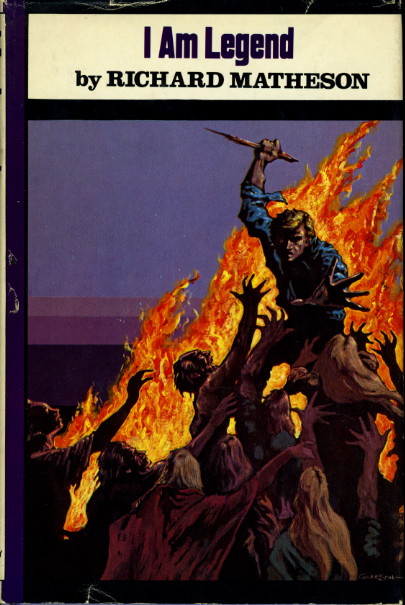
The only time I remembered a character’s hair color was when I read the movie tie-in edition of I am Legend, with a movie scene featuring Will Smith on the cover. Robert Neville, the character portrayed by Smith, is described as having blond hair. That would have made the movie more visually interesting.

movie tie-in

The Robert Neville in my mind didn’t look like Will Smith – not even a blond Will Smith.

older cover

He had the same eye color as this guy, but the hair color was more vague. He definitely didn’t have the huge left hand and/or extra-long left arm.

What the characters do is far more important to me than how they look, unless how they look is a big part of their character or influences their actions. If a character has a third eye, I’d like to know about it. But a third nipple is of less interest, unless a third nipple was clearly stated in the prophesies as the mark of the Chosen One, or three still-warm nipple rings were found at the scene of the murder.

I suppose physical appearance is more important in certain books. Romance novels might need to beef up their men and curve up their women to help sell the fantasy. Maybe that’s why I’ve never seen Pee Wee Herman on the cover of a romance novel.

Our reading preferences shape our writing. That’s why I can’t remember describing the physical traits of many main characters, except for that three-nippled messiah. My characters are like those Star Trek aliens who took whatever form Captain Kirk needed them to take to be able to relate to them. They can assume any appearance you want them to take.

What I must paint them with is a personality. I must make my characters have character, good or bad. I must make the central characters grow, or meaningfully not grow. This is the color on my brush.

Before one of the tens of people who have read my work becomes tempted to think me a liar, I should explain that I sometimes describe the physical traits of minor characters. I do this instead of giving them names. Names are superfluous for characters with walk-on parts (See: “Angry Man in Crowd” in your local movie credits). Referring to a bit player by a dominant physical characteristic makes them more noteworthy than throwing a temporary name label on them.

If I had to describe my central characters, they would all be medium build, medium height, with light brown hair and greenish, blueish, brownish eyes.

If any of characters show two or less dimensions, I’m truly sorry. That’s on me.

Is a main character’s physical appearance important to you as a reader? How about as a writer?