One man’s muse is the same man’s bully

We’ve all heard people talk about how they are compelled to write. Compelled to write? Compelled to roll out of bed every morning and trudge off to work—that makes sense. A job brings in money. But compelled to write? Compelled to struggle with an arrangement of words that stands a snowball’s chance in Hell of ever economically justifying the energy put into it? What twisted mental force would compel a person to do that?

Whatever the force, it is certainly mental, and completely twisted. It’s been inside my head, demanding my lunch money and making me do its homework since I was 12, maybe longer. I wasn’t bullied by kids in school, but I’ve been menaced by the specter of wasted potential all my life. I expect to labor under its threats until I die, leaving the specter forever unsatisfied. My bully’s failure should give me the last laugh, except that I’m kind of rooting for my bully to win. I told you it was twisted.

Bully with wings

Look out, Whiskers! She’s about to put you in a headlock and steal your lunch money. (The Tenth Muse” by John White Alexander.)

Lots of people search the dark corridors of their own minds for that hidden room, bursting with the light of genius (and associated cash and prizes). We’re sure it must be there, if only we could find the door and the key to unlock it. We toil in darkness, every so often glimpsing a fleeting flash that, if not a mini-stroke, must be a reflection of the sparkling key to that door.

We rush to the spot where the flash originated. We throw ourselves down on hands and knees. We grope for that elusive key to the room flowing with the milk and honey of inspiration. When I’m feeling around the dirty floor of my mind for that special key, I am writing. I have to do it. I can’t pass up the chance to unlock the door to my full potential. It means my masterpiece. But there are acres of linoleum inside my head, and some fool installed mirrors on the walls. So the flash could have come from anywhere.

It occurs to me, as I swipe my hands across the grimy floor of my mind, that I should do some mopping. But I always have grander schemes than common housework in front of me at the time. Besides, when I find that key and strike it rich, I’ll hire a cleaning lady. Maybe I’ll even have all the burnt-out light bulbs replaced. I plan to do it up right.

I’m not looking for that shiny, magic key every time I crawl around the floor of my mind. Sometimes I am groping for the rusted key to the room holding the memory of where I left my wallet.

It would be easier to find my wallet, and my hidden potential, if my mind weren’t so cluttered. I’m forever banging my head on other stuff, like bittersweet memories and bits of music or art that once touched my soul. Sometimes I hit my head so hard I see stars, and one of the those stars is always the reflection from the key to the hidden room of light. Bittersweet memories and beautiful art will pull stunts like that. They always get me on my hands and knees again, groping for that key, writing.
Got all the gaps worked out of your story? What about the gaps in your text?

I’m justifying this post. By that I mean I’m aligning it to both right and left margins, as opposed to proclaiming a valid reason for its existence. Whether its existence has a valid reason I leave to its readers to decide.

I don’t usually justify posts. It’s an extra button to click, and what blogger has time for that? More to the point, justifying makes the edges of the text look nice, but it can leave the interiors of lines looking like they’ve withstood an artillery barrage. Look closely at the lines of this text and you will probably see some in which there appears to be extra space between words. If it’s just a little extra space, it shouldn’t be a big deal, but congregations of longer, inflexible words do create distracting instances of overabundant space.

Justification?

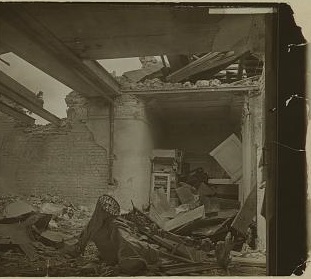
Incautious justifying can make text feel as cozy as this attractive, war-zone home.

I’m justifying this text to illustrate one of the more tedious parts of self-publishing. For those who have never formatted the layout of a book, it may be enlightening. For those planning to dip their feet into self-publishing, it may be something to consider.

Publishing is not all about telling a great story with proper grammar. Those things will get you off to a good start, but you also want an aesthetically pleasing product. No doubt, the cover should be attractive, but the interior’s visual appeal can’t be ignored.

I’ve never opened a book and thought, “Wow, this interior layout is gorgeous!” But I have seen books where the layout’s ugliness is a distraction. One common distraction is large gaps between words.

I know of three ways to avoid gaps. The first is to not justify the text. I would never do this; blog posts are one thing, but in books I think it looks disorganized. The second is to allow your writing program to auto-hyphenate. This breaks up big words so everything fits better. Some experts suggest this, but I don’t do it. One thing I stunk at in grade school was hyphenating. I don’t trust Word to do it for me, mostly because I doubt my ability to double-check it. It’s merely opening up another Pandora’s box of grammar issues.

The third way, my way, is to endure a round of tedium beyond normal editing. Editing is not fun, and this, if possible, is even less fun. I scan the proof copy for unacceptable gaps. Then I play a little puzzle game with that line and the adjacent ones, rearranging, cutting, or substituting words until the gaps are squeezed out.

It takes time, but it makes me take a closer look at the words I use. It helps me eliminate unnecessary words and say things in a clearer way. The key is to avoid ruining sentences to make them fit better. It wouldn’t be such a vexing game if this were allowed.

This should only be done once all the major editing is completed. New editing could create new gaps.

Gaps in some lines will still be greater than gaps in others, but if the gaps don’t resemble bomb craters it will be easier for the reader to focus on the words instead of the holes.

Ending obsession

Here we go again. It’s phase three of the A Housefly in Autumn remodel. As I predicted, between rewriting the middle and obsessing over the beginning, I’ve come to that time when I feel compelled to tweak the ending.

The good news is that it’s only the last couple of paragraphs I want to redo. The bad news is that those last two paragraphs contain a mother lode of tone. That’s not bad news in itself; it’s only bad news when you want to change them. It’s like changing whole pages at the beginning or whole chapters in the middle.

For the beginning, the concern is drawing readers in. At the middle, the worry is keeping them. The finale needs to hit just the right note. I think my previous note was a little flat and I’m trying to sharpen it up a bit.

When they are the last two paragraphs, two paragraphs can seem like a mountainous rewrite. It certainly has taken me more time than any two other paragraphs ever have. I’m still not completely satisfied, but at least I’m moving in the right direction.

On the bright side, I don’t have to count this late alteration as a self-induced delay to publication. This time I got smart and started obsessing about something while I was still waiting for my expert proofers to finish reviewing their copies. By the time they are done, this behemoth, two-paragraph rewrite should be complete.

At that point, I can feel good that I’ve given beginning, middle, and end their fair shares of obsessing and overthinking. The book will be as good as I can make it, lacking another 20 years’ worth of wisdom, for which I am not willing to wait.

What I'd look like after 20 more years of wisdom. Looks like I'd have a great story to tell doesn't it? Should we just wait?

What I’d look like after 20 more years of wisdom. Looks like I’d have a great story to tell, doesn’t it? Should we just wait?

It may seem like I’ve been talking about this book for 20 years already, but that’s just not true. I’ve been working on this book for 20 years (probably a mere 18, but who’s counting?). I’ve only been talking about it publicly for, well, far shorter than that.

Even so, I realize it may seem like I’ve been posting about this book for a long time without actually producing something like a book. No one feels this incongruity more keenly than I do. But no one sees the light at the end of the tunnel more clearly than I do. I am two short paragraphs away from concluding that it is what it is. Then all who are so inclined may judge for themselves whether I should have waited for 20 years more wisdom.

At that point, I can turn all my worries toward marketing. Marketing has been known to make me whine like a first grader with liverwurst on pumpernickel in his lunch box. Now that’s something to look forward to. Stay tuned.

The odd couple in my head

I was working out the logic for a database project at work when it hit me that it probably wasn’t normal for a fiction writer to be engaged in such a left-brain activity. I’m not supposed to be concerned with logic, or numbers, or any of the stuff I do at work. I’m supposed to wrap myself in flowery prose and serenade the world with my cute, yet impractical, idealism.

Fiction writers are supposed to be some minor tribe of artists. We should be ruled by that beautiful, playful, cursive hemisphere on the right. We’re supposed to ignore any straight-laced, know-better-what’s-good-for-you meddling by that block-style left half. That’s how it’s supposed to be, but until my fancy-pants right brain starts kicking in his share of the rent, it seems like the left brain is determined to make old Righty keep his poetic clutter tucked away in his own room.

I don’t know how writers who really are ruled by their right brains actually function. If that were me, I would not be a writer. I wouldn’t be a writer because I wouldn’t write anything. Righty has touching sentiments, and sometimes he has hilarious gags. But none of them would make it to paper if Righty were allowed to rule himself.

Righty likes to play too much; he’ll write down those profound thoughts later. Later would never come if not for steadfast Mr. Left’s incessant pounding on Righty’s bedroom door, demanding to know when something concrete is going to come of all his lofty thoughts. Righty lacks organization. His room would be a wonderland of wasted potential if not for Mr. Left’s iron heel.

perception

Exhibit b is the Left side of my brain. The right side of my brain is illustrated also by exhibit b, except with a V-neck and a flower on his chest instead of an Iron Cross. Exhibit a is a random human male we’ve never met. (Image: Oliver Herford)

Righty is always getting ready to write something really good. When Mr. Left is not busy securing income, he tunnels his way through the stacks of old newspapers in Righty’s room and makes his flakey roommate actually start. Left pins Righty down at his desk until Left has to go off and do some math somewhere else, whereupon Righty drifts away to gambol through the hoarder’s paradise that is his side of the skull.

You might think Righty and Mr. Left would make for unhappy roommates, but this is hardly the case. Righty secretly craves Mr. Left’s structure. Once in a while, Righty will actually come over to Left’s land of right angles and ask Left to help him organize his thoughts, because Righty wants the world to see his art, and he knows he cannot make this happen by himself.

Riding Righty’s back is hard work, but Mr. Left doesn’t complain. Mr. Left is no fool; he pays the bills, but he knows Righty has great potential. If he can impose discipline on Righty, maybe, just maybe, Righty will realize his unlikely dreams. If that were ever to happen, Mr. Left wouldn’t have to work so hard every day to make sure the rent gets paid. He might even go on a little vacation with Righty and find out how it feels to have some fun.