Green Eggs and Ham: the first one’s free

Having young children means I’ve read a lot of Dr. Seuss. Rather, I’ve read a limited amount of Dr. Seuss many times over. Reading a Seuss book too many times makes you start thinking more deeply about the story than is good for you.

I’ve already shared my over-analysis of The Cat in the Hat, but so far I’ve spared you my deep thoughts about Green Eggs and Ham. That grace period is over; here I go again.

On the surface, Green Eggs and Ham captures every parent’s frustration with the reluctance of their children to try new foods. The message we hope kids are getting is that just because a food is different doesn’t mean it can’t be delicious. Though most parents would not put green meat into their own mouths, it has the potential to be a helpful message.
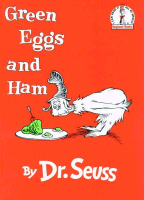
Green ham

Yes, I’d like my kids to try new things, but I’m a little skeptical of this meal myself.

But considering the lengths to which Sam I Am goes to deliver this message, one must wonder if the ends justify the means.

We have no idea why Sam is so determined to have the unnamed character try green eggs and ham. He doesn’t indicate any parental relationship. Lacking that, his incessant nagging takes on the flavor of peer pressure, or worse, outright stalking. The pursuit ends only with a frightful train accident that might easily have spelled tragedy for both Sam I Am and his quarry.

Why would Sam I Am go to such lengths to persuade a character, who seems to be a mere acquaintance, to taste green eggs and ham? Try offering an oddly-colored foodstuff to a friend of a friend. When he declines, chase him around town with it and suggest rhyming pairs of common nouns whose presence might make him more amenable to your strange offering.

Sam’s peculiar persistence calls into question the nature of his goods. Is it really ham and eggs? My faith in Dr. Seuss persuades me it really is about ham and eggs, but it’s not hard to imagine it as a euphemism for something else. If I told you there was a book, published in 1960, about one guy pressuring another guy to try some freaky, new stuff, would you think of ham and eggs?

I don’t want to think that Sam was pushing something he shouldn’t have been, but why on earth would he suppose that a hunk of green ham would make for better eating in a box with a fox? Aside from the lack of dining ambiance inside a box, how would being cooped with a wild carnivore enhance anyone’s ham-eating pleasure?

Sam nearly makes sense when he asks about the possibility of his tarried acquaintance eating his ham and eggs in a house, but then he goes right back off the deep end by introducing a mouse into the equation. If he really wants to make the sale, he should quit blurting out the name of whatever creature he happens to be hallucinating about.

Only when Sam’s hectoring has brought the other character face to face with death does the latter agree to do whatever Sam asks, so long as it will get that suffocating monkey off his back. He tries green eggs and ham. His eyes light up and he professes, quite credibly, to liking the sample very much.

This resolution of the conflict is either a well-deserved triumph for focused, dedicated parents everywhere or it is a tragic loss of innocence. It depends upon how you look at it, which very likely depends upon how many times you’ve been compelled to read the book in a single evening.


What could be better than Mr. Magoo?

In my last post, I mentioned that I am reading A Christmas Carol to my son. I want him to know the original text. Here’s how I discovered the original.

I first stumbled across A Christmas Carol one January when I worked at a bookstore. Normally, mid-January is not the best time to read a Christmas tale, but for a retail worker, that is about the time when you finally are allowed to enjoy the Christmas season, so it was not an untimely find.

I found it among some unsold Christmas books, pulled from the shelves when their season passed. Having nothing better to do on my lunch hour, I began to read. I’d never read Dickens in school and I thought I had done well to avoid him. I’d known the plot of this story since toddlerhood, when Mr. Magoo performed it for me. I expected to find that this Dickens fellow had merely supplied a stiff, uninspired outline that Mr. Magoo had turned to gold with his top-of-the-line production values and his sterling acting ability.

I was mistaken. I found myself engrossed in an excellent story, beautifully told. Dickens did not bore me; he charmed me. If I had not loved this story until that point in my life, it was only because Mr. Magoo, and all the many Scrooges in film, had not done it justice. It was hard to think of old Magoo in this light, but the printed pages told the truth of the matter.

Scrooge Magoo

Even a genius of entertainment like Magoo couldn’t match the the magic of the original.

There is a reason why A Christmas Carol has endured for 170 years, and it is not because Mr. Magoo and Scrooge McDuck waste their valuable time remaking narrative duds. You can’t throw a cherry cordial in a department store without hitting a DVD knock-off version. I use knock-off glibly because even the best film versions are knock-offs compared to the original text. People out to make a quick buck repackaging an old product don’t pile onto a loser.

A Christmas Carol endures because it gets so many of the elements of story-telling right. The plot arc is a pristine bell curve of narrative art. There are no awkward outliers to skew the meaning, nor burrs of unresolved plot points. The narrative moves forward with purposeful strides through every scene.

The writing is colorful, witty, playful, and endearing. These are not words often associated with Victorian works, which is why the book surprised me so much. The greatness in the work is that the writing is also very powerful. Combining playful and powerful is a rare accomplishment in any era.

If a traditional plot arc is not your thing, A Christmas Carol may not be your favorite. I wouldn’t argue with that opinion, but I would suggest that any time you read a Christmas story about a character’s redemption, that character is probably a long-lost grandchild of Ebenezer Scrooge.

The Ghost of Storytelling Past

I’m reading A Christmas Carol to my six-year-old at bedtime every night. I could have picked up a children’s version for him, but I’m going with the original, even though much of it will fly over his head.

I made this decision for three reasons:

  1. I’m cheap and didn’t want to buy another version of a book I already own.
  2. I’m not a fan of watered down versions of books. If the boy opts for a children’s book, we’ll choose one that began as a children’s book.
  3. I think one of the parts that is the first to be cut in the children’s versions is one of the parts I most want my children to hear.

Reasons 1 and 2 are self-explanatory. Let me explain reason 3.

A Christmas Carol is a brilliant story. It wouldn’t have been made into a million different movies if it weren’t. There’s so much to love about it, and so much to like in many of its offspring films. But there is one thing that the original text has that nothing else does.

Dickens

The beautifully illustrated edition we read.

The original has Dickens himself as the storyteller.

I’m not just talking about his genius with words. I’m not just talking about his ability to set a tone or his command of the narrative. I’m talking about those instances when the narrator comes onto the page and speaks directly to the reader. This is an ancient form of magic, all but lost to us now.

It is a relic of the time when children heard stories at their elders’ knees, when stories were enriched by the personality of the storyteller.

You can’t do that today. We won’t stand for it. We want our stories delivered anonymously, not chuckled to us by a narrator who presumes to refer to himself in the first person. We don’t want it to smell of grandpa’s after shave; we want an antiseptic story to be beamed through the vacuum of space, like it is on TV.

We want to be shown, not told.

Now, I will be the first admit that some of the old fellows did too much telling. I will also agree that showing is far more effective than telling in our time, when much of the art of storytelling has been lost. But I will argue that there is a mix that includes both showing and telling that is the rarest treasure in the unveiling of a story.

Dickens was a master at the mixology of show and tell. And who could appreciate show and tell more than a first grader? Okay, maybe a kindergartener, but what’s done is done.

I want to offer my children the chance to hear the storyteller’s voice — to appreciate when a story is even better because of who is telling it and what his character adds to the telling.

Maybe they won’t catch it this year, but there’s always the next. And besides Dickens, we’ve got lots of Hans Christian Andersen to get to.

I was just too young to love you

Like many American teens, I was the victim of a well-meaning society that used high school English classes to pound an appreciation of classic literature into my head. Like many American teens, I rebelled against this attempt to pry open my mouth and pour culture down my throat. Unlike many who endured this experience, I went back to the well of literature, in my own good time.

I’m lucky. Some unexplainable motivation drove me back into the arms of the people to whom I had been so rudely introduced in high school. The clumsy way these folks were pushed into my face might have put me off reading altogether, as I’m sure it did to some.

Fortunately, I had friends like Edgar Rice Burroughs, who kept me entertained with his less-than-classic adventures. While school was doing all it could to sour me on reading, Tarzan, and an assortment of Martians, kept my nose in books.

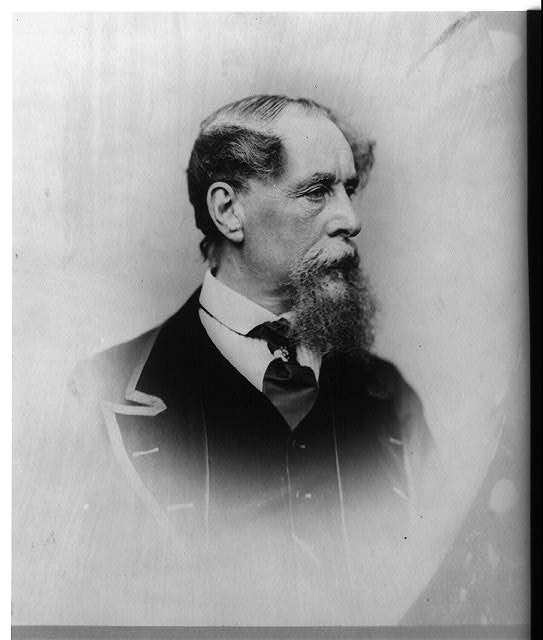
Charles Dickens

He looks so stern and boring, but he’s a little Dickens on the inside.

This still doesn’t explain why I came back to the “classics.” That was dumb luck. Without luck, I still wouldn’t have a good word to say about John Steinbeck. In school, I hated Steinbeck; I hated that little dog of his; I hated the cob-job of travel trailer he supposedly tooled around America in; and I hated the arrogance that made him think I had the least bit of interest in his vacation. These fires of hatred burned so brightly that they blinded me to the merits of The Red Pony or Of Mice and Men.

Years later, I picked up East of Eden, and read it with actual pleasure – something I had no right to expect, from my past dealings with its author. I re-read Of Mice and Men, a great story, even though I can’t quite put my mind into George’s way of thinking at the end. I’ve never returned to Travels With Charley though, and I doubt I ever will. I’m afraid it would stoke up that dormant hatred again. It was a horrible choice for introducing a young reader to Steinbeck. I get angry just thinking about it.

High school prejudiced me against people I’d never met. Somehow, I got through those years without having been made to read Dickens. This was my great escape. I was sure that Dickens would make me gag, just the same as the other old timers had. It was years before I got brave enough to pick up A Christmas Carol, mostly by accident. For all those years, I had counted a man among my enemies who should have been among my dearest friends. But I suffered from an extended case of Dickens-phobia, along with Shakespeare-phobia, and all the other phobias associated with my forced exposure to books heavier than my immature attention span.

The phobia I’ve never overcome is the one about Shakespeare. Every English teacher in school was determined to make my class appreciate Shakespeare. There was no reprieve from Shakespeare; his ghost haunted every grade level.

william shakespeare

I’m still wary of him after all the kids he humiliated in front of the entire class.

What made Shakespeare so insufferable was the demonic idea that his plays must be read aloud in class. If you can’t despise a piece of literature enough, reading it silently to yourself, just have your 10th grade classmates stumble over the text until even the teacher can endure no more and calls upon someone else to stumble. To this day I cannot read Shakespeare for fear that I will hear a teenager’s tortured voice as he stammers and stutters, banging his shins against those hurdles of words, arranged in an order completely nonsensical to everything he has ever read before.

How many more readers of classic literature would there be if only our teachers had respected the literature a little more, rather than spraying it at us from a fire hose? If a teacher had given me Hamlet and said, “I think you’ve earned this,” I would have put more effort into understanding it. Even if they had said, “You’re not ready for this yet,” I would have wanted to figure out why not. That’s the way I got interested in beer.

My peers and I became devotees of beer, mostly because nobody in authority thought we deserved it. We showed them. Maybe I’ve reached the point where I’ve earned another crack at Shakespeare, but I’m haunted by traumatic memories. Even though I don’t deserve it any more than I ever did, I’ll probably crack a beer instead.