That time the Wonderful Wizard put out a hit on the Wicked Witch

Ever since becoming a family man, I’ve discovered myself lacking funds with which to buy books. I just finished reading The Wonderful Wizard of Oz, mostly because it was a free Kindle download and it’s too cold to go out to the library.

It’s a quick read, which, with three young children, means I can read it in a month. Books that aren’t quick reads I can’t read at all.

You may recall a movie of a similar title. All movies take liberties with the original text, and this movie took its fair share.

In the book, there is no mean schoolmarm, out for Toto’s blood. There are no farm hands and no traveling sideshow man. The good witch of the North is an old lady. Glinda represents the South. The Munchkins are as tall as Dorothy and don’t glow Technicolor. The shoes Dorothy loots from the dear departed feet of the Witch of the East are silver, not ruby.

Dorothy

Or maybe it’s just that Dorothy is shorter than we’ve been led to believe.

I’ve always thought there must be more to recommend the character of the flying monkeys than was depicted in the film. I was right. The monkeys only do the witch’s bidding because they are duty-bound to obey. When their required submission to the witch ends, they become helpful little fellows.

The most surprising difference is that the Wicked Witch plays only a minor role. The Wizard plays a larger role, and is perhaps worse than the witch. Rather than merely giving Dorothy a difficult time about her request to go home, as everyone knows is a Wonderful Wizard’s prerogative, this one demands that she kill the Wicked Witch if she ever wants to see Kansas again. He doesn’t just want the witch’s broom, or anything else that might be merely swiped from her, he wants that hag D. E. A. D.
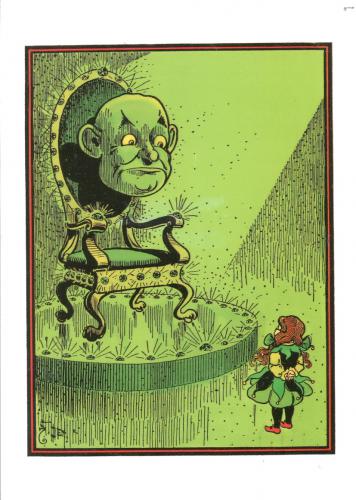
Marching orders

“Make it look like an accident. And when you’re done with her, I want to talk to you about a job on a guy named Hoffa.”

Having given Dorothy her homework, he insists that her companions help her in order to get hearts and brains and stuff. But it is clear that he expects Dorothy, among all her adult associates, to lead the operation.

The Wizard was wise in picking Dorothy to lead the hit. She makes short work of the witch, without much help from her team. As in the film, the witch is taken down with water and Dorothy claims it was an accident; in the film, you are disposed to believe her.
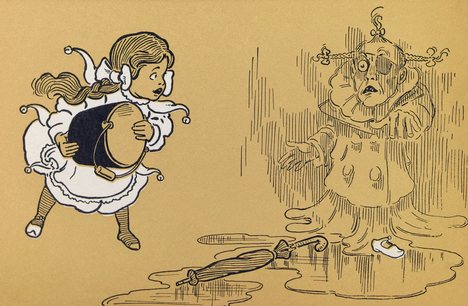
I'm melting!

Fact: 99% of all melting accidents occur in the victim’s own home.

Book and film agree, the Wizard is a fraud – an old man from Omaha whose hot air balloon got away from him. Unable to hand over the promised rewards, he plies Dorothy’s companions with platitudes, which satisfies them since they unwittingly had everything they sought all along.

He accomplishes nothing on Dorothy’s behalf. She must rely upon Glinda to get her home.

The silver shoes take Dorothy home and the conspiracy to murder the Wicked Witch shouldn’t haunt Dorothy’s conscience, because it was all a dream.

Well, in the film it was all a dream.

*Illustrations by W. W. Denslow, from the original edition.
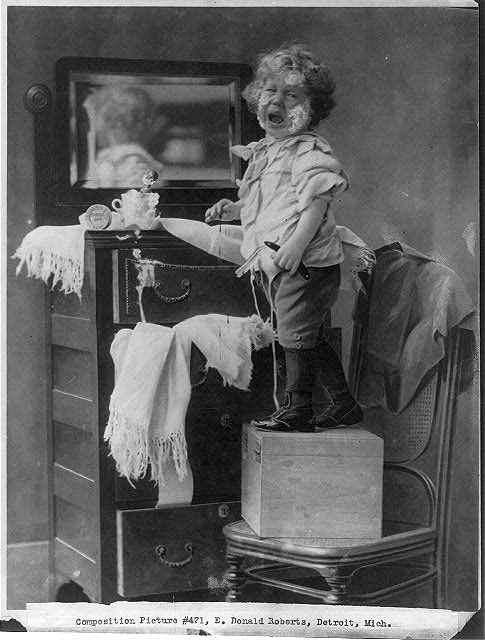
Be careful where you step; there’s misunderstood artistic genius everywhere

Accepting criticism of your work in a positive manner comes in two distinct levels. The first level is reacting graciously. This means saying thank you to the critic for taking the time to provide feedback, even when that feedback seems harsh or off point. This is not easy to do, the first time that stinging critique comes back. But any writer who refrains from beginning his reply with the words “Your Mama . . .” is on the right track.

This level of positive response gets easier, until it becomes second nature. That’s good, because (a)getting into a screaming match with a critic never improves a writer’s image, and (b) this is the easier of the two levels.

The harder level happens within the writer’s own mind. Have you ever received a disappointing review and immediately thought, “They just don’t get what I’m trying to do here.” on your way to politely saying thank you out loud?

The harder level is reached when you don’t allow yourself to think that.

It’s very difficult sometimes, but it is key to better writing.

I'm so misunderstood

“They just don’t get what I’m trying to do here!”

The publishing delays I experienced with A Housefly in Autumn allowed me to enter it into consecutive ABNA (Amazon Breakthrough Novel Award) competitions. I achieved different levels of success, with a wide array of feedback.

One year, both judges of my 5,000 word excerpt were overwhelmingly laudatory in their comments. The next year, both judges (different people each year) had reservations. Their reservations were about the language used. It just so happened that the language was one of the foremost things “I’m trying to do here.”

I knew the language would be somewhat unusual to the contemporary reader. I hoped it would add some old fashioned charm to match the setting of the story. Since it wasn’t an issue the first year, I began to feel more confident about my choice.

My confidence was misplaced. Even though one of the second year judges admitted that the language grew on him/her, and that the excerpt turned out to be one of his/her favorites, the language was still an issue.

Having won two of four judges, and eventually converted the third, it would have been easy for me to discount the fourth judge’s opinion and bury it under the “They just don’t get what I’m trying to do here.” mantra. In fact, that is just what I was sorely tempted to do.

It would have been a big mistake.

That fourth judge is not just a single person. Judge #4 represents thousands of potential readers. Potential readers are not so easy to come by, and if a quarter of them find the writing awkward from the start, that’s a big loss.

Also, keep in mind that these judges were committed to reading the entire excerpt, regardless of their first impressions. In the real world, the third judge likely would have given up on the book before it had a chance to win him/her over and become a favorite.

That means that half of the potential readers probably would have put the book down because the language didn’t suit them. It would grow on none of them, because they would stop reading. This criticism had to be taken seriously.

If two of four judges “just didn’t get what I was trying to do here,” it was because I wasn’t doing it right. It’s not the reader’s responsibility to figure out my motives. It’s my job to entertain the reader, and not let my motives get in the way of that.

It's not your audience's job to figure out the secret genius to your art.

It’s not your audience’s job to figure out the secret genius to your art. That could take a lot more time than they have to spend.

It was time to go back to work. It was time to reassess “what I’m trying to do here.”

“What I’m trying to do here,” first and foremost, has to be to engage and entertain the reader. If not that, nothing else happens.

In order to do this, the language needed to be modified. It wasn’t as difficult as I feared. A word change here, a slightly different phrasing there, could alleviate the awkwardness to the contemporary reader without compromising the cohesion of the language to the story.

There may still be some readers who find the writing awkward. There’s always the danger of that. I go forward knowing that I did my best to move my motives out of the way of the story while preserving the story I needed to tell.

For that, I am thankful for the judges who “just didn’t get what I was trying to do here.”