Addition by subtraction: ditching the unhelpful words

I’m working my way through the third proof copy of A Housefly in Autumn and it’s making me remember why it took me four or five proof copies to get my other books ready.

I’m always searching for a tweak to make it a little better.

I haven’t noticed any embarrassing mistakes so far on this copy. I haven’t even come across anything that I feel is definitely an error. In spite of this, I have plenty of red pen marks on this third copy already, and I’m not half way through.

What am I marking up then?

Mostly, I’m striking words that seemed necessary at one time, but now just seem like extra words. They are not extra words of the James Fenimore Cooper magnitude. They don’t lead down dead end paths into inescapable thickets. At least in my opinion, they don’t. But they don’t add anything to the potential reader’s understanding of the story either.

An extra wordsmith

James Fenimore Cooper, a man of abundant imagination and even more abundant verbiage.

It’s amazing how many of these words pop up in a novel. And it’s amazing how many edits it takes to get most of them out.

I added a very short scene to beginning of the story prior to this proof. It didn’t change the themes of the tale, but it did slightly alter the tone in which it is narrated. This is the other major category of cross-outs this time around. There are some residual statements sprinkled throughout the book that reflect the previous tone too much. These need to be changed or removed. They are pretty easy to spot, but not always simple to fix.

At the end of this proof, I hope to have an efficient story with a smooth, consistent narrative tone from start to finish. Then I can move on to the really nit-picky stuff on proof number four. Maybe I’ll even have the luxury of revisiting issues I previously vacillated over before deciding. You have to flip a lot of coins in self-publishing. Sometimes you want to go back and flip them over again, not because that gives you a better decision, but it might make you feel like you put enough thought into it.

Meanwhile, I’m not giving up on finding errors. By now, I am the least qualified person to find any errors that remain. My jaded eyes have skipped them before, and they’ll skip them again. I’m counting on other pairs of eyes to bring me errors. I hope they do better than I could do right now, because the consequences of hard decisions I can live with; glaring mistakes are harder to stomach.

The saga goes on. It pains me that it takes so long. I’m disappointed to have missed a Christmas release. But if it makes the book a cleaner, better reading experience it will have been worth every dragged-out day of it.
Valet parking: annoying in real life, worse in fiction

I once read a novel in which Character A was driving to a meeting with Character B. They had a lot of very important things to discuss that would greatly advance the plot. I was eager to arrive at this meeting, because I am all about advancing the plot.

I was all ready to meet Character B and see what fascinating revelations he had for us. I think Character A was all hyped for it too, but what we wanted didn’t matter. The author stepped in to block our way until we had parked the car. We parked in a specific space, in a specific lot, a specific distance from the meeting place.

The spot where we parked the car had no bearing on the outcome of our meeting with Character B. It had no effect upon the story whatsoever. The fact that we drove to the meeting was of no importance. Yet, instead of beginning the chapter discussing juicy topics with Character B, we were made to suffer through parking the car. It made me sad.

It made me sad because I have far less reading time than I would like, and I don’t want to spend it parking cars when there are mysteries to solve – mysteries that have nothing to do with where certain cars are parked. My reading time is precious to me; please don’t make me your literary valet.

Don't park your plot

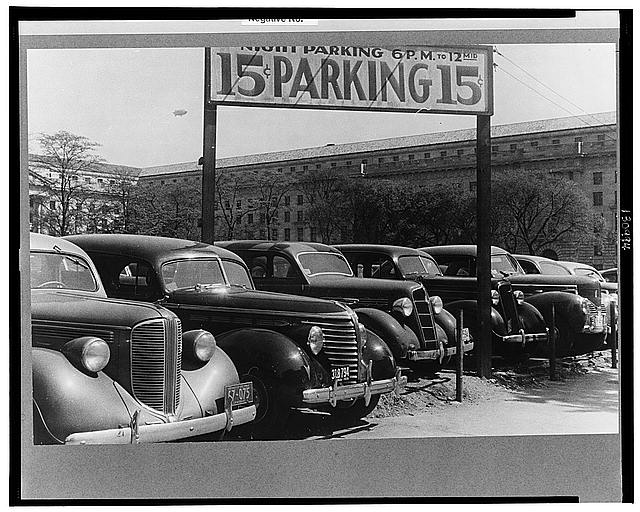
Save yourself 15 cents and a bunch of unnecessary words. Forget about parking and get on with the story. (Image: David Myers/US Farm Security Administration)

Parking cars, ordering coffee, having a particular eye color—these are fine things for characters to do, if they are relevant to the plot or show some insight into the character. Otherwise, they are just more words that are likely to block my path and divert my attention before I finish the book.

My rant is not against a particular book or author. Superfluous activities crop up often in fiction. They are a pet peeve of mine, especially because I am not immune to them in my own writing. The vast majority of writers probably have them in their beginning drafts. Part of the work of polishing a manuscript is locating meaningless actions and destroying them.

It may be impossible for the author to identify all the wasted actions in his own book, but it is crucial that he make a whole-hearted attempt. Each wasted action makes the story less intriguing, or to be blunt about it, more boring. It should be ample motivation for an author to know that every time he crosses one of them out, he makes his story better. Nothing should make hard work more palatable than that.

So, here’s the deal: I won’t make you park my cars, unless it’s crucial to your enjoyment of the story, if you don’t make me park yours. Hell, let’s not even drive if we don’t have to. Fiction is a kind of magic; we can just show up at our meetings when we need to. It will save gas, the environment, and maybe even our respective novels.


There are only three parts of your story to worry about: the beginning, the middle, and the end

I’ve moved on to my second proof copy of A Housefly in Autumn. This incorporates all the changes I made to the first proof. I normally go through four or five proofs before I am satisfied that the book is ready to be presented to the public.

In the first proof copy I made numerous changes, none of them major. A few of them were actual errors, but most involved making sentences more efficient. It’s amazing, the little things you don’t see until the manuscript holds like a real book.

The first proof had me worried about typographical errors and other embarrassing occurrences. I feel better about that stuff now, but the second proof brings its own worries.

These are big picture worries, about the overall execution of the storytelling.

Beating up the proof copy

My wife’s proof copy is already taking a beating, and she’s only just begun.

If you break a story down into beginning, middle, and ending, that leaves only three parts to worry about. This reduces the number of worries and gives you more time to worry over each thing.

I most recently obsessed about the middle. Before the first proof, I rewrote much of the middle, trying to transform parts that retained too much “telling” into more “showing.” Since this novel has a large oral storytelling component, in which a character literally tells a story, there were some limits to how much of this I could do.

I’m not saying I won’t obsess about the middle again, but since I just finished doing that, the middle will have to go to the back of the line.

For now, I’m focused on worrying about the beginning. It is an axiom of modern fiction that you have to grab the reader by the throat at word one and not let him breathe until he is irretrievably engulfed in the story. This concept is so well revered that a fair percentage of books now begin with explosions or with characters burying (or digging up) dead bodies.

Those incidents aren’t appropriate for this book, so I’m toying with adding a flash forward to an action-packed scene at the beginning. I need to do this without it seeming too much like a cheap gimmick. It also needs to fit with the historical setting, when people began a story at the beginning, regardless of where the bridges were set to blow.

If I can’t figure out how to work in some page 1 fireworks, I guess I’ll have to hope that my beginning is interesting enough. Meanwhile, I’ll worry that it’s not.

I have not spent much time obsessing about the ending. I’m pretty comfortable with it, except for maybe the last couple of pages. I haven’t found time to worry about a mere page or two, but I will at some point.

Do the last lines bring home the points I worked hard to make throughout the book? Or are they relics of the book this used to be, before it matured and added meat to its bones? These are the questions that await my future obsession with the ending.

Maybe that will come with proof copy number three.