How do I know I’m close to being nearly famous? Because the Internet says so (and the Internet never lies).

A funny thing happened while I was Googling myself. What, you don’t Google yourself? Whatever. I’m not ashamed to admit it. I keep track of myself online, because well, really, who else is going to do it?

Anyway, the results were pretty standard stuff: links to my blogs, links to my books on Amazon, the web site that will tell you everything you ever wanted to know about me (or a guy with a very similar name) for a small fee, and a link to my senior picture in the 1985 St. Johnsville Central High Yearbook.

If he had only known about Wikipedia back then, he would have dressed for success.

If he had only known about Wikipedia back then, he would have dressed for success.

There was a link to Berkeley Fiction Review (BFR). They published one of my stories about 10 years ago, so that made sense.

Then there was a link to the BFR Wikipedia page. Why, I wondered, would a search of my name bring up BFR on Wikipedia? I clicked it.

I scanned the page of information about the whys and wherefores of Berkeley Fiction Review. There, in the middle of the page, was my name, listed with about 40 others under the heading, “Notable contributors.” I am on the same list as Charles Bukowski. I confess, I don’t recognize most of the other names on the list, but they must be of some minor renown, as the majority of them have links to their own Wikipedia pages.

I don’t have my own Wikipedia page, but at the rate I’m going, I figure if I keep Googling myself, one will eventually show up for my troubles. And then I’ll be “big time.”

Who knew old Issue 27 would supply a notable contributor to ranks?

Who knew old Number 27 would supply a notable contributor to ranks?

I understand users are allowed to edit Wikipedia entries, but I promise I had nothing to do with putting my name down as a notable contributor. For one thing, I’d be too afraid of crashing the entire Wikipedia empire to attempt making  an edit.

Worse, what if they had a way to trace it and found out I was the one who put my own name on a list of nearly famous writers? That’d be awkward.

I don’t know how I got on the list of “Notable contributors,” but I sure am tickled to be there. I thought about adding a signature line to emails I send that says: “Scott Nagele, Notable contributor,” but then a wave of humility (perhaps it was envy) swept over me. After all, I was one of the minority whose name showed in plain, black font, not one of the specials in the inviting, blue, “link to my personal Wikipedia page” font. My static, disconnected name leads nowhere.

Still, among the many hundreds of BFR contributors over the years who are not notable enough to merit their own Wikipedia entries, I must be among the 20 most notable.  Either that, or somebody just picked a few random names from a past issue in order to fill the holes in the list of blue-fonters. Either way, I’m mentioned on Wikipedia. So how ‘bout them apples?

 

Edgar Rice Burroughs and making pulp fiction classic

Classic is a subjective term. Tarzan of the Apes is included in some classic libraries and excluded from others. None of the 100+ other Edgar Rice Burroughs novels is mentioned in any discussion of classics.

But they are classics to me. Even as a child, I recognized their flaws, but I didn’t care. Burroughs took me to Africa and Mars. Even more, he helped me learn to love to read. To me that makes him a classic writer.

ERB’s books followed common plot arcs: Hero meets Damsel. They are indifferent toward each other. Damsel, unmindful of what meeting the hero in the beginning of an adventure story portends, is careless in her personal security. She is kidnapped by slave traders, or some other impolite group.

Hero flies to Damsel’s aid, not out of any personal regard for her, but because a hero wants employment for his skills. Hero rescues Damsel. They talk a bit more and each comes to the unwilling conclusion that the other has cute dimples or some such endearing trait. Things seem to have turned in a good direction.

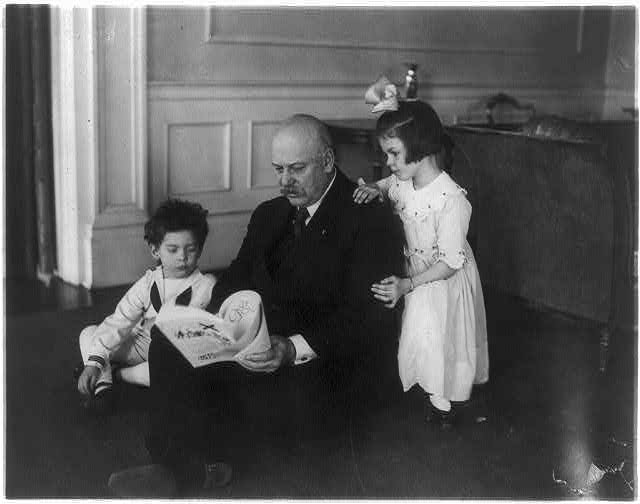
Edgar Rice Burroughs - the first author I couldn't put down.

Edgar Rice Burroughs – the first author I couldn’t put down.

Yet, there is trouble brewing. The villains have not yet been brought to justice (i.e. killed in self-defense) and we are only halfway through the book. Tragedy strikes when Hero says something innocuous that is misinterpreted as an insult by Damsel. She storms off, leading Hero to conclude such a mercurial woman isn’t worth his affections, her cute dimples notwithstanding.

This emotional rollercoastering causes Hero to lose focus, allowing the slave traders to capture both. The bad guys intend to croak Hero, while proceeding to auction Damsel to the highest bidder, if the rogue leader can keep his grotesque hands off of her until then. He’s noticed her dimples too, and realizing how mercurial she is, he’s really hot for her.

Hero and Damsel are taken in different directions — he to a gruesome death, she to be ogled by a horrid specimen of humanity, who somehow can’t actually bring himself to touch her, but is upon the point of doing so at every moment. Her torture is magnified by knowing Hero is probably dead by now, and realizing she didn’t actually hate him that much when he was alive. In fact, had it not been for his uncouth behavior . . .

Her hopeless eyes are a big turn-on to the villain. They give him the juice he needs to finally come at her with his filthy, greasy hands. His bulbous nose and his brown teeth, together with the smell of animal fat on his unwashed body, cause Damsel to scream exactly once before closing out the chapter by fainting dead away.

While all this foreplay is going on, Hero is brought to the apparatus necessary for the imaginative killing of heroes that is ever being conceived, yet never actually executed, by bad dudes in the arts. Hero quickly assesses and demonstrates the flaws of the lethal apparatus to his captors by killing them all with its safety defects.

Hero flies to the succor (again) of the insufferable Damsel. Though he may give a passing thought to her dimples, he races to her aid for reasons truly noble. It is, after all, more heroic to rescue somebody he doesn’t like, dimples or not.

Hero interrupts the impending outrage just as things are about to progress to where they cannot be allowed to go in the early 20th century. Though Hero takes no pleasure in dispensing death, the lust-crazed fiend will accept no resolution less than giving complete satisfaction to the incensed reader. But he will not die before advising Damsel that she has misinterpreted Hero’s words toward her.

Content at providing closure, the villain breathes his last. Hero and Damsel realize the foolishness of letting a misunderstanding come between them, and they kiss, with no tongues.

I eagerly followed this plot every time. Maybe I was just young and callow, but that doesn’t matter. I was entertained and my imagination was sparked. It kept me reading. That’s what matters.

You don’t have to rewrite the good parts

My wife is my initial beta reader. Like me, and in a strange coincidence, she also has three young children. Together with her many jobs and responsibilities, these children make it as difficult for her to find time to read as they make it for me to find time to write – probably more so. Consequently, I must be patient and find something else to work on while awaiting the initial feedback on the latest work.

Lacking a suitable idea for a new project, I am left with the daunting notion of revisiting some old projects. I have four unpublished novels in completed draft form. That is to say there are four that come to mind; there may be others my subconscious finds too painful to contemplate.

Of the four, one can probably be fixed to meet my standards for publication. Another might have potential, but needs serious structural work. The other two are long shots. All four need lots of attention.

It’s difficult to get motivated to do the amount of rewriting that even the best of them would require. Rewriting doesn’t touch the good and the fun parts very much. The peaks are fine; it’s the dark, grimy, stinky valleys that beg rewrites. Your brain gets dirty and sweaty at the very bottom of the pit.

I know I eventually have to put on my overalls and get down into the dirt of the salvageable novel, but I’ll still find excuses to put it off. As for the others, I may just save those for when I’m famous, and also dead.

The After I’m Dead (AID) novels will be my last embarrassing legacy. My money-grubbing great-grandchildren will bring them to light for a quick payday. People will shake their heads at the poor quality, but do so quietly out of respect for the departed. Since I will be famous (play along with me) and also dead (couldn’t have happened to a nicer guy), morbid curiosity will turn these into my best-selling books.

-"And now, sweet grandchildren, you must promise that you will never bring this sub-par manuscript to light." -"We won't. We swear on our grandfather's grave."

-“And now, sweet grandchildren, you must promise that you will never bring this sub-par manuscript to light.”
-“We won’t. We swear on our grandfather’s grave.”

My great-grandchildren will buy 10,000 square-foot homes in Malibu and I’ll roll over in my 12 square-foot grave.

Perhaps I should really get to work on rewriting the AID novels after all. I like to keep still when I’m sleeping.

I guess I should start with the salvageable novel first, because nobody gets to live in Malibu if I don’t get famous before I croak. On the other hand, I don’t want to live in Malibu and, at this rate, my great-grandchildren don’t deserve to.

So maybe I’ll just keep procrastinating. Maybe I’ll even write some more meandering blog posts as an excuse to avoid the hard work waiting for me.

Maybe I’ll spend the time with my kids, teaching them lessens they can pass on to their children and grandchildren about how not to be mooching, greedy bastards.

Who knows what I’ll do. At any rate, I most likely won’t become famous.

That’ll teach ‘em.

Moby Dick – Part II: I’m with the whale on this one

The following is Part II of my critique of Moby Dick from my old web site. At this point, I had finished the book, which was quite a relief to me. Last week I posted Part I, written when I was only half way through the novel. If you want to read Part I first, click here.

Part II: Finished with Moby Dick

Previously, I shared some thoughts formed while reading the first half of Moby Dick. Though I was not thrilled with the story, I was determined to finish it. I had seen a faint glimmer of potentially smooth storytelling and was really hoping this potential would blossom into an engaging second half.

Having finished the book, I am here to report that my hopes were dashed upon the rocks of long-winded meandering. The novel peaked somewhere between the 10 and 13 percent marks (as read on Kindle), and never came near reaching those heights again.

Moby Dick is bereft of likable characters. If I had to choose, I would say my favorite (i.e. the least annoying) character was Moby Dick himself. He is my favorite because he shows up for only the last 10% or so of the book, which is also good advice for any potential reader. Unlike Ahab, Starbuck, and all the other prominent, hard-bitten sea-farers, he doesn’t talk too much. I appreciate good dialog in a novel, but these sailors are forever spouting some drivel that means next to nothing. Even when they are not speaking, they are thinking pointless drivel. I wonder if Melville attended the same writing workshops as James Fenimore Cooper.

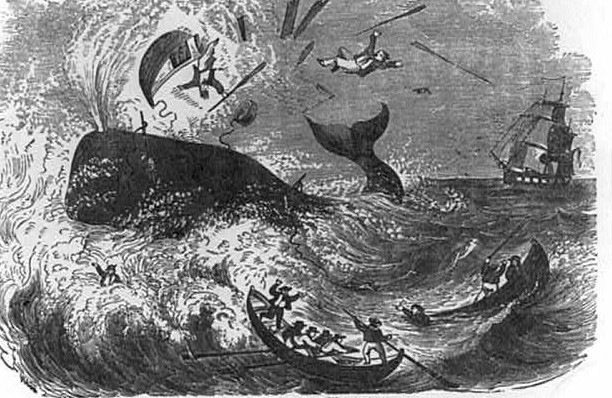
Moby Dick shows up for the climactic final scene, takes care of his business, wagging his jaw no more than necessary to crush a few boats, and then goes home. He wastes no time tripping over insipid attempts to make himself sound intellectual. If only the author could have been half as efficient.

The whale's not much for dialogue. He just takes care of business and goes home.

The whale’s not much for dialogue. He just takes care of business and goes home.

Instead, Melville wanders. At the beginning, it seemed like a major part of the plot would be the unlikely friendship between the Yankee narrator and a partially-civilized cannibal. Yet, by the time the ship shoves off from the dock, the cannibal has become no more noteworthy to the narrator than any other of the harpooners. This may be a blessing in disguise, for if nothing else, it prevented the cannibal from indulging in drawn-out soliloquies.

The author’s focus drifts in the wind throughout the book. Even at the very end, it is still drifting. Melville seems to forget, until it is nearly too late, that the narrator must actually live if we are to put any credence in the story he has just spent way too long relating to us. The narrator is almost certainly floating toward the light when Melville hastily yanks him back into the mortal world with an afterthought of a tale about his unlikely survival of the final battle.

It turns out that the great whale was efficient, but not completely thorough in his actions. He left one man alive to tell the tale. I wonder if he regrets this oversight as much as I do.