He was a good bear before Hollywood got to him

As a child, I never took interest in Winnie-the-Pooh. My only exposure to what seemed a hopeless band of anthropomorphic misfits was television. TV convinced me Pooh was merely a chubby ne’er-do-well with no sense or self-discipline, who would accidentally strangle himself if left to his own devices.

His friends were no more interesting. There was some kind of mule with chronic fatigue syndrome, whose pity parties wore thin. There was a pig in a sleeveless jumpsuit, and a boy who looked like he needed to eat some meat and potatoes.

I don’t remember all the characters because I never enjoyed the films. I began avoiding Winnie and his crew. I avoided them without a backward glance for about 40 years.

Then a thoughtful person gave my son a Winnie-the-Pooh storybook. I had never consider Pooh as literature because I’d been turned off by him as television. Having seen what Hollywood did to Tarzan and The Little Mermaid this isn’t surprising.

When my son asked me to read from his Winnie-the-Pooh treasury, I winced. I wanted to make up the story instead of reading it. I wanted to say, “Once upon a time there was this ridiculous bear who only wanted honey, and since he had no sense and he could not control his desires, he got his head stuck in a pot of honey and had to live with his head inside the pot for the rest of his pitiful life. The end. And let that be a lesson to you, young man.”

I did not say this; that would have been lazy parenting, and the boy’s mother was sitting within earshot. I did the honorable thing: I tried persuading the boy he would prefer Green Eggs and Ham. When that failed, I sighed and began reading.

To my surprise, the literary Winnie-the-Pooh is quite well done. This Milne fellow knew how to tell a story with charm. Winnie is not nearly so vacuous as in his films. He makes up witty little songs, and though he possesses less forethought than is to be hoped, he does spend some time on afterthought.
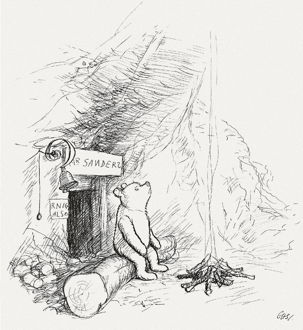
Humble Winnie

They were simple times, before all the glamor and glitz, but they were good times. (Image: E. H. Shepard)

Rabbit’s desire to keep his home free of unwanted visitors is relatable to any middle-aged man. The only thing that would make him more perfect is if he came to the door waving an 80-year-old shotgun he never owned shells for.

I remember Piglet to have been portrayed as cowardly on TV. TV didn’t uncover the real depth of Piglet. Piglet has a keen sense of discretion. He is willing to accompany Pooh in pursuit of a couple of potentially hostile Woozles, but when he and Pooh are outnumbered he reads the writing on the wall. Piglet knows how to count and when to cash out. Now, if only he would cash out of that 1920s bathing suit.

We haven’t met Eeyore yet. No doubt, he will turn out to be a grizzled veteran of the Boer War, suffering from a tail wound and in constant pain from a bullet lodged in his hip. What once seemed like incessant complaining will surely be words of wisdom from a hero of the siege of Kimberley.

Though we got off to a rocky start, I like Pooh now. I like the way his stories are written. There is a unique talent for storytelling in the books. I hope it doesn’t take my boys 40 years to appreciate that.

Are you trying to tell me my research stinks?

Skunks happen for a reason. I’m convinced of that now.

In February, my family was left reeling from the noxious fumes of a skunk using the area under our deck as a late-night rendezvous location to get her groove on with the boy skunks in the region. We all hated that skunk more than anything, but I’ve developed a new appreciation for her since then.

Why have I softened toward her, and how does this have anything to do with writing?

She provided me with another thrilling adventure for my fatherhood blog (read it here). This alone did not make her visit worth it. It’s only in the last few days I truly appreciated her visit.

I’m preparing a new novel, A Housefly in Autumn, for publication. It’s set in 19th century Europe.

When you write a story about a different place and time, you research as much as you can, but some things are too obscure to discover. In these cases, you get things as nearly correct as possible and keep vague about details you can’t nail down. You avoid the impossible and keep to situations that, if not historically provable, are at least historically plausible.

In doing this, you make assumptions. Sometimes, you don’t even realize you are making an assumption, and this assumption is the idea you fail to research.

This is where the skunk comes in.

In A Housefly in Autumn, there is a scene in which the protagonist mentions a skunk as if that would not be a surprising animal to see in a garden. At my house, it’s common.

I wrote this scene years ago, and have edited it many times, without giving the skunk a second thought.

On my fatherhood blog, I’ve mentioned skunks several times. People from other continents have commented, showing a perfect understanding of the hazards presented by the animal. This reinforced my assumption about the universality of skunks.

Back in February, I found myself extensively researching skunks, trying to find the right solution to our infestation, and one image stuck in the back of my mind, waiting.

A few days ago, I was scouring one of the last proofs of my novel. I came to the aforementioned scene for the thousandth time. On the thousandth time, the latent image from my skunk research rushed to the front of my mind. My jaw dropped.

I hurried online to verify the image. It was a map of skunk habitat, and it was correct.

Skunks are an American animal.

Never would I have guessed there are no wild skunks in Europe. Pepe Le Pew is French, right?

Maybe there are wild skunks in Europe by now, because those exotic animals from other continents rarely turn out the awesome pets promised, and they’ll probably survive in the woods behind the neighbor’s house. But in the 19th century, I doubt it.

Needless to say, A Housefly in Autumn is now a skunk-free novel. Most readers may never have noticed, but I do hope to sell two or three copies in Europe. And who knows how many other naïve assumptions I’ve made?

Just like every other part of a novel, the detail accuracy will never be perfect, but mine is now a little better, and I owe it to a real skunk.

skunk lunch

For my European, African, Asian, Australian, and Antarctican friends: this is what a skunk digging for insects on your lawn looks like.


I probably don’t care about your superfluous nipple

Do you care what color eyes the protagonist in a novel has? Is a character whose green eyes shine like emeralds more interesting than one whose blue eyes are mentioned in passing? What about the one whose eye color was never mentioned? What kind of loser must he be?

I don’t care what characters look like. When their physical traits are described, I quickly forget them and picture the character as if he had not been described at all. I paint him as an amorphous, generic human, without any detailed features.

In my mind, the character has no eye or hair color; he is a sort of human silhouette.

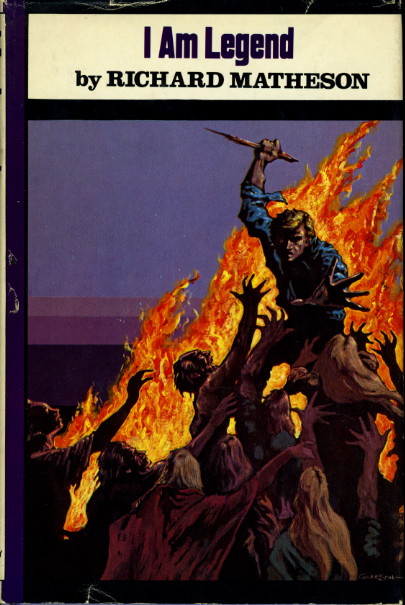
The only time I remembered a character’s hair color was when I read the movie tie-in edition of I am Legend, with a movie scene featuring Will Smith on the cover. Robert Neville, the character portrayed by Smith, is described as having blond hair. That would have made the movie more visually interesting.

movie tie-in

The Robert Neville in my mind didn’t look like Will Smith – not even a blond Will Smith.

older cover

He had the same eye color as this guy, but the hair color was more vague. He definitely didn’t have the huge left hand and/or extra-long left arm.

What the characters do is far more important to me than how they look, unless how they look is a big part of their character or influences their actions. If a character has a third eye, I’d like to know about it. But a third nipple is of less interest, unless a third nipple was clearly stated in the prophesies as the mark of the Chosen One, or three still-warm nipple rings were found at the scene of the murder.

I suppose physical appearance is more important in certain books. Romance novels might need to beef up their men and curve up their women to help sell the fantasy. Maybe that’s why I’ve never seen Pee Wee Herman on the cover of a romance novel.

Our reading preferences shape our writing. That’s why I can’t remember describing the physical traits of many main characters, except for that three-nippled messiah. My characters are like those Star Trek aliens who took whatever form Captain Kirk needed them to take to be able to relate to them. They can assume any appearance you want them to take.

What I must paint them with is a personality. I must make my characters have character, good or bad. I must make the central characters grow, or meaningfully not grow. This is the color on my brush.

Before one of the tens of people who have read my work becomes tempted to think me a liar, I should explain that I sometimes describe the physical traits of minor characters. I do this instead of giving them names. Names are superfluous for characters with walk-on parts (See: “Angry Man in Crowd” in your local movie credits). Referring to a bit player by a dominant physical characteristic makes them more noteworthy than throwing a temporary name label on them.

If I had to describe my central characters, they would all be medium build, medium height, with light brown hair and greenish, blueish, brownish eyes.

If any of characters show two or less dimensions, I’m truly sorry. That’s on me.

Is a main character’s physical appearance important to you as a reader? How about as a writer?

One man’s muse is the same man’s bully

We’ve all heard people talk about how they are compelled to write. Compelled to write? Compelled to roll out of bed every morning and trudge off to work—that makes sense. A job brings in money. But compelled to write? Compelled to struggle with an arrangement of words that stands a snowball’s chance in Hell of ever economically justifying the energy put into it? What twisted mental force would compel a person to do that?

Whatever the force, it is certainly mental, and completely twisted. It’s been inside my head, demanding my lunch money and making me do its homework since I was 12, maybe longer. I wasn’t bullied by kids in school, but I’ve been menaced by the specter of wasted potential all my life. I expect to labor under its threats until I die, leaving the specter forever unsatisfied. My bully’s failure should give me the last laugh, except that I’m kind of rooting for my bully to win. I told you it was twisted.

Bully with wings

Look out, Whiskers! She’s about to put you in a headlock and steal your lunch money. (The Tenth Muse” by John White Alexander.)

Lots of people search the dark corridors of their own minds for that hidden room, bursting with the light of genius (and associated cash and prizes). We’re sure it must be there, if only we could find the door and the key to unlock it. We toil in darkness, every so often glimpsing a fleeting flash that, if not a mini-stroke, must be a reflection of the sparkling key to that door.

We rush to the spot where the flash originated. We throw ourselves down on hands and knees. We grope for that elusive key to the room flowing with the milk and honey of inspiration. When I’m feeling around the dirty floor of my mind for that special key, I am writing. I have to do it. I can’t pass up the chance to unlock the door to my full potential. It means my masterpiece. But there are acres of linoleum inside my head, and some fool installed mirrors on the walls. So the flash could have come from anywhere.

It occurs to me, as I swipe my hands across the grimy floor of my mind, that I should do some mopping. But I always have grander schemes than common housework in front of me at the time. Besides, when I find that key and strike it rich, I’ll hire a cleaning lady. Maybe I’ll even have all the burnt-out light bulbs replaced. I plan to do it up right.

I’m not looking for that shiny, magic key every time I crawl around the floor of my mind. Sometimes I am groping for the rusted key to the room holding the memory of where I left my wallet.

It would be easier to find my wallet, and my hidden potential, if my mind weren’t so cluttered. I’m forever banging my head on other stuff, like bittersweet memories and bits of music or art that once touched my soul. Sometimes I hit my head so hard I see stars, and one of the those stars is always the reflection from the key to the hidden room of light. Bittersweet memories and beautiful art will pull stunts like that. They always get me on my hands and knees again, groping for that key, writing.