Addition by subtraction: ditching the unhelpful words

I’m working my way through the third proof copy of A Housefly in Autumn and it’s making me remember why it took me four or five proof copies to get my other books ready.

I’m always searching for a tweak to make it a little better.

I haven’t noticed any embarrassing mistakes so far on this copy. I haven’t even come across anything that I feel is definitely an error. In spite of this, I have plenty of red pen marks on this third copy already, and I’m not half way through.

What am I marking up then?

Mostly, I’m striking words that seemed necessary at one time, but now just seem like extra words. They are not extra words of the James Fenimore Cooper magnitude. They don’t lead down dead end paths into inescapable thickets. At least in my opinion, they don’t. But they don’t add anything to the potential reader’s understanding of the story either.

An extra wordsmith

James Fenimore Cooper, a man of abundant imagination and even more abundant verbiage.

It’s amazing how many of these words pop up in a novel. And it’s amazing how many edits it takes to get most of them out.

I added a very short scene to beginning of the story prior to this proof. It didn’t change the themes of the tale, but it did slightly alter the tone in which it is narrated. This is the other major category of cross-outs this time around. There are some residual statements sprinkled throughout the book that reflect the previous tone too much. These need to be changed or removed. They are pretty easy to spot, but not always simple to fix.

At the end of this proof, I hope to have an efficient story with a smooth, consistent narrative tone from start to finish. Then I can move on to the really nit-picky stuff on proof number four. Maybe I’ll even have the luxury of revisiting issues I previously vacillated over before deciding. You have to flip a lot of coins in self-publishing. Sometimes you want to go back and flip them over again, not because that gives you a better decision, but it might make you feel like you put enough thought into it.

Meanwhile, I’m not giving up on finding errors. By now, I am the least qualified person to find any errors that remain. My jaded eyes have skipped them before, and they’ll skip them again. I’m counting on other pairs of eyes to bring me errors. I hope they do better than I could do right now, because the consequences of hard decisions I can live with; glaring mistakes are harder to stomach.

The saga goes on. It pains me that it takes so long. I’m disappointed to have missed a Christmas release. But if it makes the book a cleaner, better reading experience it will have been worth every dragged-out day of it.
Valet parking: annoying in real life, worse in fiction

I once read a novel in which Character A was driving to a meeting with Character B. They had a lot of very important things to discuss that would greatly advance the plot. I was eager to arrive at this meeting, because I am all about advancing the plot.

I was all ready to meet Character B and see what fascinating revelations he had for us. I think Character A was all hyped for it too, but what we wanted didn’t matter. The author stepped in to block our way until we had parked the car. We parked in a specific space, in a specific lot, a specific distance from the meeting place.

The spot where we parked the car had no bearing on the outcome of our meeting with Character B. It had no effect upon the story whatsoever. The fact that we drove to the meeting was of no importance. Yet, instead of beginning the chapter discussing juicy topics with Character B, we were made to suffer through parking the car. It made me sad.

It made me sad because I have far less reading time than I would like, and I don’t want to spend it parking cars when there are mysteries to solve – mysteries that have nothing to do with where certain cars are parked. My reading time is precious to me; please don’t make me your literary valet.

Don't park your plot

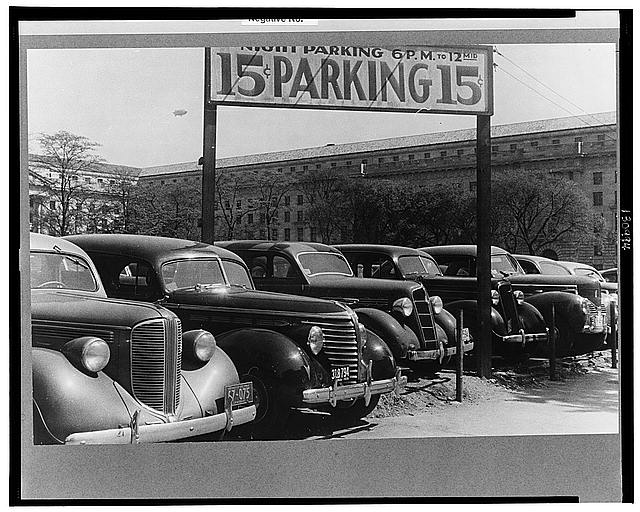
Save yourself 15 cents and a bunch of unnecessary words. Forget about parking and get on with the story. (Image: David Myers/US Farm Security Administration)

Parking cars, ordering coffee, having a particular eye color—these are fine things for characters to do, if they are relevant to the plot or show some insight into the character. Otherwise, they are just more words that are likely to block my path and divert my attention before I finish the book.

My rant is not against a particular book or author. Superfluous activities crop up often in fiction. They are a pet peeve of mine, especially because I am not immune to them in my own writing. The vast majority of writers probably have them in their beginning drafts. Part of the work of polishing a manuscript is locating meaningless actions and destroying them.

It may be impossible for the author to identify all the wasted actions in his own book, but it is crucial that he make a whole-hearted attempt. Each wasted action makes the story less intriguing, or to be blunt about it, more boring. It should be ample motivation for an author to know that every time he crosses one of them out, he makes his story better. Nothing should make hard work more palatable than that.

So, here’s the deal: I won’t make you park my cars, unless it’s crucial to your enjoyment of the story, if you don’t make me park yours. Hell, let’s not even drive if we don’t have to. Fiction is a kind of magic; we can just show up at our meetings when we need to. It will save gas, the environment, and maybe even our respective novels.


I was just too young to love you

Like many American teens, I was the victim of a well-meaning society that used high school English classes to pound an appreciation of classic literature into my head. Like many American teens, I rebelled against this attempt to pry open my mouth and pour culture down my throat. Unlike many who endured this experience, I went back to the well of literature, in my own good time.

I’m lucky. Some unexplainable motivation drove me back into the arms of the people to whom I had been so rudely introduced in high school. The clumsy way these folks were pushed into my face might have put me off reading altogether, as I’m sure it did to some.

Fortunately, I had friends like Edgar Rice Burroughs, who kept me entertained with his less-than-classic adventures. While school was doing all it could to sour me on reading, Tarzan, and an assortment of Martians, kept my nose in books.

Charles Dickens

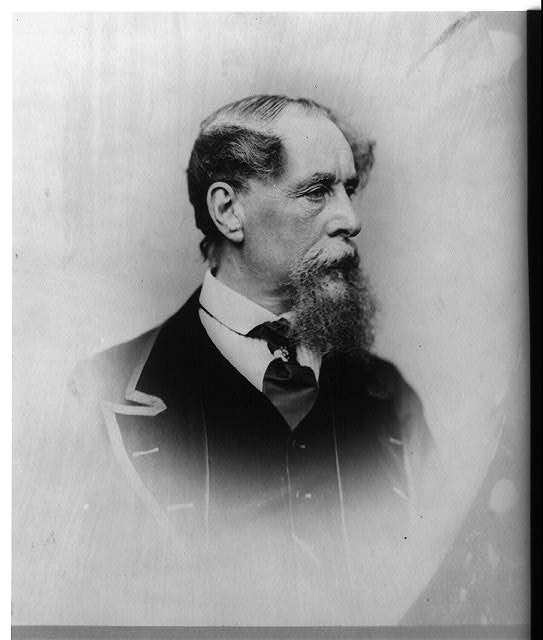
He looks so stern and boring, but he’s a little Dickens on the inside.

This still doesn’t explain why I came back to the “classics.” That was dumb luck. Without luck, I still wouldn’t have a good word to say about John Steinbeck. In school, I hated Steinbeck; I hated that little dog of his; I hated the cob-job of travel trailer he supposedly tooled around America in; and I hated the arrogance that made him think I had the least bit of interest in his vacation. These fires of hatred burned so brightly that they blinded me to the merits of The Red Pony or Of Mice and Men.

Years later, I picked up East of Eden, and read it with actual pleasure – something I had no right to expect, from my past dealings with its author. I re-read Of Mice and Men, a great story, even though I can’t quite put my mind into George’s way of thinking at the end. I’ve never returned to Travels With Charley though, and I doubt I ever will. I’m afraid it would stoke up that dormant hatred again. It was a horrible choice for introducing a young reader to Steinbeck. I get angry just thinking about it.

High school prejudiced me against people I’d never met. Somehow, I got through those years without having been made to read Dickens. This was my great escape. I was sure that Dickens would make me gag, just the same as the other old timers had. It was years before I got brave enough to pick up A Christmas Carol, mostly by accident. For all those years, I had counted a man among my enemies who should have been among my dearest friends. But I suffered from an extended case of Dickens-phobia, along with Shakespeare-phobia, and all the other phobias associated with my forced exposure to books heavier than my immature attention span.

The phobia I’ve never overcome is the one about Shakespeare. Every English teacher in school was determined to make my class appreciate Shakespeare. There was no reprieve from Shakespeare; his ghost haunted every grade level.

william shakespeare

I’m still wary of him after all the kids he humiliated in front of the entire class.

What made Shakespeare so insufferable was the demonic idea that his plays must be read aloud in class. If you can’t despise a piece of literature enough, reading it silently to yourself, just have your 10th grade classmates stumble over the text until even the teacher can endure no more and calls upon someone else to stumble. To this day I cannot read Shakespeare for fear that I will hear a teenager’s tortured voice as he stammers and stutters, banging his shins against those hurdles of words, arranged in an order completely nonsensical to everything he has ever read before.

How many more readers of classic literature would there be if only our teachers had respected the literature a little more, rather than spraying it at us from a fire hose? If a teacher had given me Hamlet and said, “I think you’ve earned this,” I would have put more effort into understanding it. Even if they had said, “You’re not ready for this yet,” I would have wanted to figure out why not. That’s the way I got interested in beer.

My peers and I became devotees of beer, mostly because nobody in authority thought we deserved it. We showed them. Maybe I’ve reached the point where I’ve earned another crack at Shakespeare, but I’m haunted by traumatic memories. Even though I don’t deserve it any more than I ever did, I’ll probably crack a beer instead.

Watch your backstory

I mentioned before the modern requirement that novels begin with a hook. This is the opening bang that grabs the reader’s attention so that he stands a chance of getting to the rest of the book in this age of the short attention span.

Most real stories don’t start with a bang. The stories we hear at parties don’t begin with a crescendo; they build to it (if we are lucky). Jokes don’t begin with a punch line. But we have to look party acquaintances in the face, making it awkward to walk away from their stories after the first sentence.

Nobody thinks you are rude if you walk away from a novel because it doesn’t hook you right away. That’s the advantage polite society has over novels.

The good news for novels is that the hook doesn’t have to be explosions and frantic action. It can be an unusual situation. It doesn’t have to make the reader’s heart race, so long as it makes him curious. The example I used before was that of a character burying a dead body.

Opening with an unusual situation can be more appropriate than actual fireworks for many novels, but it comes with its own baggage. The unusual situation has to be given context; it’s baggage needs to be unpacked. Inside its baggage is a very harmless-looking bundle called backstory.

Backstory never looks, to the author, like something that could blow up on him. There are no lit fuses or open flames. Backstory merely needs to be explained, but if it feels, to the reader, like it is being explained, the result is an explosion of boredom. That’s the anti-hook. Goodbye reader.

Not all backstories are created equal. Some are easier to finesse than others. If the person burying the dead body is a serial killer, the unusual scene can be explained by his future actions. Less background information is necessary.

minimal backstory required

The professional grave digger doesn’t require a great deal of backstory to put his actions into context, and he is probably a more sympathetic character than the serial killer. (Photo: John Vichon)

The situation doesn’t have to be unusual for the character, only for the reader. If the situation is unusual for the character, it will likely require more backstory.

If the character burying the body is someone who never imagined themselves doing such a thing, and will not likely make a routine of it, then the author has to spend more time going backward. How did this character end up in this unlikely spot? This brings heightened danger of putting the brakes on the story as well as confusing the reader.

Backstory is one of the most difficult elements of storytelling to pull off. Yet, when the only people who are allowed to start a story at its beginning are those we can’t gracefully escape, it is necessary. Making the opening scene unusual to the character as well as the reader makes the backstory even more difficult the navigate.

But there is a silver lining.

Novels in which both the reader and the character begin in an unusual spot, have the potential to be the most interesting of all. They can foster a bond between character and reader that the reader is not likely to form with a serial killer. If the author can sprinkle in the backstory carefully enough to interest and enlighten the reader, the story’s potential is well on its way to being fulfilled.

I hope to master the art of backstory someday, because I’m not that much into serial killers.