The first review

Last week I introduced my new novel (out later this month). Today I am sharing a pre-publication review from BookLife. BookLife is the Indie books arm of Publisher’s Weekly.

Every author would love a review filled with phrases like, “Best book I ever read,” “Life-changing,” or “Most influential book of its time.” This review includes none of those phrases. That’s probably a good thing, because if it did contain those phrases, you’d likely wonder which of my aunts writes reviews for BookLife.

Nonetheless, I think it’s a fairly positive review. It has a couple of minor factual errors in the first paragraph, which my aunt would never have made (e.g. substitute “early twentieth century” for “late nineteenth century”), but I don’t think those types of gaffes are rare for the first paragraphs of reviews. Anyhow, I believe the assessment piece is more valuable to readers than the plot summary in any review.

Enough reviewing the review. Here it is.

This fascinating supernatural tale from Nagele (A Housefly in Autumn), told in an offhanded style that keeps readers off balance, opens with five-year-old Emma’s asking, at a family dinner, about “The Other Place.” She has recurring dreams of a mysterious being, The Gatekeeper, who takes her from present-day Pennsylvania to a late nineteenth century farm where she sees an older girl, Mary Ellen, who looks very much like Emma. For mysterious reasons, the Gatekeeper repeatedly forces Emma to get the other girl in trouble by setting fires—and he threatens to harm Emma’s parents, Rob and Marcia, if she disobeys. Rob and MarcFrontia alternate between dismissing Emma’s dreams to fearing that she might be losing her grip on reality, echoing the thinking of Alex and Janet, Mary Ellen’s parents. That couple frequently beats Mary Ellen, as punishment for the fires, and The Gatekeeper urges her to take murderous revenge.

Quick paced and unsettling, The Other Place offers readers teasing mysteries to work through along with Emma’s parents. One surprising thread: what is the connection between The Gatekeeper and the song version of William Hughes Mearns’s poem “Antigonish”? As Emma’s dreams increasingly seem like they might be real, she finds herself inside Mary Ellen’s mind, fighting to keep Mary Ellen from being driven to murder, while Rob and Marcia eventually accept that their daughter is not delusional, they struggle to save both girls from The Gatekeeper.

Nagele weaves an intriguing story about families, childhood, the supernatural, self-sacrifice, and innocence both lost and saved, though the pace and pared-down language come at the expense of fleshing out the characters, especially Emma and her family. Scenes of abuse and terrorized children will put off some readers, but Emma’s fight to save Mary Ellen from evil is admirable, her determination and kindness shining through. The Other Place is rich in detail of the places past and present, and readers of horror-tinged historical mysteries will be intrigued to learn more about Glenn Miller and William Hughes Mearns.
A book in the hand is worth four waiting for edits

The last time I wrote a post here about my writing projects, and I’m ashamed to say how long ago that was, I wrote about a four-book series in which I was knee-deep at the time. The good news is that I finished writing that series. The bad news is all the post-writing difficulties. Professional editing alone represents a prohibitive cost to the production of the set. And that’s just one of the things that needs to happen to the adolescent manuscripts before they can grow up to be big, strong books.

While considering how to embark upon that transition (i.e. banging my head against a wall), I have not been completely idle in other areas, except for blogging, in which pursuit I have been near completely idle. While I have not been blogging, or producing a marketable series, I have been working on this:

Granted, it’s not a series. It’s just a solitary novel. But on the plus side, it has been professionally edited. More to its credit, it has a cover, front and back. It’s even formatted in an easily-readable fashion. It may be a little thing (compared to a multi-book saga), but it’s very nearly done. That is to say, it’s almost an actual book, the kind people could buy and read if the fancy so struck them. And as Hans Christian Andersen was wont to say, “That is certainly something.” (Disclaimer: I don’t really know what Hans said in Danish; but the English translations usually amount to the quote above.)

If I click all the right buttons on the right web pages, this book will be released in May, 2023. If I don’t, it’s off to remedial button-clicking class for me. Anyway, enough about my technology issues, here’s the marketing blurb.

Emma and her parents share recurring dreams, in which they are a different family, living 100 years ago in an unfamiliar place, and heading toward tragedy. When Emma’s parents discover their dream family actually existed, it becomes clear that these visits to the past are more than mere dreams—they are playing an unseen role in this historical family’s lives. As the century-old history of this troubled family materializes, it reveals the truth that the impending tragedy spells doom for both families. Only five-year-old Emma has the power to avert disaster, but it will require extraordinary courage against overwhelming evil for Emma to save both families from destruction in The Other Place.

I will post more updates about this book through its publication. In theory, this will serve the dual purposes of building awareness about the book and making me back into the sort of active blogger I used to be. It may also give me something better to do than bang my head against the wall trying to discover a way to manage the production of four hefty novels in succession. That would be the icing on the cake, but a good cake without any icing would be enough for me right now.

The Series Saga: one book, two books, three books, four

It’s been two years since I posted my first update on what I’ve come to call the Series Saga. At the time of that first update, I’d already been working on the project for more than a year. Now, three years in, I hope I’ve reached the halfway point, but I really don’t know. It’ll take as long as it takes, I guess.

The Series Saga, for those who haven’t been following along, or those who forgot since my last update, 11 months ago, is my quest to turn one over-long novel into a series of novels in a major writing construction project.

READ THE SAGA FROM THE BEGINNING here

As of my last update, the series stood at three books. For reasons I enumerated at the time, I hoped it would not grow to four books.

A lot can change in 11 months. I went from hoping against a fourth book to seeing the need for a fourth book to accepting the fact of a fourth book to writing a fourth book.

I am now slightly more than halfway through writing the draft of the fourth book, which is actually the third book in the series. The chronological fourth book was the first book written. All this jiggery-pokery is explained in the earlier updates (sort of).

The good news is I’m confident I can close all the gaps with this fourth book (a.k.a. book 3) between the third book and the first book, which are actually books 2 and 4 in the storyline. In case you are marking your scorecard at home, this means the second book written is book 1 in the series.

Simple really.

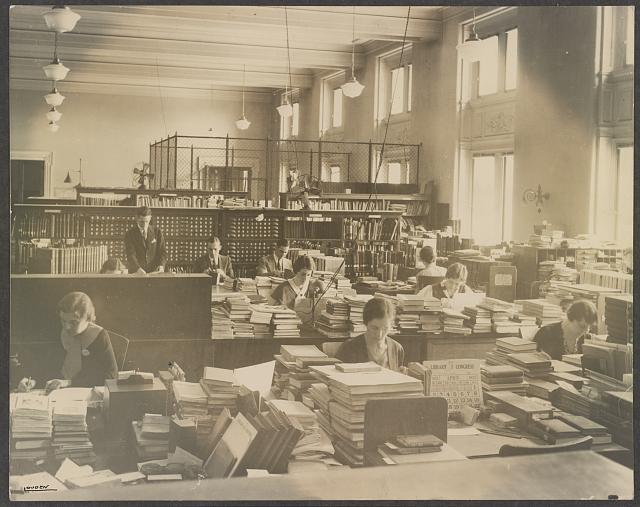
“Mr. Dewey, are we supposed to organize these books in the order they were written, or in the order they fall in the narrative?”

The other good news is nobody needs to know or care in what order I wrote the books. Even if you weren’t marking your scorecard at home, you’re off the hook. The pop quiz has been canceled.

I mentioned, in an earlier update, my belief that it’s probably better to write a series in order. If the above paragraphs don’t illustrate why, nothing will. Every time I want to talk about this project, I feel like I need to make an illustrative chart. Graph paper isn’t on any lists of writing supplies.

Anyhow, I feel pretty good about being able to close out the story with all the pieces fitting into place. I feel pretty bad about what comes after that. Writing a 1200-page story in four self-contained parts shouldn’t be the easy part. I keep telling myself that like it’s going to become the truth.

False.

Writing a 1200-page yada, yada, yada, is the easy part. This makes me a little sad because there’s a part of me that feels like it should be an accomplishment. There’s a part of me that feels like pizza shouldn’t be cooked on a conveyor belt, too, and that part is also often disappointed.

For now, I still have nearly half a book to write, so I guess I’ll try to enjoy what’s left of my breezy fun time.


Tombs of the ancient dreams

It seems appropriate that my last post was about the people in olden times who wrote novels before the age of word processing.  I made a discovery since then that makes me feel closer to them.

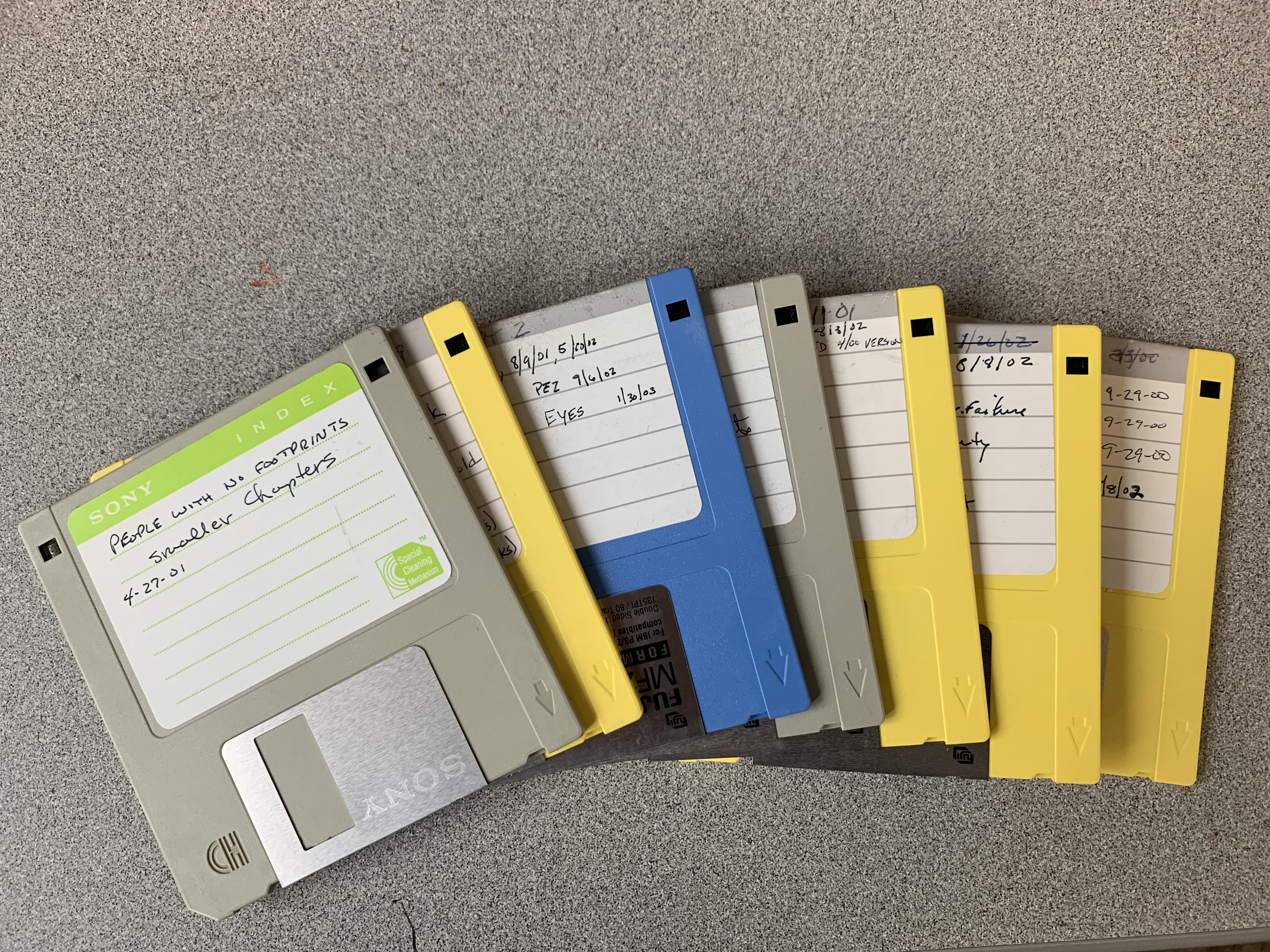
I was searching through a drawer, looking for some object of modern usefulness when I came across a stack of these, tucked into the back corner.

A trove on ancient parchments.

For those too young to recognize this object, it is a floppy disk. It is an object used to store electronic data before the advent of thumb drives and the Cloud.

It is not floppy. Its predecessors were wider, thinner, and floppy. I remember using them too. This ultramodern version is much more durable than the floppy floppies, and likely holds a lot more data, upwards of .1% of what our smallest storage devices hold now, I would guess.

The handwritten notes on my disk labels indicate this group was used between 1999 and 2003. Knowing me, this was probably long after civilized society had given them up. It doesn’t seem like these artifacts could belong to this century at all.

Maybe someday somebody will invent a machine to read these things.

Even though they don’t hold much by today’s standards, words don’t take up much electronic space, so they represent a fair amount of work from a young writer seeking his way. Some of the files they hold were eventually published, but only after years of rewrites. Other files represent work relegated to storage as bits and bytes.

I think I have versions of all these files saved in more accessible places, even though I may never revisit them. I do this for my descendants, in case I become posthumously famous and they need to use my discarded scraps to raise income. With a little industry they may discover these files: “Look, here’s some crap Gramps wrote when he was young. He clearly never meant it to be made public, so we should sell it to a publisher.”

I adore my enterprising great-great-grandchildren, but they should know, before they start counting their chickens, all these novels and stories were written in WordPerfect. My sharp eye for the future of technology determined this format would drive MS Word to extinction as it became the dominant platform with its many advantages.

But I’m sure, in the genius future, there will be a way to convert immature writing from WordPerfect files into cash money.

In the present, I’m not famous, which proves I don’t know how to convert any writing from any file into money. These disks harken me back to those heady days when I thought maybe someday I would figure that out. The amazing thing is I’m still trying to solve that puzzle. It seems some of us don’t know how to let it go and grow old gracefully.