Edgar Rice Burroughs and making pulp fiction classic

Classic is a subjective term. Tarzan of the Apes is included in some classic libraries and excluded from others. None of the 100+ other Edgar Rice Burroughs novels is mentioned in any discussion of classics.

But they are classics to me. Even as a child, I recognized their flaws, but I didn’t care. Burroughs took me to Africa and Mars. Even more, he helped me learn to love to read. To me that makes him a classic writer.

ERB’s books followed common plot arcs: Hero meets Damsel. They are indifferent toward each other. Damsel, unmindful of what meeting the hero in the beginning of an adventure story portends, is careless in her personal security. She is kidnapped by slave traders, or some other impolite group.

Hero flies to Damsel’s aid, not out of any personal regard for her, but because a hero wants employment for his skills. Hero rescues Damsel. They talk a bit more and each comes to the unwilling conclusion that the other has cute dimples or some such endearing trait. Things seem to have turned in a good direction.

Edgar Rice Burroughs - the first author I couldn't put down.

Edgar Rice Burroughs – the first author I couldn’t put down.

Yet, there is trouble brewing. The villains have not yet been brought to justice (i.e. killed in self-defense) and we are only halfway through the book. Tragedy strikes when Hero says something innocuous that is misinterpreted as an insult by Damsel. She storms off, leading Hero to conclude such a mercurial woman isn’t worth his affections, her cute dimples notwithstanding.

This emotional rollercoastering causes Hero to lose focus, allowing the slave traders to capture both. The bad guys intend to croak Hero, while proceeding to auction Damsel to the highest bidder, if the rogue leader can keep his grotesque hands off of her until then. He’s noticed her dimples too, and realizing how mercurial she is, he’s really hot for her.

Hero and Damsel are taken in different directions — he to a gruesome death, she to be ogled by a horrid specimen of humanity, who somehow can’t actually bring himself to touch her, but is upon the point of doing so at every moment. Her torture is magnified by knowing Hero is probably dead by now, and realizing she didn’t actually hate him that much when he was alive. In fact, had it not been for his uncouth behavior . . .

Her hopeless eyes are a big turn-on to the villain. They give him the juice he needs to finally come at her with his filthy, greasy hands. His bulbous nose and his brown teeth, together with the smell of animal fat on his unwashed body, cause Damsel to scream exactly once before closing out the chapter by fainting dead away.

While all this foreplay is going on, Hero is brought to the apparatus necessary for the imaginative killing of heroes that is ever being conceived, yet never actually executed, by bad dudes in the arts. Hero quickly assesses and demonstrates the flaws of the lethal apparatus to his captors by killing them all with its safety defects.

Hero flies to the succor (again) of the insufferable Damsel. Though he may give a passing thought to her dimples, he races to her aid for reasons truly noble. It is, after all, more heroic to rescue somebody he doesn’t like, dimples or not.

Hero interrupts the impending outrage just as things are about to progress to where they cannot be allowed to go in the early 20th century. Though Hero takes no pleasure in dispensing death, the lust-crazed fiend will accept no resolution less than giving complete satisfaction to the incensed reader. But he will not die before advising Damsel that she has misinterpreted Hero’s words toward her.

Content at providing closure, the villain breathes his last. Hero and Damsel realize the foolishness of letting a misunderstanding come between them, and they kiss, with no tongues.

I eagerly followed this plot every time. Maybe I was just young and callow, but that doesn’t matter. I was entertained and my imagination was sparked. It kept me reading. That’s what matters.

Moby Dick – Part I: Somebody should make a story out of this

Having had my mental energy usurped by a recent upswing in the intensity of my day job, it seems the perfect time to reintroduce my critique of Moby Dick from my former web site. It is a two-parter; the first part is impressions of the first half of the book. The second part was written after finishing the novel.

Part I: Half way through Moby Dick

I found a free Kindle version of Moby Dick. Since I am a sucker for finding out what’s going on with the classics, this was a clear incentive to give it a try. I should make it plain that I am only half-way through at present.

Most people think Moby Dick is a long book, but it is actually three long books. The first is a whaling primer, complete with whale classifications, history, and even a couple of chapters on how whaling is depicted in the fine arts. The second book is a defense of the occupation against other mariners, and general society, who may be inclined to look down upon the whaling trade. The third, and smallest, book is a novel, generally touching upon the subject of whaling.

There may be an audience for each of these three books. Unfortunately, the books are all mixed up, hodgepodge, into one. At the beginning of each chapter, the reader takes a spoonful of whale-product pot luck without knowing into which of the three books he is delving.

Three books in one, what a bargain!

Three books in one, what a bargain!

It is common among pieces of 19th century literature to meander into unfortunate asides that interrupt the narrative. Consequently, I am willing to give some leeway on this point. But Melville takes the inch I give and turns it into a mile, educating me on many topics about which I would just as soon remain ignorant, if I could save an hour by doing so. He spent a chapter explaining what’s wrong with the color white.

The storytelling itself (when it can be unearthed) suffers from a major point-of-view problem that would brand any modern author an untutored novice. Moby Dick is narrated by Ishmael, one of the crew of the ship. It does not take long for Ishmael to flee his own skin and flit about as a fly on the wall in places where his body is not present. The narrator describes scenes that Ishmael is in no position to see. Heartened by this omnipotent superpower, the narrator jumps into the heads of Ahab and his three ship’s officers to give us a glimpse of their most intimate thoughts.

You may be asking yourself, “Why has this dolt kept reading, if he finds so many problems with this book?” The answer is that there is one truly bright spot I hope will blossom in the second half.

In the actual narrative portions, when the story is really being told from the first-person, the prose is rather engaging. Melville’s style can be quite charming, as it was for almost three chapters in a row, in between sessions of Whaling 101 class. I’m hoping the last half of the book contains more of this type storytelling and less instruction and thought-reading.

I will continue reading, hoping that Ishmael is satisfied I’m now trained to competently follow the story of a fictitious whaling expedition. If I can also satisfy him that I want a chronicler of events as he experiences them, rather than a mind reader who presents me with every character’s thoughts, we may just be able to get along until the end.

You got a receipt for that beanstalk, Jack?

I’ve written about reading to my kids an edition of The Three Little Pigs that completely ditched any concept of personal responsibility, making the two pig casualties simple victims of fate. The latest fairy tale to make me wonder about its lessons is Jack and the Beanstalk.

As with the pigs, Jack comes in many versions. The one we read was a Golden Books edition, which I think are supposed to be the standard for children’s classics. I hope I’m wrong about this, and there is a Jack with better morals out there.

bad boy Jack

Let’s hope there’s a reform school at the top of this thing.

Jack makes bad choices, but benefits from them. He is absolved of his poor bargaining decisions because of a freak bit of luck. There’s no way he should have traded his cow for a few beans. His mother was right to give him hell about it. Out of a thousand kids who traded for magic beans, 999 of them went to bed hungry and rose hungry the next day, and that was the end of it.

It was pure luck that Jack happened upon the only trader offering legitimate magic beans. This happenstance made a stupid decision look good. It made his mother look like an overbearing scold, when she was really the sensible one. We never hear about Jimmy and the Beanstalk, or Stanley and the Beanstalk. You know why? Because their magic beans were hoaxes. They got spanked and sent to bed. In the morning, they ate dirt for breakfast. No happy ending there.

Jack gets lucky. In the morning there is a giant beanstalk outside his window. Jack climbs it up into the clouds – probably not the wisest decision, but I’ll give him a pass on that one. At the top, he finds a castle. He goes inside. I would too.

Inside the castle, Jack discovers a giant. This giant has two noteworthy possessions: a goose capable of laying golden eggs and a magic harp. Without any hemming or hawing, Jack decides to steal these things. Jack spends so little time weighing the morality of this theft that we cannot tell if he would act similarly in a neighbor’s house, or if this is a special case because giants are different and therefore okay to steal from.

Jack hurries down the beanstalk with his booty. Naturally, the giant chases him. In some versions, Jack chops down the beanstalk; in this one the beanstalk falls of its own accord. This is a relief, since it negates the burden of explaining to my children why Jack stole from the giant and then murdered him. The theft issue is quite enough.

But it’s really not so bad. You see, unbeknownst to Jack, the giant stole the goose and harp from Jack’s dear departed father. It was justice in the end, expunging Jack’s crime of stealing. Again, dumb luck bailed out Jack. Though Jack stole from pure greed, the giant’s estate couldn’t press charges because the items were pilfered by their rightful owner. It all makes me wonder from whom Jack’s father stole the stuff in the first place.

Legally, Jack is off the hook. Morally? Well, that’s a discussion you’ll have to have with your child.

I probably don’t care about your superfluous nipple

Do you care what color eyes the protagonist in a novel has? Is a character whose green eyes shine like emeralds more interesting than one whose blue eyes are mentioned in passing? What about the one whose eye color was never mentioned? What kind of loser must he be?

I don’t care what characters look like. When their physical traits are described, I quickly forget them and picture the character as if he had not been described at all. I paint him as an amorphous, generic human, without any detailed features.

In my mind, the character has no eye or hair color; he is a sort of human silhouette.

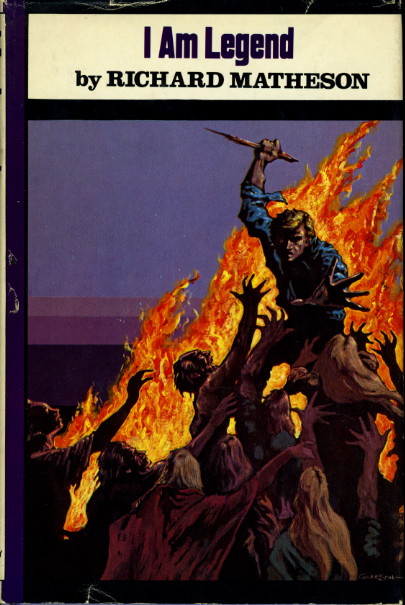
The only time I remembered a character’s hair color was when I read the movie tie-in edition of I am Legend, with a movie scene featuring Will Smith on the cover. Robert Neville, the character portrayed by Smith, is described as having blond hair. That would have made the movie more visually interesting.

movie tie-in

The Robert Neville in my mind didn’t look like Will Smith – not even a blond Will Smith.

older cover

He had the same eye color as this guy, but the hair color was more vague. He definitely didn’t have the huge left hand and/or extra-long left arm.

What the characters do is far more important to me than how they look, unless how they look is a big part of their character or influences their actions. If a character has a third eye, I’d like to know about it. But a third nipple is of less interest, unless a third nipple was clearly stated in the prophesies as the mark of the Chosen One, or three still-warm nipple rings were found at the scene of the murder.

I suppose physical appearance is more important in certain books. Romance novels might need to beef up their men and curve up their women to help sell the fantasy. Maybe that’s why I’ve never seen Pee Wee Herman on the cover of a romance novel.

Our reading preferences shape our writing. That’s why I can’t remember describing the physical traits of many main characters, except for that three-nippled messiah. My characters are like those Star Trek aliens who took whatever form Captain Kirk needed them to take to be able to relate to them. They can assume any appearance you want them to take.

What I must paint them with is a personality. I must make my characters have character, good or bad. I must make the central characters grow, or meaningfully not grow. This is the color on my brush.

Before one of the tens of people who have read my work becomes tempted to think me a liar, I should explain that I sometimes describe the physical traits of minor characters. I do this instead of giving them names. Names are superfluous for characters with walk-on parts (See: “Angry Man in Crowd” in your local movie credits). Referring to a bit player by a dominant physical characteristic makes them more noteworthy than throwing a temporary name label on them.

If I had to describe my central characters, they would all be medium build, medium height, with light brown hair and greenish, blueish, brownish eyes.

If any of characters show two or less dimensions, I’m truly sorry. That’s on me.

Is a main character’s physical appearance important to you as a reader? How about as a writer?