The publishing process made me a better storyteller

Maybe I should have kept up my vigorous regimen of procrastination.

Fortunately, I hadn’t given up procrastination cold turkey, I was gradually easing off it as part of a 112 step program.

While I am waiting for my initial beta reader (wife) to list all the things wrong with the first draft of my latest book, I decided to twiddle my thumbs for a good long while before reworking one of the several unpublished novels I keep tucked away for later.

Incidentally, there are a many things wrong with the first draft of the latest book, so it may take her some time to compile them.

Thanks to the fascinating qualities of my twirling thumbs, combined with confluence of youth spring soccer and baseball seasons, and a big project at work, I have rewritten all of 12 pages in the last two months. The manuscript is more than 400 pages, so those dozen pages seem somewhat measly.

Yet, I am a man who can occasionally find sunshine in little things. (My initial beta reader may disagree with this, but she doesn’t always appreciate the subtlety of my understated sunshine.) I am pleased with what I have accomplished.

There’s a lot in those 12 pages. Mostly, there’s a much more engaging beginning to a story than there used to be.

I finished the draft of this novel about 10 years ago. I didn’t publish it because, though I believed it a good story, it wasn’t everything I wanted it to be and I didn’t know why.

Ten years later, I might have figured out why.

My presentation of the story did not measure up to the story itself.

In those 10 years, I could have written 10 novels and still not learned enough about storytelling. As it happens, in those 10 years, I spawned three children, so I may have changed 10,000 diapers but I didn’t write anything near 10 novels.

"How many diapers?"

“How many diapers?”

But it wouldn’t have mattered if I’d written 20. The thing that made me learn most about storytelling was publishing three books.

Publishing wasn’t a financial windfall by any means, but it was a learning experience, and a valuable one. Knowing I would put these stories before the public made me consider them from angles I’d never had to before. It made me focus on readers: how I took hold of them, how I held onto them, and where I led them. It forced me to act like a professional: to analyze my own work and that of competing writers with new attention to detail. It didn’t mean I was going to attempt to copy the successful ones, but it did make me think about the elements that made them a success.

The act of publishing made me more aware of many things about my books, but more than anything else, it made me constantly reevaluate how I present a story. There’s more to learn, but I’m better than I used to be.

If I can keep up this breakneck pace of rewriting, I may actually turn this old novel into a well-presented story to share in about five years or so.
Moby Dick – Part II: I’m with the whale on this one

The following is Part II of my critique of Moby Dick from my old web site. At this point, I had finished the book, which was quite a relief to me. Last week I posted Part I, written when I was only half way through the novel. If you want to read Part I first, click here.

Part II: Finished with Moby Dick

Previously, I shared some thoughts formed while reading the first half of Moby Dick. Though I was not thrilled with the story, I was determined to finish it. I had seen a faint glimmer of potentially smooth storytelling and was really hoping this potential would blossom into an engaging second half.

Having finished the book, I am here to report that my hopes were dashed upon the rocks of long-winded meandering. The novel peaked somewhere between the 10 and 13 percent marks (as read on Kindle), and never came near reaching those heights again.

Moby Dick is bereft of likable characters. If I had to choose, I would say my favorite (i.e. the least annoying) character was Moby Dick himself. He is my favorite because he shows up for only the last 10% or so of the book, which is also good advice for any potential reader. Unlike Ahab, Starbuck, and all the other prominent, hard-bitten sea-farers, he doesn’t talk too much. I appreciate good dialog in a novel, but these sailors are forever spouting some drivel that means next to nothing. Even when they are not speaking, they are thinking pointless drivel. I wonder if Melville attended the same writing workshops as James Fenimore Cooper.

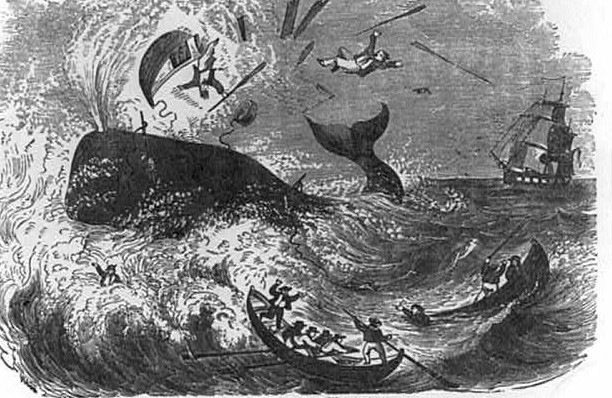
Moby Dick shows up for the climactic final scene, takes care of his business, wagging his jaw no more than necessary to crush a few boats, and then goes home. He wastes no time tripping over insipid attempts to make himself sound intellectual. If only the author could have been half as efficient.

The whale's not much for dialogue. He just takes care of business and goes home.

The whale’s not much for dialogue. He just takes care of business and goes home.

Instead, Melville wanders. At the beginning, it seemed like a major part of the plot would be the unlikely friendship between the Yankee narrator and a partially-civilized cannibal. Yet, by the time the ship shoves off from the dock, the cannibal has become no more noteworthy to the narrator than any other of the harpooners. This may be a blessing in disguise, for if nothing else, it prevented the cannibal from indulging in drawn-out soliloquies.

The author’s focus drifts in the wind throughout the book. Even at the very end, it is still drifting. Melville seems to forget, until it is nearly too late, that the narrator must actually live if we are to put any credence in the story he has just spent way too long relating to us. The narrator is almost certainly floating toward the light when Melville hastily yanks him back into the mortal world with an afterthought of a tale about his unlikely survival of the final battle.

It turns out that the great whale was efficient, but not completely thorough in his actions. He left one man alive to tell the tale. I wonder if he regrets this oversight as much as I do.

It depends on your definition of Horror

I haven’t written about my Work In Progress in a while. And since I’ve got some time to kill while I wait for my last book to become a Best Seller, this might be a good time for an update.

My WIP is a collection of three novellas. It’s probably more accurate to call them two novelettes and a novella, but that takes more words to say, and who’s counting anyway? The genre is horror, kind of. It’s more psychological horror than anything revolving around chain saws and slack-jawed yokels. There’s really not much bloodshed in it at all, which is why I put the “kind of” after horror. I might call the novellas psychological thrillers, except I always think of spies or mobsters when I think psychological thriller, and there are neither of those, so I’m back to horror, kind of.

Poe. Not really his style of horror story.

Not really Poe’s style of horror story.

Then again, genre confusion is nothing new for me.

Whatever they are, I’ve finished the first drafts of all of them.

Yay!

Okay, party’s over; let’s get serious.

I had my first chance to read through them.

The two shorter pieces are entertaining, I think. They are not earth-shattering additions to the genre, whichever genre they happen to be, but I can see readers enjoying them as quick reads.

Definitely not Lovecraft's kind of horror.

Definitely not Lovecraft’s kind of horror story.

When it comes to the longer story, the feature presentation, if you will, I feel as if I’ve provided myself with good news and bad news. The good news is there are parts I think are quite good. The bad news is good parts are not enough to make a good story.

It’s not that the story is bad. It’s not, but as is, it’s not good enough.

What’s wrong with it? Well, for one thing, it’s probably too confusing. Confusing your readers is never good, unless you are an established post-modernist or something like that. In that case, confusing everyone just makes you a greater genius.

But I am neither a post-modernist nor a genius. At best, I am an adventuresome writer, playing with supernatural subject matter for the first time, and I may have gotten the Play-Doh colors all mixed up.

More in line with du Maurier's type of horror . . . but not really.

More in line with du Maurier’s type of horror story . . . but not really.

The fun thing in writing about unknown forces is that you get to make your own rules for what’s possible. Nothing is bound by the laws of physics we know. The trouble can be in remembering your new rules and applying them consistently. Plus, you’ve got to let the reader know the rules; they can be difficult to convey, without explicitly explaining them, when they are counter-intuitive to commonly known laws of nature.

Can this book be saved? I don’t know. I may be going too hard on myself, or too easy. I’ll have to get a second opinion, and then a few more after that.

All I know for sure is that I won’t even consider publishing it until I’m confident it’s a good quality, entertaining book, all the way through. How I get there from here will be my own horror story.

You got a receipt for that beanstalk, Jack?

I’ve written about reading to my kids an edition of The Three Little Pigs that completely ditched any concept of personal responsibility, making the two pig casualties simple victims of fate. The latest fairy tale to make me wonder about its lessons is Jack and the Beanstalk.

As with the pigs, Jack comes in many versions. The one we read was a Golden Books edition, which I think are supposed to be the standard for children’s classics. I hope I’m wrong about this, and there is a Jack with better morals out there.

bad boy Jack

Let’s hope there’s a reform school at the top of this thing.

Jack makes bad choices, but benefits from them. He is absolved of his poor bargaining decisions because of a freak bit of luck. There’s no way he should have traded his cow for a few beans. His mother was right to give him hell about it. Out of a thousand kids who traded for magic beans, 999 of them went to bed hungry and rose hungry the next day, and that was the end of it.

It was pure luck that Jack happened upon the only trader offering legitimate magic beans. This happenstance made a stupid decision look good. It made his mother look like an overbearing scold, when she was really the sensible one. We never hear about Jimmy and the Beanstalk, or Stanley and the Beanstalk. You know why? Because their magic beans were hoaxes. They got spanked and sent to bed. In the morning, they ate dirt for breakfast. No happy ending there.

Jack gets lucky. In the morning there is a giant beanstalk outside his window. Jack climbs it up into the clouds – probably not the wisest decision, but I’ll give him a pass on that one. At the top, he finds a castle. He goes inside. I would too.

Inside the castle, Jack discovers a giant. This giant has two noteworthy possessions: a goose capable of laying golden eggs and a magic harp. Without any hemming or hawing, Jack decides to steal these things. Jack spends so little time weighing the morality of this theft that we cannot tell if he would act similarly in a neighbor’s house, or if this is a special case because giants are different and therefore okay to steal from.

Jack hurries down the beanstalk with his booty. Naturally, the giant chases him. In some versions, Jack chops down the beanstalk; in this one the beanstalk falls of its own accord. This is a relief, since it negates the burden of explaining to my children why Jack stole from the giant and then murdered him. The theft issue is quite enough.

But it’s really not so bad. You see, unbeknownst to Jack, the giant stole the goose and harp from Jack’s dear departed father. It was justice in the end, expunging Jack’s crime of stealing. Again, dumb luck bailed out Jack. Though Jack stole from pure greed, the giant’s estate couldn’t press charges because the items were pilfered by their rightful owner. It all makes me wonder from whom Jack’s father stole the stuff in the first place.

Legally, Jack is off the hook. Morally? Well, that’s a discussion you’ll have to have with your child.