Sole survivor little pig laments brothers’ misfortune

My sons have a Three Little Pigs book. I thought this was the same story I had known as a child. But after reading it for the 300th time, I decided it really isn’t the same story.

It’s like the same story. The pigs build houses out of different materials, and the big, bad wolf summarily blows them down, or not, depending upon the construction rating of the materials. Yet there is one key element missing that makes it completely different from the story I knew.

In the story I recall, the straw pig and the sticks pig were warned that their materials were inadequate in the face of the wolf’s hurricane threat. The pigs go on to use these substandard materials in open mockery of the danger.

In my kids’ book, the pigs are turned out of their mother’s house as young adults, with no discernible construction know-how. They build their respective houses of the first materials they encounter, and they do a fine job, considering their lack of both experience and hands. No one advises them, and they are unaware of the danger posed by the wolf. This small difference changes the entire meaning of the story.

Pigs who are warned about the dangers of cutting corners in their construction projects, make the story about consequences of lazy, negligent decisions. These pigs ignored the risk because taking it into their calculations was inconvenient. They wanted quick and easy housing, so they took out the fairy tale equivalent of interest-only mortgages.

The straw and sticks pigs lived just long enough to realize the error of their ways, because there are no second chances for foolish fairy tale pigs. Their flimsy houses were no protection against the wolf and they were eaten up. This harsh punishment is why it is important to learn life’s lessons quickly.

The third little pig took his time and did it right. Hard-working and conscientious, his reward was not that he became a reality show star, or undeservedly wealthy. His reward was simply that he did not get eaten up. He lived on in the security of his sound judgment and prospered through the sweat of his own brow. But most importantly, he didn’t get eaten up.

There is a clear connection between actions and consequences in this story.

The pigs live

In this Disney film version, the two lazy pigs actually mock the third pig’s industry. They all take refuge in the house of brick and survive. Judging by the wall art, they are more fortunate than their father.

When the pigs are not warned about the quality of their building materials, the end results are much more dependent upon fate than upon the respective decisions of the pigs.

Each of the pigs uses the first building material he finds. No one says, “You know, for a little extra money, you could go with brick and really up your anti-wolf rating.” The material used is the result of happenstance.

The third little pig is just plain lucky. He happens upon a cart of bricks. He acts exactly as the others acted, and his life is saved by circumstance. He is not eaten up only because he was in the right place at the right time.

There is a certain amount of right place, right time in life, but our actions affect the chances of our being in that sweet spot. I don’t want my boys stumbling upon random materials out of which to build their lives, thinking there’s nothing to be gained by doing a little work to find out which is best. Sometimes it feels like the big bad wolf is bound to eat us up no matter what we do. But we have the power to give ourselves a fighting chance, if we work at it.

I’m going to have to warn those pigs myself. I’m going off script, old school. Those pigs will know exactly what they’re getting themselves into. So when two get eaten up, it will still be sad, but we won’t be mourning a tragedy devoid of rhyme or reason.
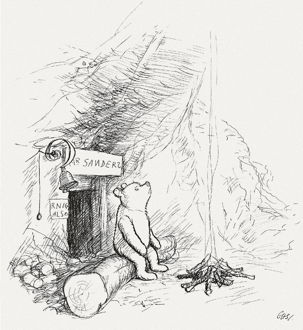
He was a good bear before Hollywood got to him

As a child, I never took interest in Winnie-the-Pooh. My only exposure to what seemed a hopeless band of anthropomorphic misfits was television. TV convinced me Pooh was merely a chubby ne’er-do-well with no sense or self-discipline, who would accidentally strangle himself if left to his own devices.

His friends were no more interesting. There was some kind of mule with chronic fatigue syndrome, whose pity parties wore thin. There was a pig in a sleeveless jumpsuit, and a boy who looked like he needed to eat some meat and potatoes.

I don’t remember all the characters because I never enjoyed the films. I began avoiding Winnie and his crew. I avoided them without a backward glance for about 40 years.

Then a thoughtful person gave my son a Winnie-the-Pooh storybook. I had never consider Pooh as literature because I’d been turned off by him as television. Having seen what Hollywood did to Tarzan and The Little Mermaid this isn’t surprising.

When my son asked me to read from his Winnie-the-Pooh treasury, I winced. I wanted to make up the story instead of reading it. I wanted to say, “Once upon a time there was this ridiculous bear who only wanted honey, and since he had no sense and he could not control his desires, he got his head stuck in a pot of honey and had to live with his head inside the pot for the rest of his pitiful life. The end. And let that be a lesson to you, young man.”

I did not say this; that would have been lazy parenting, and the boy’s mother was sitting within earshot. I did the honorable thing: I tried persuading the boy he would prefer Green Eggs and Ham. When that failed, I sighed and began reading.

To my surprise, the literary Winnie-the-Pooh is quite well done. This Milne fellow knew how to tell a story with charm. Winnie is not nearly so vacuous as in his films. He makes up witty little songs, and though he possesses less forethought than is to be hoped, he does spend some time on afterthought.

Humble Winnie

They were simple times, before all the glamor and glitz, but they were good times. (Image: E. H. Shepard)

Rabbit’s desire to keep his home free of unwanted visitors is relatable to any middle-aged man. The only thing that would make him more perfect is if he came to the door waving an 80-year-old shotgun he never owned shells for.

I remember Piglet to have been portrayed as cowardly on TV. TV didn’t uncover the real depth of Piglet. Piglet has a keen sense of discretion. He is willing to accompany Pooh in pursuit of a couple of potentially hostile Woozles, but when he and Pooh are outnumbered he reads the writing on the wall. Piglet knows how to count and when to cash out. Now, if only he would cash out of that 1920s bathing suit.

We haven’t met Eeyore yet. No doubt, he will turn out to be a grizzled veteran of the Boer War, suffering from a tail wound and in constant pain from a bullet lodged in his hip. What once seemed like incessant complaining will surely be words of wisdom from a hero of the siege of Kimberley.

Though we got off to a rocky start, I like Pooh now. I like the way his stories are written. There is a unique talent for storytelling in the books. I hope it doesn’t take my boys 40 years to appreciate that.

Discovering the magic of Story

I mentioned last December that I was reading A Christmas Carol to our six-year-old at bedtime. Until then, we’d been reading children’s books. I could knock off a children’s book in under five minutes, kiss him, tuck him in, and be back downstairs without missing too much action from whatever sporting event I was watching.

It was great for me as a sports fan, and it kept up the routine of a bedtime story, but there wasn’t much else to it. Meanwhile, the boy was progressing as a reader in his own right, but he viewed reading as a chore.

As I read him the original version of A Christmas Carol, I noticed he paid more attention, rather than just counting it as time spent with Daddy, and more importantly, a precious delay in bedtime.

Maybe he needed something more engaging than the average children’s book when not doing the hard work of reading himself. Maybe he didn’t enjoy reading because he’d never been hooked on the idea of Story. He’d never been bitten by the bug that makes a person need to know what happens next.

After Christmas, instead of going back to children’s books, we moved on to Grimm’s Fairy Tales. As with Dickens, we stayed away from watered-down versions. We went full-strength, with all its violence and villainy. If you think this is too much ugliness for an innocent first-grader, just listen to a few of them have a conversation or look at what they’re watching on TV.

Admittedly, the lessons of Grimm’s are sometimes questionable. In the story about the shoemaker’s elves, the elves do wonderful favors for the shoemaker, right up until the shoemaker shows his gratitude by leaving them presents. His presents motivate the elves to abandon him, leaving the impression he would have been better off as an ingrate.

But these iffy morals lead to questions. They let us talk about the story, which the children’s books seldom did. They make us think.

I bought a kids’ version of Grimm’s for him to read to me. For a while, reading it was something he wanted to be rewarded for. The other day, he told me he’d read ahead, on his own – something he’s never done before. He’s started reading to me at bedtime.

Grimm's for all ages.

Nighttime reading for father and son.

Maybe he’s just naturally maturing, or maybe he’s discovering the magic of Story; maybe both.

I’m saving Hans Christian Andersen for when we’re done with Grimm’s. I want him to be a practiced listener when we get to Andersen. While many of the lessons of Grimm’s boil down to “Don’t be stupid” or “Watch your back,” Andersen’s morals are often less ambiguous, while at the same time, more complex. There are tales of self-sacrifice, which is not only a good thing to hear once in a while, it usually makes for an interesting story.

Hans

Give us a little magic to dream on, Mr. Andersen.

Hans Christian Andersen resides in my personal Pantheon of Storytellers. I’m not sure how comfortable he is there, wedged between Twain and Thurber, but that’s his problem. I’m hoping he can foster a love of Story in my son, and maybe even get him to like reading a little. You’ve got to admire anybody who’s still giving out gifts 140 years after his death.

The Third Novella: a horror story about writing a Horror story

Writing a book is a solitary sport. Publishing a book is anything but solitary. You need a lot of people to help you. Even when you are lucky to have diligent people helping you, everything takes time, which means you will wait through various periods for them to do their work before you can get the thing published.

About 18 months ago, while I was waiting for some beta readers to go through A Housefly in Autumn, I decided that starting a new book would be more productive of my time than twiddling my thumbs.

I envisioned a book consisting of three novellas of a genre very different from A Housefly in Autumn. These stories would be contemporary and not suited to young adults. They are my nightmares, the ground where parenthood meets horror.

Though not horror in a gory sense, they are dark enough to put them into a genre in which I have not written since high school. Back then, I was completing creative writing assignments, not contemplating an eventual published book.

I finished the first two novellas in accordance with the vague plan in my head. The third came third because it was less well-developed in my mind, so I let it marinate while I finished drafts of the other two. When the third’s turn came, I had sat on it long enough to know that it would not develop further until I started to write it.

As I waited to get the cover art for Housefly, I began the third novella. Little by little, it picked its way through the forest of words until it found its trail of plot. It began to come together, the story itself inspiring new elements to fill in its missing pieces.

The ending still floated on the mist, but as I got closer, I began to see outlines of solid shapes in that mist. I was fitting it all together in my mind.

Then I got some really fantastic artwork for Housefly. It was time to start laying out the actual book that had always just been a manuscript. The new project got pushed to the back burner. When you have three little boys at home and a full-time day job, the back burner is off.

The third novella stopped cold. What time I could muster was applied to getting Housefly through the next steps.

I don’t outline. This works for me, except when it doesn’t.

Waiting for help on the last proofing of Housefly, I went back to that third novella. After six months, I didn’t recall which i was undotted and which t uncrossed.

I’d have to go back and read it. I didn’t like to because I prefer to get through the first draft before I read, and I was afraid of what I would find in my first mature attempt to write horror, even watered-down horror.

So far, I’ve read through about one-third of it. It’s not as bad as I feared. Now if I can only re-figure out how it ends, I might actually start to like it. Horror doesn’t scare me so much anymore.

the third novella

The Third Novella. That could be the title of a horror story. Anyway, this third novella is waiting to be finished.