What could be better than Mr. Magoo?

In my last post, I mentioned that I am reading A Christmas Carol to my son. I want him to know the original text. Here’s how I discovered the original.

I first stumbled across A Christmas Carol one January when I worked at a bookstore. Normally, mid-January is not the best time to read a Christmas tale, but for a retail worker, that is about the time when you finally are allowed to enjoy the Christmas season, so it was not an untimely find.

I found it among some unsold Christmas books, pulled from the shelves when their season passed. Having nothing better to do on my lunch hour, I began to read. I’d never read Dickens in school and I thought I had done well to avoid him. I’d known the plot of this story since toddlerhood, when Mr. Magoo performed it for me. I expected to find that this Dickens fellow had merely supplied a stiff, uninspired outline that Mr. Magoo had turned to gold with his top-of-the-line production values and his sterling acting ability.

I was mistaken. I found myself engrossed in an excellent story, beautifully told. Dickens did not bore me; he charmed me. If I had not loved this story until that point in my life, it was only because Mr. Magoo, and all the many Scrooges in film, had not done it justice. It was hard to think of old Magoo in this light, but the printed pages told the truth of the matter.

Scrooge Magoo

Even a genius of entertainment like Magoo couldn’t match the the magic of the original.

There is a reason why A Christmas Carol has endured for 170 years, and it is not because Mr. Magoo and Scrooge McDuck waste their valuable time remaking narrative duds. You can’t throw a cherry cordial in a department store without hitting a DVD knock-off version. I use knock-off glibly because even the best film versions are knock-offs compared to the original text. People out to make a quick buck repackaging an old product don’t pile onto a loser.

A Christmas Carol endures because it gets so many of the elements of story-telling right. The plot arc is a pristine bell curve of narrative art. There are no awkward outliers to skew the meaning, nor burrs of unresolved plot points. The narrative moves forward with purposeful strides through every scene.

The writing is colorful, witty, playful, and endearing. These are not words often associated with Victorian works, which is why the book surprised me so much. The greatness in the work is that the writing is also very powerful. Combining playful and powerful is a rare accomplishment in any era.

If a traditional plot arc is not your thing, A Christmas Carol may not be your favorite. I wouldn’t argue with that opinion, but I would suggest that any time you read a Christmas story about a character’s redemption, that character is probably a long-lost grandchild of Ebenezer Scrooge.

The Ghost of Storytelling Past

I’m reading A Christmas Carol to my six-year-old at bedtime every night. I could have picked up a children’s version for him, but I’m going with the original, even though much of it will fly over his head.

I made this decision for three reasons:

  1. I’m cheap and didn’t want to buy another version of a book I already own.
  2. I’m not a fan of watered down versions of books. If the boy opts for a children’s book, we’ll choose one that began as a children’s book.
  3. I think one of the parts that is the first to be cut in the children’s versions is one of the parts I most want my children to hear.

Reasons 1 and 2 are self-explanatory. Let me explain reason 3.

A Christmas Carol is a brilliant story. It wouldn’t have been made into a million different movies if it weren’t. There’s so much to love about it, and so much to like in many of its offspring films. But there is one thing that the original text has that nothing else does.

Dickens

The beautifully illustrated edition we read.

The original has Dickens himself as the storyteller.

I’m not just talking about his genius with words. I’m not just talking about his ability to set a tone or his command of the narrative. I’m talking about those instances when the narrator comes onto the page and speaks directly to the reader. This is an ancient form of magic, all but lost to us now.

It is a relic of the time when children heard stories at their elders’ knees, when stories were enriched by the personality of the storyteller.

You can’t do that today. We won’t stand for it. We want our stories delivered anonymously, not chuckled to us by a narrator who presumes to refer to himself in the first person. We don’t want it to smell of grandpa’s after shave; we want an antiseptic story to be beamed through the vacuum of space, like it is on TV.

We want to be shown, not told.

Now, I will be the first admit that some of the old fellows did too much telling. I will also agree that showing is far more effective than telling in our time, when much of the art of storytelling has been lost. But I will argue that there is a mix that includes both showing and telling that is the rarest treasure in the unveiling of a story.

Dickens was a master at the mixology of show and tell. And who could appreciate show and tell more than a first grader? Okay, maybe a kindergartener, but what’s done is done.

I want to offer my children the chance to hear the storyteller’s voice — to appreciate when a story is even better because of who is telling it and what his character adds to the telling.

Maybe they won’t catch it this year, but there’s always the next. And besides Dickens, we’ve got lots of Hans Christian Andersen to get to.

Valet parking: annoying in real life, worse in fiction

I once read a novel in which Character A was driving to a meeting with Character B. They had a lot of very important things to discuss that would greatly advance the plot. I was eager to arrive at this meeting, because I am all about advancing the plot.

I was all ready to meet Character B and see what fascinating revelations he had for us. I think Character A was all hyped for it too, but what we wanted didn’t matter. The author stepped in to block our way until we had parked the car. We parked in a specific space, in a specific lot, a specific distance from the meeting place.

The spot where we parked the car had no bearing on the outcome of our meeting with Character B. It had no effect upon the story whatsoever. The fact that we drove to the meeting was of no importance. Yet, instead of beginning the chapter discussing juicy topics with Character B, we were made to suffer through parking the car. It made me sad.

It made me sad because I have far less reading time than I would like, and I don’t want to spend it parking cars when there are mysteries to solve – mysteries that have nothing to do with where certain cars are parked. My reading time is precious to me; please don’t make me your literary valet.

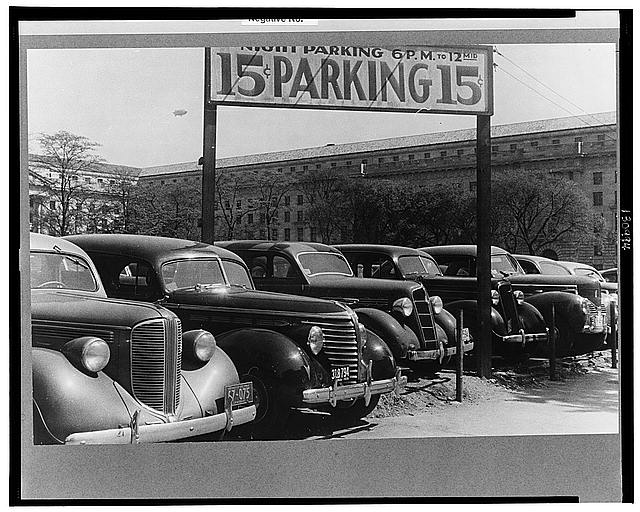
Don't park your plot

Save yourself 15 cents and a bunch of unnecessary words. Forget about parking and get on with the story. (Image: David Myers/US Farm Security Administration)

Parking cars, ordering coffee, having a particular eye color—these are fine things for characters to do, if they are relevant to the plot or show some insight into the character. Otherwise, they are just more words that are likely to block my path and divert my attention before I finish the book.

My rant is not against a particular book or author. Superfluous activities crop up often in fiction. They are a pet peeve of mine, especially because I am not immune to them in my own writing. The vast majority of writers probably have them in their beginning drafts. Part of the work of polishing a manuscript is locating meaningless actions and destroying them.

It may be impossible for the author to identify all the wasted actions in his own book, but it is crucial that he make a whole-hearted attempt. Each wasted action makes the story less intriguing, or to be blunt about it, more boring. It should be ample motivation for an author to know that every time he crosses one of them out, he makes his story better. Nothing should make hard work more palatable than that.

So, here’s the deal: I won’t make you park my cars, unless it’s crucial to your enjoyment of the story, if you don’t make me park yours. Hell, let’s not even drive if we don’t have to. Fiction is a kind of magic; we can just show up at our meetings when we need to. It will save gas, the environment, and maybe even our respective novels.


Watch your backstory

I mentioned before the modern requirement that novels begin with a hook. This is the opening bang that grabs the reader’s attention so that he stands a chance of getting to the rest of the book in this age of the short attention span.

Most real stories don’t start with a bang. The stories we hear at parties don’t begin with a crescendo; they build to it (if we are lucky). Jokes don’t begin with a punch line. But we have to look party acquaintances in the face, making it awkward to walk away from their stories after the first sentence.

Nobody thinks you are rude if you walk away from a novel because it doesn’t hook you right away. That’s the advantage polite society has over novels.

The good news for novels is that the hook doesn’t have to be explosions and frantic action. It can be an unusual situation. It doesn’t have to make the reader’s heart race, so long as it makes him curious. The example I used before was that of a character burying a dead body.

Opening with an unusual situation can be more appropriate than actual fireworks for many novels, but it comes with its own baggage. The unusual situation has to be given context; it’s baggage needs to be unpacked. Inside its baggage is a very harmless-looking bundle called backstory.

Backstory never looks, to the author, like something that could blow up on him. There are no lit fuses or open flames. Backstory merely needs to be explained, but if it feels, to the reader, like it is being explained, the result is an explosion of boredom. That’s the anti-hook. Goodbye reader.

Not all backstories are created equal. Some are easier to finesse than others. If the person burying the dead body is a serial killer, the unusual scene can be explained by his future actions. Less background information is necessary.

minimal backstory required

The professional grave digger doesn’t require a great deal of backstory to put his actions into context, and he is probably a more sympathetic character than the serial killer. (Photo: John Vichon)

The situation doesn’t have to be unusual for the character, only for the reader. If the situation is unusual for the character, it will likely require more backstory.

If the character burying the body is someone who never imagined themselves doing such a thing, and will not likely make a routine of it, then the author has to spend more time going backward. How did this character end up in this unlikely spot? This brings heightened danger of putting the brakes on the story as well as confusing the reader.

Backstory is one of the most difficult elements of storytelling to pull off. Yet, when the only people who are allowed to start a story at its beginning are those we can’t gracefully escape, it is necessary. Making the opening scene unusual to the character as well as the reader makes the backstory even more difficult the navigate.

But there is a silver lining.

Novels in which both the reader and the character begin in an unusual spot, have the potential to be the most interesting of all. They can foster a bond between character and reader that the reader is not likely to form with a serial killer. If the author can sprinkle in the backstory carefully enough to interest and enlighten the reader, the story’s potential is well on its way to being fulfilled.

I hope to master the art of backstory someday, because I’m not that much into serial killers.