The AI bots offer to save me from obscurity

I hope an AI program is saving somebody’s life in a hospital right now, because it’s not doing me any favors.

I’m at the age when you develop a natural suspicion of a new technology, but I’m still young enough to recognize when somebody is using it to try to make a quick buck off me.

I hoped I could live in blissful ignorance of AI until the day when Skynet sends Arnold Schwarzenegger back in time to wipe my puny human blot off the face of the Earth.

No such luck.

I’ve begun getting random emails, clearly AI-generated, from fake people extoling the countless virtues of the books I’ve written.

The emails contain more detail about the plots of the novels than a person could glean in a reasonable time from reviews and samples, but less and different details than a real person would mention after having read any of the books.

Also, the flattery is at a superhuman level.

The flattery is important because the purpose of each email is to convince me to pay the bank account behind the machine to help me find the audience my novels so richly deserve.

The “author” of the email claims to be the “curator” of a 2500 highly-motivated readers and reviewers. And how would you like for this “curator” to share your amazing novel with this hungry group?

I don’t normally respond to this type of thing, but one of them was particularly persistent. I let her know that she was free to share the book she loved so well with anyone she thought would be interested.

As you might expect, her reply included the price list for this group of book-lovers. Her voracious readers were on sale for $25 each. Yes, that means I pay people $25 to read my work.

I figure this must be the new math they got in schools now.

In my own way, I told her no thank you.

I can buy as many as I want for $25 each.

But she kept sending emails. I should mention that her emails contained a mildly sexy photo of a young woman in the signature. I think that was supposed to make me believe the picture was her, and perhaps I would be more willing to throw money at a mildly sexy young woman and her brothel of literary prostitutes.

I was not.

I did show the picture to my wife, who is mildly concerned that pictures of mildly sexy young women will induce a mildly dangerous heart attack within her mildly aging husband.

The sleuth I married initiated a web search of the alleged mildly sexy woman and came up with nothing. Apparently, the 2500 readers are all curated old school, because it’s not happening online. My wife also noticed that the name in the signature was spelled mildly differently from name in the email address.

I have not responded since. I’ve even stopped looking at the picture of the mildly sexy woman AI scraped off the web. That’s when you know you’ve lost me.

I have every reason to be satisfied with the transaction. At $25 per head, I’ve saved a lot of money on all the people who have never read my books. That’s a small fortune.

Plus, I feel better about our coming war with the machines knowing the cyborgs still haven’t mastered spell check.
Free isn’t worth what it used to be

It’s been two months since I ran the free ebook promotion I detailed in my last post. To summarize, I gave away about 3,400 Kindle copies of my latest book, The Other Place.

I had hoped that 1% of the people who downloaded the free copy would leave a review on Amazon.

Did I get those 34 reviews?

No. Not yet anyway.

I’ve received one review since the giveaway.

I did get about 15 ratings, but those are less useful than text reviews.

So I’ve been thinking about my lack of reviews. Is 1% too high a target? There was a time, I think, when 1% was a reasonable expectation, but I now believe that time is gone.

I can download 6 free books a day, but I can’t read 6 books a day.

When I purchased the Freebooksy promotion, I joined the email list that goes out to subscribers. An email appeared in my inbox every day with an average of six free ebooks featured per email (and this is just from one organization).

Personally, I don’t like clutter, real or virtual, so I am not inspired to download a book I’m unlikely to read, even if it is free. Not that there’s anything wrong with it, but I know there are lots of folks who will take free stuff on the chance it may someday be used.

I think it’s also human nature to be more careful to use something you paid for as opposed to something you grabbed on impulse because it was free.

In the days when free ebooks were less plentiful, a 1% review rate was probably reasonable. Now, free downloads come fast and furious, and it’s impossible for most readers to keep up with reading all, or perhaps even a fraction, of what they have collected for free.

Ratings make feedback quick and easy (and less meaningful)

Once upon a time, the only way for readers to submit feedback for books sold on Amazon was to leave a review. Now users can leave a star rating without a text review. This may lead to more ratings from readers who haven’t the time or disposition to write a review, but I think it also leads to fewer reviews now that one click is enough to register one’s opinion.

We must be mindful that Amazon reviews do not exist for authors. They are there as a guide to future customers. Authors are definitely more obsessed with them than customers are, but that doesn’t change their purpose.

Still, an author cannot help being disappointed at not having a more useful guide in place for potential customers. As a customer, I know that ratings are less meaningful information than reviews are.

Who is to blame?

Who is at fault for this disappointment? Not Freebooksy. They helped me give away as many copies as I could expect and more. Not the readers who downloaded the free copies. Those copies are theirs now and they are free to do, or not do, with them as they wish. They don’t owe me a review, a rating, or anything else.

I guess that leaves me. My expectations were not properly calibrated for the time and place in which I am doing business.

But now they are. You live and learn.

Buying eyeballs at 5 cents a pair

Indie authors learn to take their victories where they can. Every improvement, in terms of drawing attention to your work, is a victory. It doesn’t matter that it might be a blip in the road to an author supported by a major publishing house. Everything is relative. They key is to be going in the right direction.

As a small fish in a big pond, it often becomes more important to count eyeballs than to count money. Maybe someday you’ll be able to count money in a meaningful way, but first you need the eyeballs.

Counting a worthwhile number of eyeballs means discounting books, often to the point of giving them away. An author who has sunk a certain amount of money into producing a book would like to be able to recoup some of that investment, but that may have to wait.

I’ve given away books before (or maybe I should say, attempted to give away books). I have finally come to accept that it takes a monetary investment to effectively give away books. It’s not enough to make your ebook free on Amazon for a few days. There are thousands of ebooks available for free download on Amazon every day. It’s easy to get lost in that mass, and consequently, not be able to give it away.

It was difficult to reconcile myself to the idea of spending money to give something away for free. I finally bit the bullet and chalked it up to another part of the investment necessary to producing a book.

I spent $179 for concurrent 1-day campaigns on Freebooksy and The Fussy Librarian. This included having my most recent book featured on each website and included in an email to each site’s subscribers. I used KDP Select to make my ebook free for the 3 days surrounding these campaigns.

I really didn’t know what to expect. I thought 300-500 downloads would be great.

The first day my ebook was free (pre-campaign), downloads totaled 5 copies.

The second day (campaign day), downloads totaled slightly more than 3,000 copies.

The third day (post campaign), 400 more copies were added to that total.

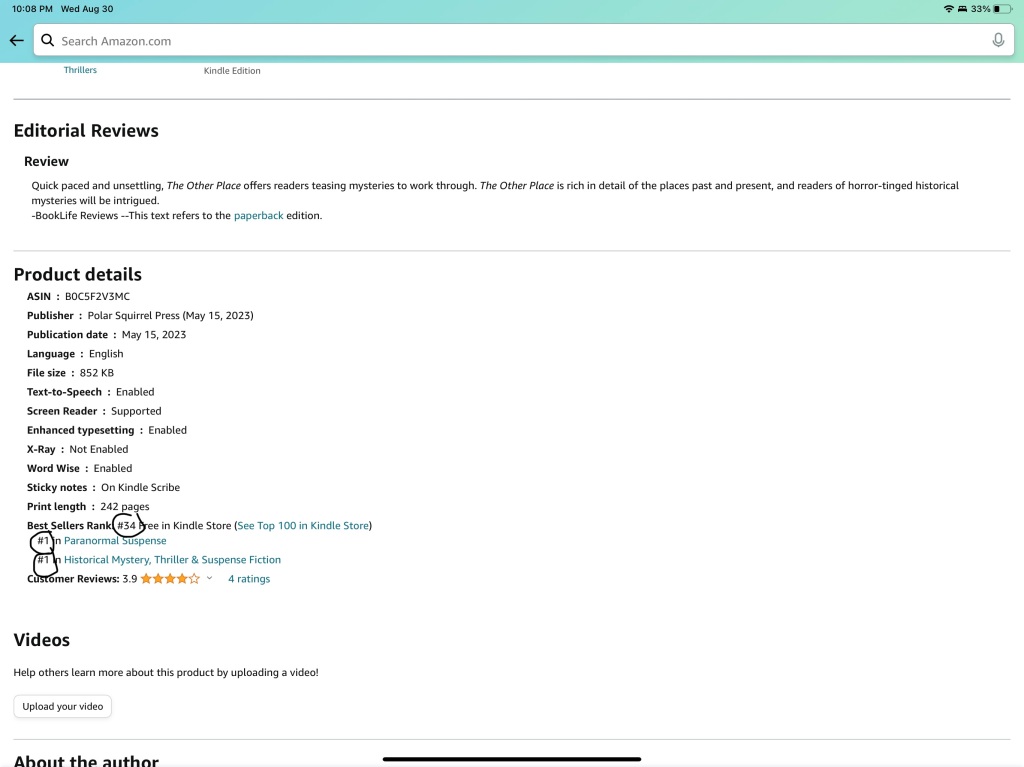
My high-water mark was actually #30 in the Free Kindle Store. This was a better result than I expected.

Okay, I spent $179 giving away 3,400 books; what does that do for me?

Time will tell, but if 1% leave reviews, that’s 34 reviews. My hope is that those reviews will provide some of the objective persuasion necessary to convince readers to select the book when it is no longer free. Sure, there’s some assumption built into that plan, but I feel better about it knowing that, potentially, 3,400 extra pairs of eyes are reading my book.

I’m counting that as a victory.

Going live!

Book release day, or as Amazon calls it, “Going Live.” It’s exciting for sure, but it’s also leaves one with a feeling of vulnerability. How do I get this book in front of people? How do I persuade them to give it chance? For those who do give it a chance, how do I encourage them to give feedback? What will the tone of the feedback be?

Writing is hard work, but it’s safe work. It happens in your own world, the one you control, mostly. Everything that comes after writing has to happen in a much broader world. This world you can only hope to influence. It’s a wide world filled with questions you can’t answer on your own. You need help, you need to hone your beyond-writing skills, and perhaps most of all, you need to rely on the faith that you wrote a good book.

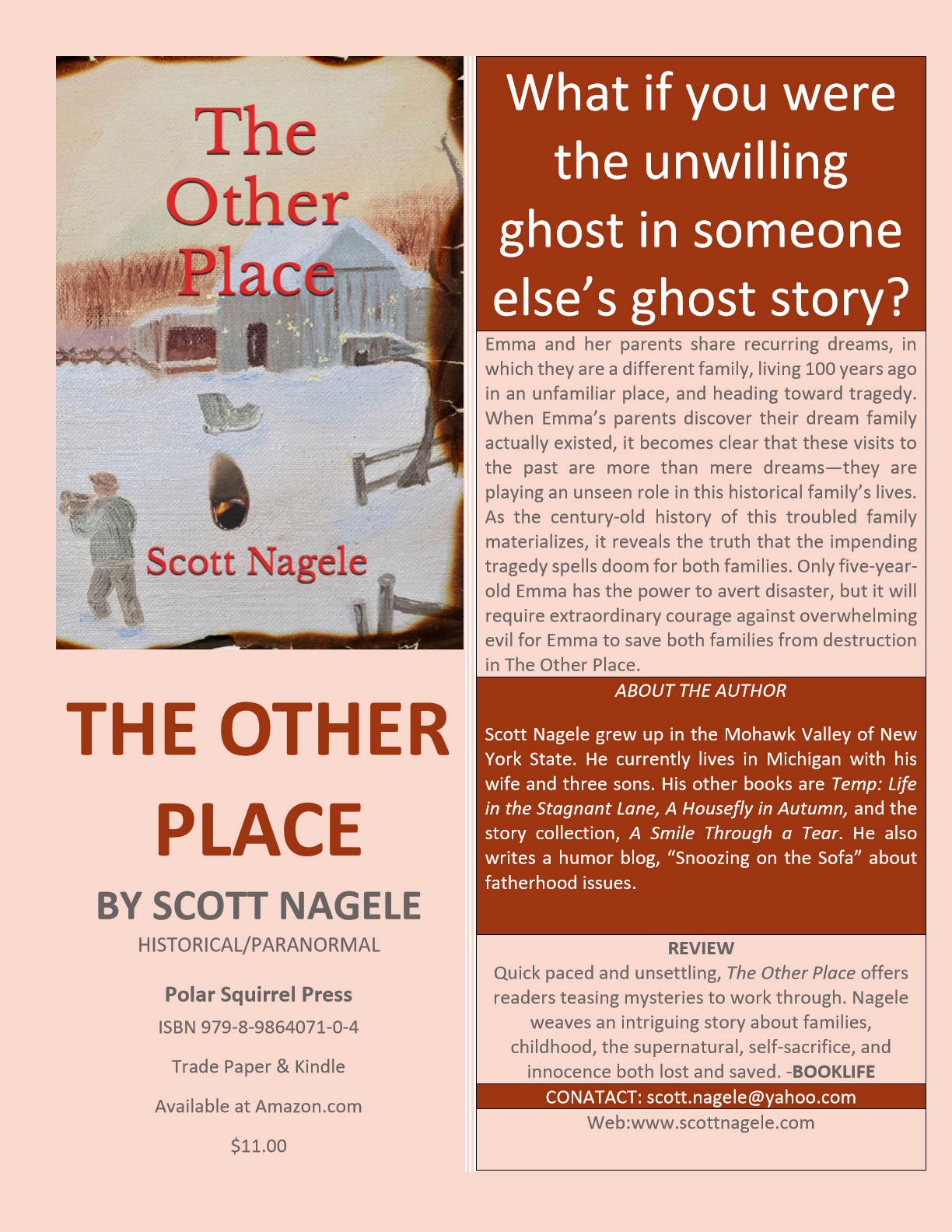
Here’s a skill I’m trying to hone: creating a sell sheet for my new novel. I welcome comments on its look and appeal.

For those interested, here are the purchase links:

Paperback

Kindle

I appreciate every single look this book gets. There are a lot of good books out there, and most people have a limited supply of money. It’s a wonderfully humbling thing when someone spends their money on your art, but I am also grateful for the people willing to share a post, or tell a friend, or just leave an encouraging word. Every little bit helps.

Writing is difficult work. For many writers, promotion, marketing, publicity (everything that falls under the heading of reaching out) is the most difficult work of all. That said, thank you for reading this post.