“One Little Piece” (Flash Fiction)

I’m really starting to enjoy writing flash fiction. As someone who has always kept to traditional short stories and novels, I’ve only recently dipped my toes into the pool of short-shorts. It turns out the water is fine. I’m not sure where this new form will lead, but if nothing else, I’m having fun with it for now.

You can read some of my slightly longer stories through the “A Little Taste” and “A Cautionary Tale” tabs above. The “About My Books” tab has a dropdown selection of links to my short story collection and novels.

Meanwhile, here’s my latest attempt at flash fiction:

The installers had gone for lunch. Jerry surveyed the family room where the old carpet had been torn up, but new carpet had not been laid. The bare floor made the room foreign and uninviting.

The house hadn’t had new carpeting in decades, and though Jerry hated changing anything, it was time. He stared at the floor, trying to recall what it had looked like this morning, and for the past 35 years. A little bit of something against the wall caught his eye.

Holding the wall, he bent to pick up the blemish to the otherwise clean floor. Grasping the object, he expelled a small groan in straightening himself.

He held it between his thumb and forefinger, positioning it at the focal length his eyes required. He pursed his lips and blinked his eyes as recognition filled him. “Vermont and New Hampshire,” he breathed, shaking his head gently. “He searched for you guys for weeks.”

Jerry squeezed the tiny square in his hand, even as he squeezed closed his eyes. Then, he made himself open his eyes. He shuffled across the foreign floor to the stairs.

Upstairs, one door was closed. He opened it and entered a bedroom. The carpet here would not be changed. The posters would not come down, nor the twin bed be disturbed.

Among some books and games on the desk rested a wooden puzzle of the United States, assembled except for a small hole in New England. Jerry fitted the bit he’d found into the hole. “See? I found it for you,” he whispered to the emptiness.

He gazed at the completed puzzle for a long time, wondering what it must feel like to be whole again. As he shut the door behind him, he coached himself, “One little piece at a time.”
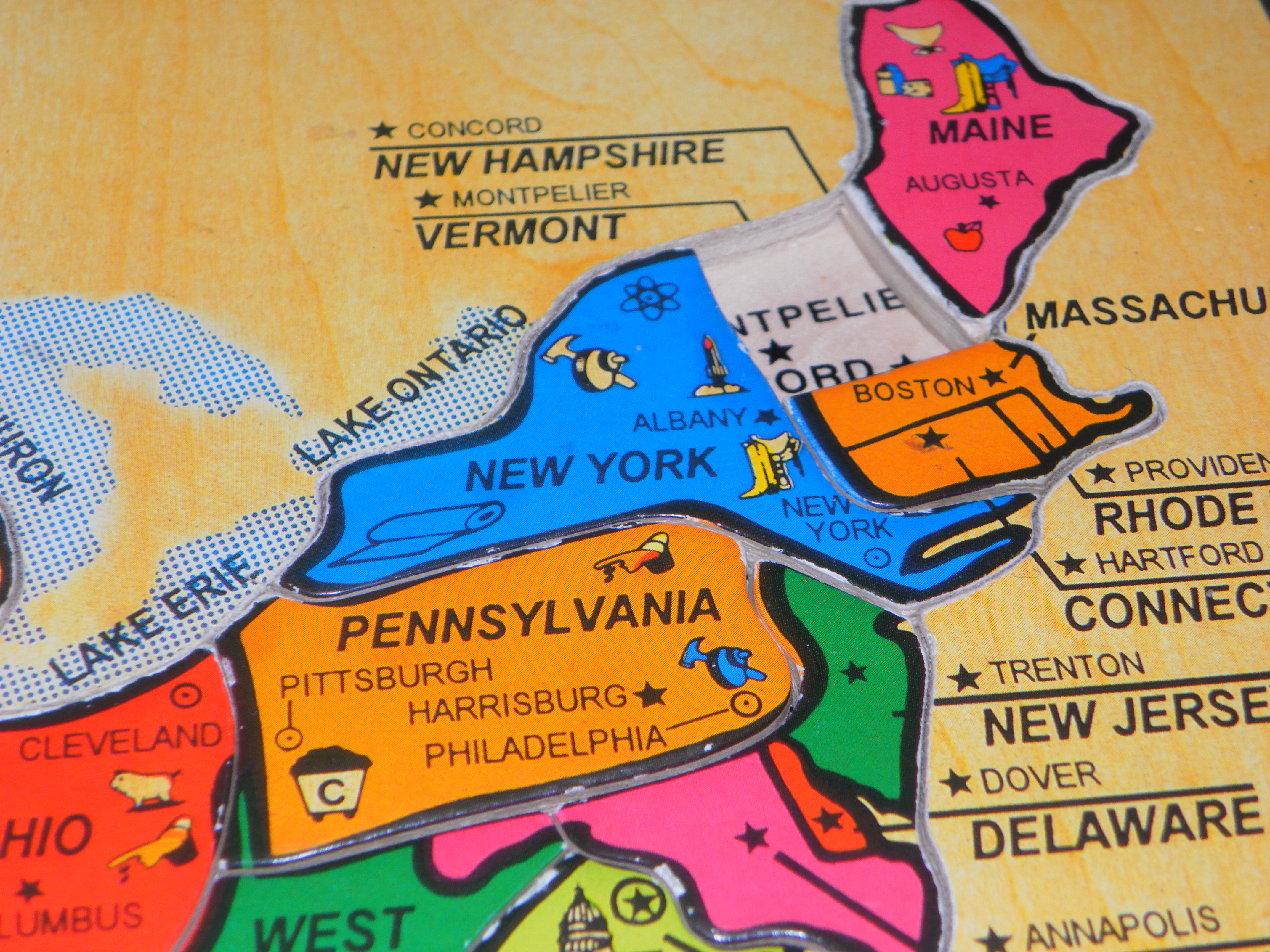
The hole

My humble beginnings in fiction approach their 40th humble anniversary

When I was in elementary school, the Daughters of the American Revolution held an annual writing competition for 5th and 6th graders.  The story I wrote for this in 5th grade is the earliest fiction I remember writing. The entries were hand-written. My poor penmanship probably prevented the ladies of the D.A.R. from comprehending my story.  This, and the lack of effort I put into the tale, led to failure in my first writing competition.

In 6th grade, I tried harder, and my penmanship must have become more legible. I won the award for my school. I had to read my story in front of the assembled Daughters, which terrified me, but I got a little medal to pin on my chest that said, “Excellence in History.”

They were a tough crowd.

They were a tough crowd.

The theme of the contest that year was travel in colonial America. I hit that theme hard. In the space of five or six handwritten pages, my protagonist used about 10 different methods to move from point A to point B. Point B was Bunker Hill, where there happened to be a battle raging. Having gotten my main character to his destination, I wasn’t sure what to do with him. Since there wasn’t any D.A.R. contest for 7th grade, I wouldn’t need a sequel so I killed him. He died heroically, like a patriot. It didn’t hurt to hit the Daughters in their collective soft spot.

The summer after 6th grade, I decided to write a mystery novel. I had it all figured out: whodunit, why and how. It turned out that was the easy part. The hard part was all the story that needed to come before the big reveal at the end. After about a dozen handwritten pages full of scintillating dialog, punctuated by dramatic sips of coffee, I decided to take a break and go ride my bike. Riding my bike was easier, but very time-consuming. It took up the rest of the summer, so I didn’t get to do more work on my novel.

Through high school I wrote short stories for no particular reason. I’d hammer them out on my mother’s Smith Corona. My typing was no better than my penmanship, even after the keyboarding class. My mother was the only one who read my stories. She had to see where all the white-out was going, after all.

My chief rival for bottom of the keyboarding class.

My chief rival for bottom of the keyboarding class.

In college I took a couple of fiction courses, but most of the fiction I wrote was in papers for my other classes. I’d become practiced at inventing facts that seemed plausible to instructors who didn’t have time to check. College was supposed to be about learning to think critically, which was exactly how I was judging which bullshit I could get away with.

Since my school days, I’ve done less bike riding, which has allowed me to finish some novels. Certain things have come full circle. I’m still looking to hit the emotional soft spots, but for an audience wider than the D.A.R. I still usually figure out the endings before the beginnings. I’m also still busy judging which fabrications will fly. Fiction is all one glorious lie, and like any good lie, it should always be plausible.

Even my penmanship and typing  are still lousy. The only thing I’ve lost is the medal that says, “Excellence in History.”

The publishing process made me a better storyteller

Maybe I should have kept up my vigorous regimen of procrastination.

Fortunately, I hadn’t given up procrastination cold turkey, I was gradually easing off it as part of a 112 step program.

While I am waiting for my initial beta reader (wife) to list all the things wrong with the first draft of my latest book, I decided to twiddle my thumbs for a good long while before reworking one of the several unpublished novels I keep tucked away for later.

Incidentally, there are a many things wrong with the first draft of the latest book, so it may take her some time to compile them.

Thanks to the fascinating qualities of my twirling thumbs, combined with confluence of youth spring soccer and baseball seasons, and a big project at work, I have rewritten all of 12 pages in the last two months. The manuscript is more than 400 pages, so those dozen pages seem somewhat measly.

Yet, I am a man who can occasionally find sunshine in little things. (My initial beta reader may disagree with this, but she doesn’t always appreciate the subtlety of my understated sunshine.) I am pleased with what I have accomplished.

There’s a lot in those 12 pages. Mostly, there’s a much more engaging beginning to a story than there used to be.

I finished the draft of this novel about 10 years ago. I didn’t publish it because, though I believed it a good story, it wasn’t everything I wanted it to be and I didn’t know why.

Ten years later, I might have figured out why.

My presentation of the story did not measure up to the story itself.

In those 10 years, I could have written 10 novels and still not learned enough about storytelling. As it happens, in those 10 years, I spawned three children, so I may have changed 10,000 diapers but I didn’t write anything near 10 novels.

"How many diapers?"

“How many diapers?”

But it wouldn’t have mattered if I’d written 20. The thing that made me learn most about storytelling was publishing three books.

Publishing wasn’t a financial windfall by any means, but it was a learning experience, and a valuable one. Knowing I would put these stories before the public made me consider them from angles I’d never had to before. It made me focus on readers: how I took hold of them, how I held onto them, and where I led them. It forced me to act like a professional: to analyze my own work and that of competing writers with new attention to detail. It didn’t mean I was going to attempt to copy the successful ones, but it did make me think about the elements that made them a success.

The act of publishing made me more aware of many things about my books, but more than anything else, it made me constantly reevaluate how I present a story. There’s more to learn, but I’m better than I used to be.

If I can keep up this breakneck pace of rewriting, I may actually turn this old novel into a well-presented story to share in about five years or so.

Where did our love go, follower #31?

I lost a Goodreads follower. Even though I’ve never been quite sure what the relationship between Goodreads authors and their followers is supposed to be, I feel a little sad about this. Sure, I didn’t really know that person; but I still feel rejected. The disappearance of their tiny thumbnail image from my Author Dashboard leaves a little, square hole in my life.

As far as I can tell Goodreads followers see pretty much the same side of you as Goodreads friends do, except they are not necessarily people you know.

For the longest time, I had one follower. Then, one day, I noticed I had a dozen. From there my group slowly grew until I had 31 followers. How I got this many followers I don’t know, but I naturally chalked it up to my snowballing popularity. Who knows? Someday I might hit 40, and from there the sky’s the limit.

Yesterday I noticed my followers numbered only 30. Somebody made the conscious decision to stop following me, and like a jilted lover, a part of me longs to know why. Why did you leave me? What could I have done differently to keep your love? – or in this case, your passing interest.

I don’t think I did anything offensive. I did rate The Lost World by Sir Arthur Conan Doyle with four stars. Was that not enough stars? Too many? Now, I fear I’ll never know what drove my 31st follower away.

How did I end up in a love triangle (technically a triacontakaitrigon) with Sir Arthur and 31 others?

How did I end up in a love triangle triacontakaitrigon with Sir Arthur and 31 others? It’s his bedroom eyes, isn’t it?

Aside from the personal rejection, I’m left to contemplate what this contraction means for my long, but mostly secret career as a writer. Has my popularity peaked? Did 31 followers represent the Golden Age of my appeal? Will they all begin to trickle away now, leaving me clutching at withered laurels as I struggle to regain my renown? I can see it on my headstone:

When this is the height of your fame, they don't even bother with your name, because who cares?

When this is the height of your fame, they don’t even bother with your name, because who cares?

I suppose I’ll never know why I was kicked to the curb. I’m left to piece together speculative theories. The most plausible is that one of the 18-26 people who are following me by accident, ever since they clicked the button next to the button they intended to click, took the unlikely step of auditing the list of authors they are following. Finding no justification for my name on their list, they took immediate corrective action, this time taking care about who they unclicked.

Either that or one of the 6-12 people who followed me as a lark during a carefree, and possibly drunken, moment of web surfing, decided to begin taking their online decisions more seriously and eliminate all their irresponsible Internet relationships.

Either way, it was clearly a mistake. It has now been fixed. Follower 31 and I have gone our separate ways. It’s probably best for everyone involved, with the exception of me. What happens when the other 30 get word that there is a way out of this mess?