I wish I would stop nagging me to join my social network

I admit it. I’m a naughty author.

Despite truckloads of sound advice instructing little guys like me to use every incarnation of social media to our advantage in promoting our books, I don’t have a Twitter account. I am often confounded by Facebook; I don’t understand the usefulness of Pinterest at all; and I don’t even know what Snapchat is.

I wouldn’t have a LinkedIn account except some people who have helped me out with my books invited me to become part of their networks and it didn’t seem right to ignore the requests. Does anyone else find it odd that they could invite me to join their networks when I wasn’t even signed up to the service?

My network is very small. I don’t really get LinkedIn. I guess it’s kind of like Facebook except people comb their hair for their profile pictures.

LinkedIn is spooky to me. It’s the haunted social media. I seem to have two versions of my profile on their servers somehow. Depending upon which browser I use to access the service, I either have the profile to which I added all of my jobs, education, and writing projects, or I have an abandoned-looking profile with little more than my name and a silhouette where my picture should be. It probably even has cobwebs, but I run away too quickly to check.

The camera makes me look 10 years younger.

The camera makes me look 10 years younger.

LinkedIn sends me lots of emails asking if I know certain people. That was merely a minor nuisance until they started getting freaky and asking if I knew Scott Nagele. For those who skipped over the tittle of this blog, that’s me.

I want to tell them I do know Scott Nagele, so quit asking me, but I don’t know how to do that without connecting to myself, which is not something you want to be caught doing beyond the teenage years.

Besides that, I have an eerie feeling that if I were able to tell them I know Scott Nagele, I would get a follow-up email asking, “Really? How well do you really know Scott Nagele?” I’m not prepared, at this time of my life, for that level of electronic soul-searching.

Maybe it’s the ghost of my phantom profile trying to contact me from beyond the Internet. “Know thine own self, lest ye turn to a dead, faceless profile like me.” (In that drawn-out, remorseful, ghostly moan.) (Oh yeah, and rattling chains.)

On the other hand, it could be my (barely) living profile trying to contact the graveyard profile through some sort of séance, using me as the medium. Either way, I’d like to be left out of it. I don’t go in for this kind of jiggery-pokery and I’d prefer it if my profiles would just leave me alone.

I’m afraid they won’t though. I fear worst will come to worst. Therefore, if you will give me a moment of privacy, I may need to connect to myself.

P.S. Click the “About My Books” tab at the top to see what I’m supposed to be talking about all over social media every day.
“One Little Piece” (Flash Fiction)

I’m really starting to enjoy writing flash fiction. As someone who has always kept to traditional short stories and novels, I’ve only recently dipped my toes into the pool of short-shorts. It turns out the water is fine. I’m not sure where this new form will lead, but if nothing else, I’m having fun with it for now.

You can read some of my slightly longer stories through the “A Little Taste” and “A Cautionary Tale” tabs above. The “About My Books” tab has a dropdown selection of links to my short story collection and novels.

Meanwhile, here’s my latest attempt at flash fiction:

The installers had gone for lunch. Jerry surveyed the family room where the old carpet had been torn up, but new carpet had not been laid. The bare floor made the room foreign and uninviting.

The house hadn’t had new carpeting in decades, and though Jerry hated changing anything, it was time. He stared at the floor, trying to recall what it had looked like this morning, and for the past 35 years. A little bit of something against the wall caught his eye.

Holding the wall, he bent to pick up the blemish to the otherwise clean floor. Grasping the object, he expelled a small groan in straightening himself.

He held it between his thumb and forefinger, positioning it at the focal length his eyes required. He pursed his lips and blinked his eyes as recognition filled him. “Vermont and New Hampshire,” he breathed, shaking his head gently. “He searched for you guys for weeks.”

Jerry squeezed the tiny square in his hand, even as he squeezed closed his eyes. Then, he made himself open his eyes. He shuffled across the foreign floor to the stairs.

Upstairs, one door was closed. He opened it and entered a bedroom. The carpet here would not be changed. The posters would not come down, nor the twin bed be disturbed.

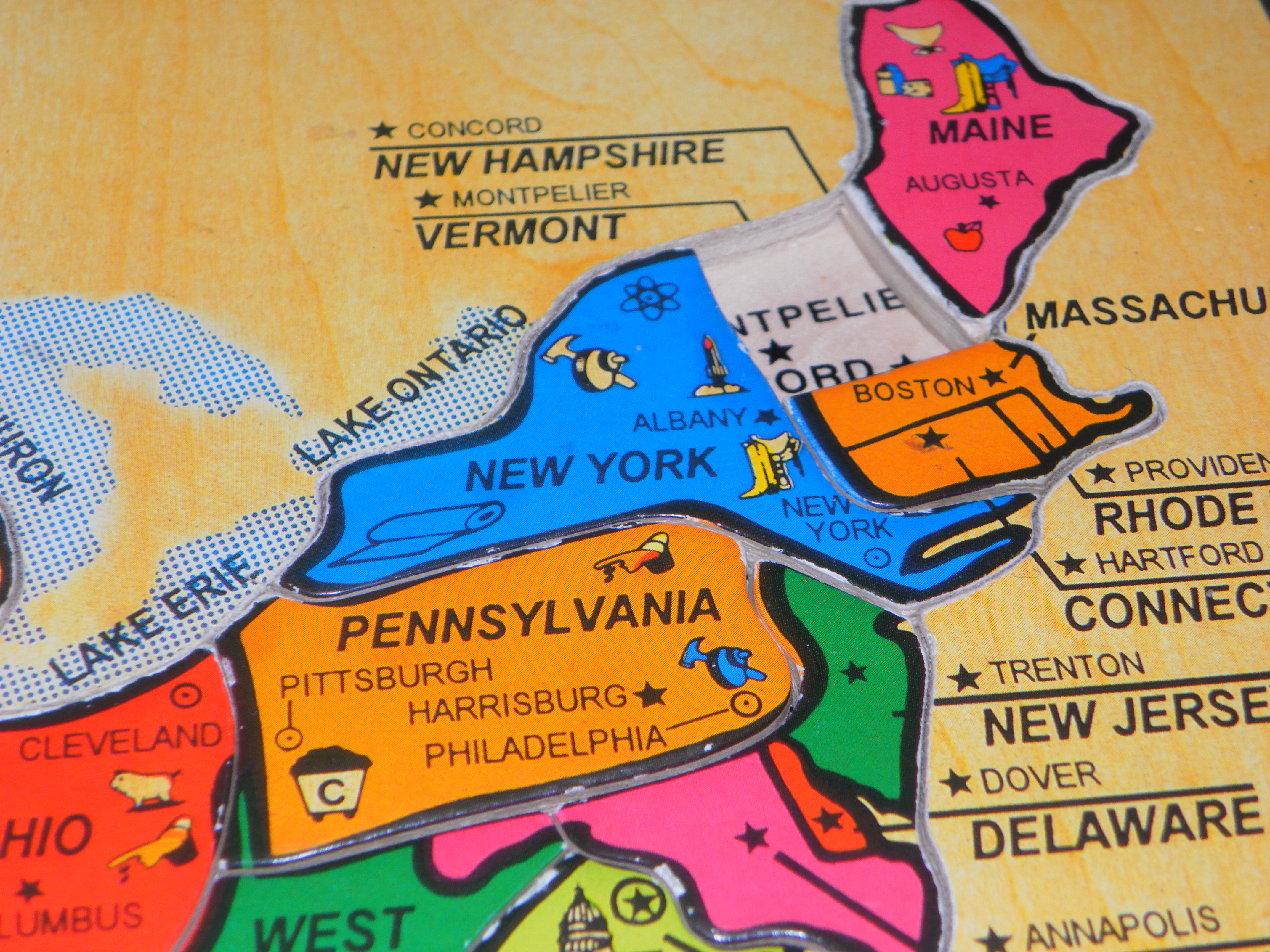
Among some books and games on the desk rested a wooden puzzle of the United States, assembled except for a small hole in New England. Jerry fitted the bit he’d found into the hole. “See? I found it for you,” he whispered to the emptiness.

He gazed at the completed puzzle for a long time, wondering what it must feel like to be whole again. As he shut the door behind him, he coached himself, “One little piece at a time.”

The hole

My love-hate relationship with James Fenimore Cooper

I’m not sure what to make of James Fenimore Cooper. Unlike Edgar Rice Burroughs, whose books I loved, despite their flaws, Cooper is an author whose books I wish I could love.

There’s a little boy deep inside to whom Cooper is magic. Growing up in Upstate New York, keenly interested in colonial history and Northeastern Indians, put me right in line for devouring Cooper’s Leatherstocking Tales. It also made me wish he had done a better job writing them.

Cooper could spin a yarn. He was imaginative, and there is enough drama in his books to keep you turning pages. The problem with Cooper is there are far too many pages to turn. I don’t mind long books. I just don’t like needlessly long books.

Cooper was profligate with the English language. He thought words grew on trees, which is not a good thing for a writer whose stories take place in the forest. Cooper grabbed handfuls of words from the nearest low-hanging branch and tossed them willy-nilly. Adverbs, adjectives, whatever he had in hand; there must be something lying among the twigs they could be used to describe.

The only time he was able to restrain himself from putting in more than his two-cents-worth.

The only time he was able to restrain himself from putting in more than his two-cents-worth.

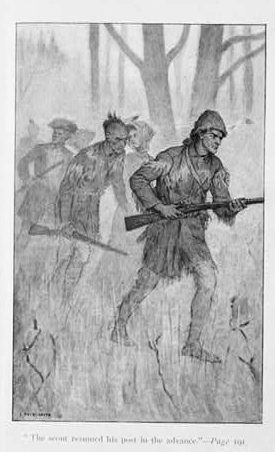
If you can weave your way through the superfluous words, the other thing that might grab at your ankles is the flawlessness of the hero. No matter where Natty Bumppo points his rifle, he is sure to hit the head of nail. On his off days, he shoots easier things, like deer, Indians, and Frenchmen, who sometimes need to be shot but hardly pad his resume as a marksman.

Natty never brags about his marksmanship. He is famous for not bragging. He repeatedly avoids self-congratulation while talking up of his exploits until his humility becomes annoyingly boastful. Bumppo is a thoughtful, taciturn man who seems always to be talking at somebody. By contrast, Tarzan was exceptional at swinging through trees, but he didn’t waste all your time not bragging about it.

A rare scene in which Natty's mouth is closed.

A rare scene in which Natty’s mouth is closed. (Artist: E. Boyd Smith)

There are a surprising number of upper-class, young women traipsing through Cooper’s wilderness. Natty Bumppo is never tempted by them. Maybe he’s too wise to get tangled up with impulsive women who can’t quell the urge to visit the far side of a border war. More likely, Natty is too pure. Naturally, when a man who has been alone in the forest for ages finds a beautiful woman in his path, it presents a wonderful opportunity to spew his backwoods philosophies at her.

If Natty Bumpo had missed his target once, or at least shut up about how un-noteworthy his “gifts” were, he’d have been a lot more interesting. If he’d entertained one lustful thought, he would have been more believable. In the end, he was just a guy who could get you through the woods, if you didn’t allow yourself to get trapped in a conversation with him.

Having said this, I admit to reading all the Leatherstocking Tales. If lost volumes were discovered, I would read them too. Cooper snared me with his subject matter. His writing frustrates me, but what can I do? There aren’t a bunch of people running around New York during the French and Indian War besides Natty Bumppo.

So here’s to you, James Fenimore Cooper; you may not have done it the best, but you did it the most, and that should be worth something.


My humble beginnings in fiction approach their 40th humble anniversary

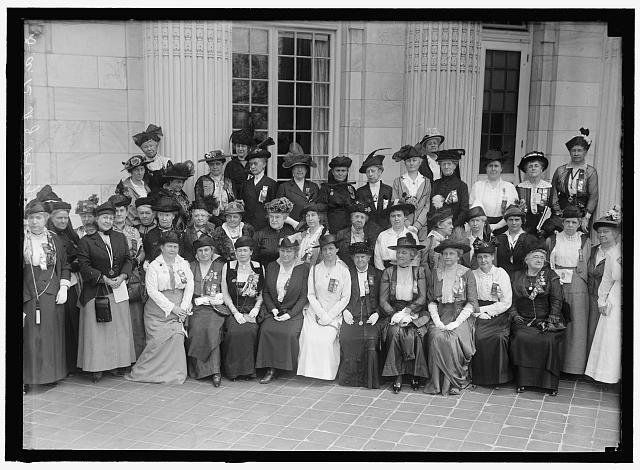
When I was in elementary school, the Daughters of the American Revolution held an annual writing competition for 5th and 6th graders.  The story I wrote for this in 5th grade is the earliest fiction I remember writing. The entries were hand-written. My poor penmanship probably prevented the ladies of the D.A.R. from comprehending my story.  This, and the lack of effort I put into the tale, led to failure in my first writing competition.

In 6th grade, I tried harder, and my penmanship must have become more legible. I won the award for my school. I had to read my story in front of the assembled Daughters, which terrified me, but I got a little medal to pin on my chest that said, “Excellence in History.”

They were a tough crowd.

They were a tough crowd.

The theme of the contest that year was travel in colonial America. I hit that theme hard. In the space of five or six handwritten pages, my protagonist used about 10 different methods to move from point A to point B. Point B was Bunker Hill, where there happened to be a battle raging. Having gotten my main character to his destination, I wasn’t sure what to do with him. Since there wasn’t any D.A.R. contest for 7th grade, I wouldn’t need a sequel so I killed him. He died heroically, like a patriot. It didn’t hurt to hit the Daughters in their collective soft spot.

The summer after 6th grade, I decided to write a mystery novel. I had it all figured out: whodunit, why and how. It turned out that was the easy part. The hard part was all the story that needed to come before the big reveal at the end. After about a dozen handwritten pages full of scintillating dialog, punctuated by dramatic sips of coffee, I decided to take a break and go ride my bike. Riding my bike was easier, but very time-consuming. It took up the rest of the summer, so I didn’t get to do more work on my novel.

Through high school I wrote short stories for no particular reason. I’d hammer them out on my mother’s Smith Corona. My typing was no better than my penmanship, even after the keyboarding class. My mother was the only one who read my stories. She had to see where all the white-out was going, after all.

My chief rival for bottom of the keyboarding class.

My chief rival for bottom of the keyboarding class.

In college I took a couple of fiction courses, but most of the fiction I wrote was in papers for my other classes. I’d become practiced at inventing facts that seemed plausible to instructors who didn’t have time to check. College was supposed to be about learning to think critically, which was exactly how I was judging which bullshit I could get away with.

Since my school days, I’ve done less bike riding, which has allowed me to finish some novels. Certain things have come full circle. I’m still looking to hit the emotional soft spots, but for an audience wider than the D.A.R. I still usually figure out the endings before the beginnings. I’m also still busy judging which fabrications will fly. Fiction is all one glorious lie, and like any good lie, it should always be plausible.

Even my penmanship and typing  are still lousy. The only thing I’ve lost is the medal that says, “Excellence in History.”