My love-hate relationship with James Fenimore Cooper

I’m not sure what to make of James Fenimore Cooper. Unlike Edgar Rice Burroughs, whose books I loved, despite their flaws, Cooper is an author whose books I wish I could love.

There’s a little boy deep inside to whom Cooper is magic. Growing up in Upstate New York, keenly interested in colonial history and Northeastern Indians, put me right in line for devouring Cooper’s Leatherstocking Tales. It also made me wish he had done a better job writing them.

Cooper could spin a yarn. He was imaginative, and there is enough drama in his books to keep you turning pages. The problem with Cooper is there are far too many pages to turn. I don’t mind long books. I just don’t like needlessly long books.

Cooper was profligate with the English language. He thought words grew on trees, which is not a good thing for a writer whose stories take place in the forest. Cooper grabbed handfuls of words from the nearest low-hanging branch and tossed them willy-nilly. Adverbs, adjectives, whatever he had in hand; there must be something lying among the twigs they could be used to describe.

The only time he was able to restrain himself from putting in more than his two-cents-worth.

The only time he was able to restrain himself from putting in more than his two-cents-worth.

If you can weave your way through the superfluous words, the other thing that might grab at your ankles is the flawlessness of the hero. No matter where Natty Bumppo points his rifle, he is sure to hit the head of nail. On his off days, he shoots easier things, like deer, Indians, and Frenchmen, who sometimes need to be shot but hardly pad his resume as a marksman.

Natty never brags about his marksmanship. He is famous for not bragging. He repeatedly avoids self-congratulation while talking up of his exploits until his humility becomes annoyingly boastful. Bumppo is a thoughtful, taciturn man who seems always to be talking at somebody. By contrast, Tarzan was exceptional at swinging through trees, but he didn’t waste all your time not bragging about it.
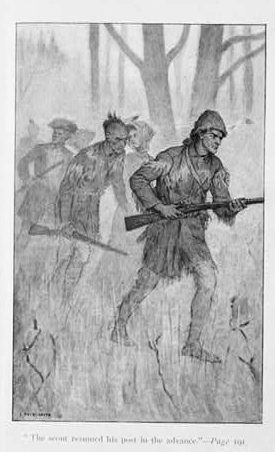
A rare scene in which Natty's mouth is closed.

A rare scene in which Natty’s mouth is closed. (Artist: E. Boyd Smith)

There are a surprising number of upper-class, young women traipsing through Cooper’s wilderness. Natty Bumppo is never tempted by them. Maybe he’s too wise to get tangled up with impulsive women who can’t quell the urge to visit the far side of a border war. More likely, Natty is too pure. Naturally, when a man who has been alone in the forest for ages finds a beautiful woman in his path, it presents a wonderful opportunity to spew his backwoods philosophies at her.

If Natty Bumpo had missed his target once, or at least shut up about how un-noteworthy his “gifts” were, he’d have been a lot more interesting. If he’d entertained one lustful thought, he would have been more believable. In the end, he was just a guy who could get you through the woods, if you didn’t allow yourself to get trapped in a conversation with him.

Having said this, I admit to reading all the Leatherstocking Tales. If lost volumes were discovered, I would read them too. Cooper snared me with his subject matter. His writing frustrates me, but what can I do? There aren’t a bunch of people running around New York during the French and Indian War besides Natty Bumppo.

So here’s to you, James Fenimore Cooper; you may not have done it the best, but you did it the most, and that should be worth something.
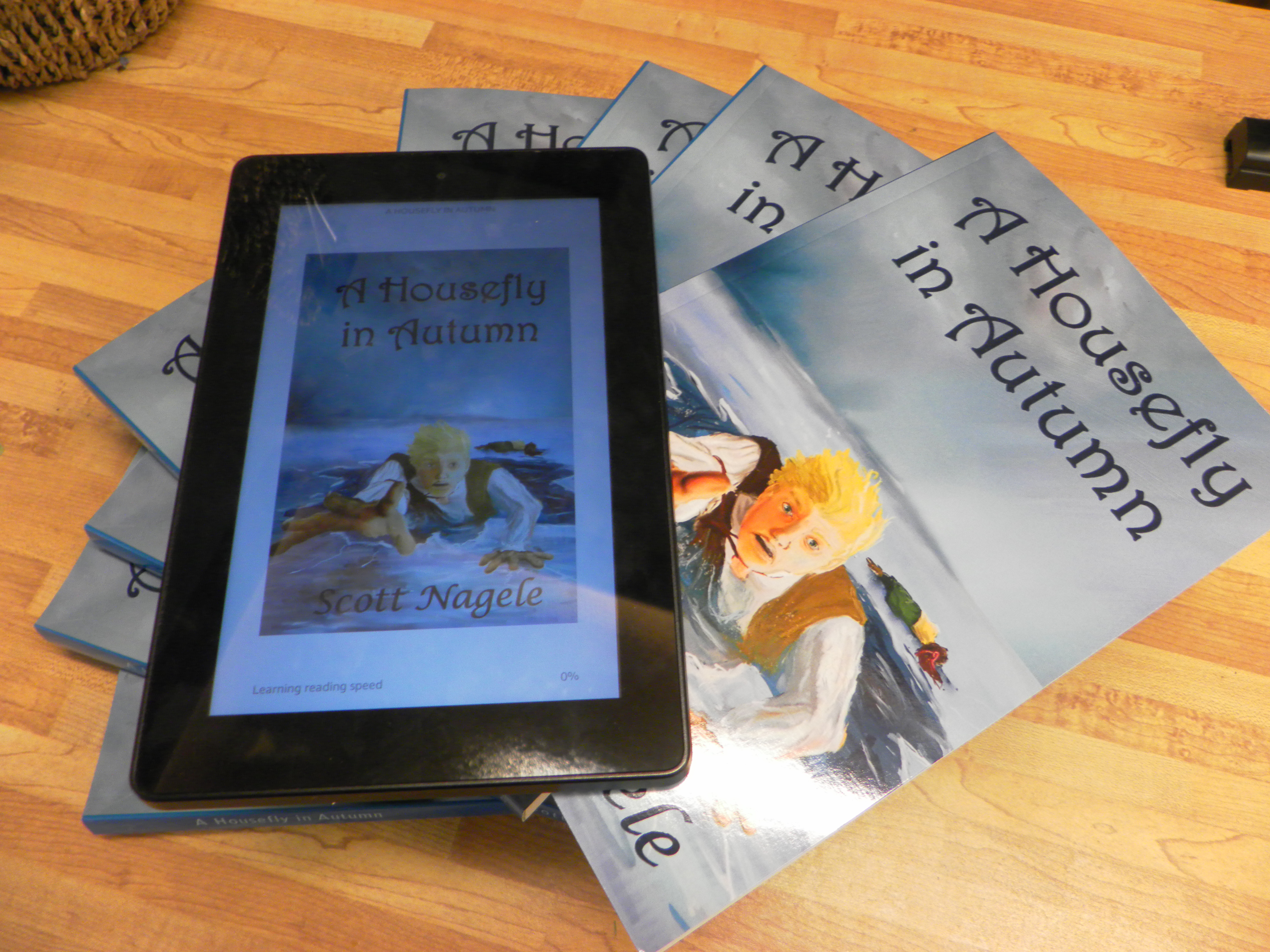
 

Book release: A Housefly in Autumn

Since I began this blog, last September, I’ve been talking about my forthcoming book, A Housefly in Autumn. Before I started this blog, I owned a traditional web site. There, I talked about my forthcoming novel for even longer. Altogether, I’ve spent a long time talking about something happening in the future. If you saw any of these mentions, you may have begun to wonder if the future would ever get here. I know there were times when I did.

It took its sweet time, but the future has arrived.

Available in Kindle and paper

If you buy the paperback at Amazon, you can download the Kindle version for free. Just in case you can’t decide which you like best.

Today is that day. I can finally hold a real live copy of A Housefly in Autumn in my hands. I can download the e-book to my Kindle. In fact, I have already done both of these things, and now so can you.

A Housefly in Autumn is available in paper and Kindle formats.

Where to buy:

Amazon Barnes & Noble Createspace
Paperback Paperback Paperback
Kindle

This book has taken longer to publish than my previous ones. The editing, the proofing, the cover art, it’s all been a longer trek. That’s why this day is sweeter to me than past release days. It’s the culmination of more investment, more sweat and toil.

That also may be part of the reason there’s more trepidation than before. There’s more toil at risk. But the toil can’t be undone so it might as well be pushed with all the other chips into the pot.

I’m all in. Now I get to see what kind of hand I’ve dealt myself.

Introducing:

A Housefly in Autumn

                Book Description

A Housefly in Autumn is intended for Young Adults and up. A historical novel, set in 19th century Europe, it follows the life of a young man whose dreams have crumbled down around him. In an act of heroism, he sacrifices his own promising future to save the life of another. Now he must decide whether to cling to the unlikely hope of regaining his old life, or aim his efforts toward making the most of the life fate has dealt him. Though it is difficult to let go of the rewards that life once promised, perhaps the greatest rewards are the ones earned by building new hope from the bits and pieces of wrecked dreams.

                Synopsis

At 17, Anders Christiansen was a young man overflowing with potential. All his teachers believed he was destined to blossom into a leading man of letters, enjoying a life of rich rewards.

That was before the accident.

Now, Anders’s great talent lies fallow. He can’t produce the complex ideas he once did. His thoughts are slow and his words simple. The world holds little promise for him anymore.

Struggling to build a meaningful life out of the wreckage of his dreams, Anders learns the value of simple treasures. Loyalty, devotion, and even sacrifice hold rewards of their own to renew hope after tragedy. Love can cause hurt, but he who gives love when he hurts the most will reap a joy outweighing the pain.

Anders gives meaning to his life in the way he spends it. He will face grave danger to spare those he loves, and though his gifts be diminished, he will share them freely with even the humblest of children. Though never sought, Anders’s reward is immense and enduring, showing the millions of reasons to go on sharing even the simplest of gifts.


So now I guess I have to find some new future event to start talking about. Fortunately, my future is full of things that probably will happen but might take longer than I expect. There will be plenty to talk about.

Cold feet and self-publishing

These are probably the cold feet I should have had before my wedding. But I was fairly secure in what I was getting into that day. I was more worried about something embarrassing happening at the ceremony than any of the ever after part.

The cold feet I avoided at my wedding have come to me over a book. This month, I will be releasing my third self-published book, A Housefly in Autumn. You’d think I would worry less about my third than my first two, but I don’t. I worry more.

Why doesn’t it get easier? It probably would get easier if I could stick to one genre. If I wrote the same kind of book every time and knew what to expect from the audience of that single genre, I’d likely feel more comfortable. But I’m trying something different. This is the first non-humor novel I’ve published. It’s not the first one I’ve written, but nothing hits the fan until you publish.

One of the benefits of self-publishing is you get to take risks. Nobody in a corner office is going to stop you from pissing away the firm’s money, because there is no firm, and more to the point, there is no money. It’s only your own blood, sweat, and tears you are potentially pissing away, and you can make more soon enough. Even so, risk can be daunting when it has your name attached to it.

the corner office

Some early self-publishers enjoying the freedom to take risks. Or maybe they’re just some guys building a corporate corner office.

Switching genres is a risk. The bigger risk is living between genres. This new book falls somewhere between Young Adult and General Fiction. Some books have succeeded very well in this gray area. Many more have failed.

There are some other little risks built into the story and the telling of it, but the little risks wouldn’t be extraordinarily frightening if not coupled with aforementioned, larger risks. In combination, each little risk has the potential to break the camel’s back.

Still, any worthwhile undertaking should be daunting. There comes a time when you have to damn the torpedoes, in spite of the risk. Yeah, I’ll fret over the release of this book, because that’s the nature turning your art toward the public eye. But I will also find confidence in recalling how much time and hard work went into producing it. Time and hard work might not be enough to claim success, but it’s enough to take a shot at it.

I’m taking this shot, regardless of my slightly chilly feet. My feet and I will do our best to make a success of this book while brewing up some new blood, sweat, and tears for the next one, which will be of yet another new genre. I guess it’s a good thing I don’t have any corner offices, or corporate money, to stop me from taking risks. All I’ve got is a pair of light blue feet, and having stood firm before the altar, they can stand behind a little old book.

Read more about A Housefly in Autumn here.

Are you trying to tell me my research stinks?

Skunks happen for a reason. I’m convinced of that now.

In February, my family was left reeling from the noxious fumes of a skunk using the area under our deck as a late-night rendezvous location to get her groove on with the boy skunks in the region. We all hated that skunk more than anything, but I’ve developed a new appreciation for her since then.

Why have I softened toward her, and how does this have anything to do with writing?

She provided me with another thrilling adventure for my fatherhood blog (read it here). This alone did not make her visit worth it. It’s only in the last few days I truly appreciated her visit.

I’m preparing a new novel, A Housefly in Autumn, for publication. It’s set in 19th century Europe.

When you write a story about a different place and time, you research as much as you can, but some things are too obscure to discover. In these cases, you get things as nearly correct as possible and keep vague about details you can’t nail down. You avoid the impossible and keep to situations that, if not historically provable, are at least historically plausible.

In doing this, you make assumptions. Sometimes, you don’t even realize you are making an assumption, and this assumption is the idea you fail to research.

This is where the skunk comes in.

In A Housefly in Autumn, there is a scene in which the protagonist mentions a skunk as if that would not be a surprising animal to see in a garden. At my house, it’s common.

I wrote this scene years ago, and have edited it many times, without giving the skunk a second thought.

On my fatherhood blog, I’ve mentioned skunks several times. People from other continents have commented, showing a perfect understanding of the hazards presented by the animal. This reinforced my assumption about the universality of skunks.

Back in February, I found myself extensively researching skunks, trying to find the right solution to our infestation, and one image stuck in the back of my mind, waiting.

A few days ago, I was scouring one of the last proofs of my novel. I came to the aforementioned scene for the thousandth time. On the thousandth time, the latent image from my skunk research rushed to the front of my mind. My jaw dropped.

I hurried online to verify the image. It was a map of skunk habitat, and it was correct.

Skunks are an American animal.

Never would I have guessed there are no wild skunks in Europe. Pepe Le Pew is French, right?

Maybe there are wild skunks in Europe by now, because those exotic animals from other continents rarely turn out the awesome pets promised, and they’ll probably survive in the woods behind the neighbor’s house. But in the 19th century, I doubt it.

Needless to say, A Housefly in Autumn is now a skunk-free novel. Most readers may never have noticed, but I do hope to sell two or three copies in Europe. And who knows how many other naïve assumptions I’ve made?

Just like every other part of a novel, the detail accuracy will never be perfect, but mine is now a little better, and I owe it to a real skunk.

skunk lunch

For my European, African, Asian, Australian, and Antarctican friends: this is what a skunk digging for insects on your lawn looks like.