The Goodreads giveaway learning curve

A few posts back I mentioned that I was holding a Goodreads book giveaway for A Housefly in Autumn. That giveaway has come and gone. Here is what I learned.

Submit your giveaway at least a week before you want it to begin. It’s supposed to take Goodreads a couple of days to approve your giveaway. Mine took about a week. I had scheduled my giveaway to begin the day after I submitted it and run for a month. Consequently, I lost about six days off the front of it. I wouldn’t have minded so much losing six days in the middle, but what I didn’t know is the first few days and the last few days of a giveaway are the most important.

There are tons of giveaways on Goodreads. Most folks who are interested in them look in two places: the list of new giveaways and the list of giveaways about to end. When my giveaway was finally approved, it was already six days old. My listing, when it showed up, was already deeply buried with in the new list. Only giveaway hunters with great perseverance would dig that deep. I missed out a good number of entries because of this.

giveaway pitch

According to the site, the average giveaway garners 825 entries. When you miss the first week or your own giveaway, you get fewer.

The middle of a month-long giveaway is the doldrums. The book is prominent on neither of the lists people search. Hence, the number of entrants drops sharply. Only after I had set up my giveaway did I find good advice about ignoring the Goodreads recommendation for longer giveaways. A long middle does no good. It’s best to jump directly from the new list to the about to end list. A week seems plenty long for a giveaway.

I offered autographed copies. This was another mistake. Autographed copies meant I would have to mail them myself, which led me to yet another mistake. I limited my giveaway to the U.S. because I didn’t want to have to pay huge amounts to ship books overseas. If I had not offered autographs, I could have bought the books online and had them shipped directly. Who knows how many entrants I cut myself off from by limiting the giveaway like this?

There are two main goals in offering a giveaway. The first is to get members to add the book the their “to-read” lists. The mistakes already mentioned hindered my efforts in this direction. As it was, 525 people entered, of which 228 added the book to their personal lists. Many of those people have more than 1,000 books on their “to-read” lists; some have tens of thousands. This means there are thousands of books on lists that will never be read.

The second goal of a giveaway is to garner reviews. Goodreads say that around 60% of people who win giveaway books write a review. Most commentary I’ve read suggests this is overly optimistic. I gave away six books. By Goodreads numbers, I should receive at least three reviews. I would love for this to happen, but one thing I’ve learned in this self-publishing biz is not to hold my breath.
The review police cast a wide net

A few years ago, the complaints about fake reviews on Amazon reached a level Amazon could not ignore. They tightened their reviewing policy and purged reviews that smelled funny to them.

Having seen enough fishy reviews on Amazon’s pages, I thought this was a good move. I feel like I can pick out insincere reviews, but, apparently, not everyone can. Besides, they can get to be annoying, when they are not entertaining, behind their veneer of deceit.

I wasn’t affected by the purges, so I never bothered to learn how Amazon determined which reviews were frauds. Time went by and I didn’t much consider the issue.

Amazon reviews can be very helpful in promoting your book. In spite of this, I decided I would try to avoid the temptation to ask for reviews with A Housefly in Autumn. The really valuable reviews are the ones people are inspired to write by their experience with the product itself. I didn’t want anyone writing a review because they felt obliged to do it.

So far I have stayed true to my intention. I have not asked anyone for a review. Consequently, after nearly a month, I have few reviews. I would have had one more, except the Amazon purge has finally struck me.

I kicked off my book with a release party. Not wanting to be alone at my party, I invited people I know. They humbled me by the way they gladly turned out. One of the attendees is a co-worker. She paid her hard-earned money for a copy, took it home and read it.

She liked it. She liked it a lot. Without any prompting, she wrote a review on Amazon. It was a short review, but it was heartfelt. I felt honored by it.

It was also short-lived. Within a day, Amazon purged it. She inquired about this and was told that she was not eligible to review this item.

They didn’t say why she was ineligible. I suspect it is a combination of her not having reviewed much on Amazon previously, the shortness of the review, the fact that it was not a “verified” Amazon purchase (she bought it at my party), and the fact that she lives in my town.

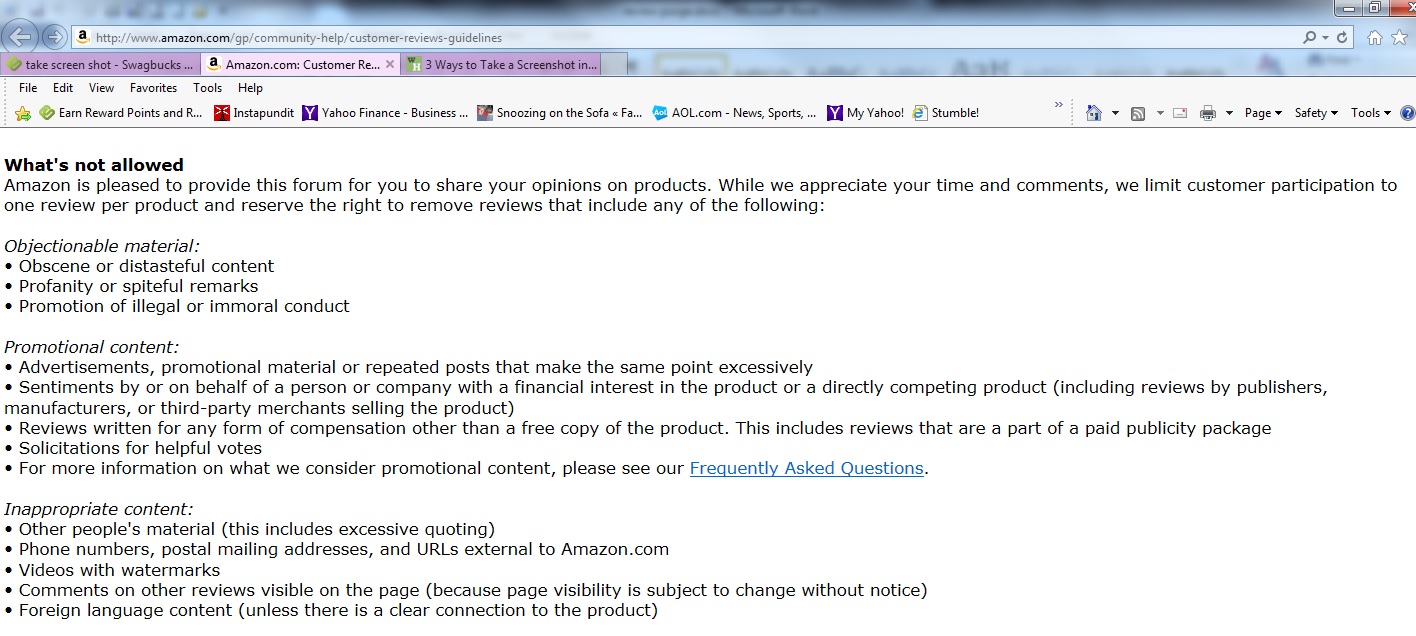
The official rules. Did the review in question violate them?

The official rules. Did the review in question violate them?

I’m disappointed at losing her review, but I am not irate with Amazon. I know they mean well and they can’t investigate every review on its own merits.

I feel as though this was an honest review. The reviewer paid for the book. No review was solicited of her, and she was in no way compensated for it. She has no economic interest in the book. The only connection she has is that she knows the author.

I hope Amazon does not consider proximity to be too much an indicator of fraud. After all, who will the non-famous author market to first, if not his own community. I would discourage family members from reviewing my books, but how far away from me must that line be drawn?

What do you think? Was this a valid review? Should people who know the author be prohibited from reviewing his books? Where should Amazon draw the line?

Selling it by giving it away

The book has been published. All the hard work of editing, proofing, and layout is done. It’s time to take a break, sit back, and relax for a while.

Not.

Anyway, I can take a break from the completed book and turn my attention to my work in progress. Well . . . actually . . . I can’t do that either. The work in progress may have to stay on hold for a while longer.

A Housefly in Autumn may be published, but I’m hardly done with it. There’s promoting to be done.

Promoting can be a hard pill to swallow for someone who revels in the introverted nature of writing. Fortunately, this is not my first trip through the cycle, so I am somewhat prepared to face it. I’m never wholly prepared for promotion, but somewhat prepared is better than not prepared at all.

Promotion can be a slap in the face to the first-time author. It is tempting to think that once a book is released, people will naturally buy it. After three books, I am fully cured of this temptation.

I know how difficult it is to sell a book. That’s why I’m working so hard to give them away.

It may sound counter-productive to give books away, and maybe it is. There’s no guarantee it will result in eventual sales, but the idea is that people who might not have bought the book will be attracted to the giveaway. If they enjoy it, they may review it or tell their friends, or otherwise increase visibility, eventually making the book attractive enough to be worth actual money to the reading public.

Book giveaway

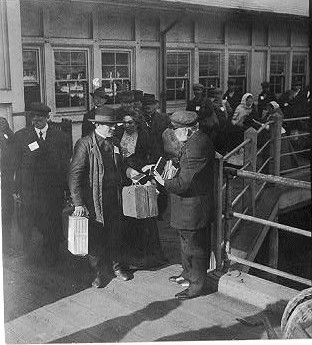
If not for the Internet, I’d be handing them out to passersby down at the docks.

The giveaways I’m working on right now are at Goodreads, for the print copy, and Amazon, for the Kindle version.

The Goodreads giveaway is running now. I am giving away six print copies of A Housefly in Autumn. The giveaway is open to US readers and runs through July 26, 2015, when six winners will be chosen.

The Kindle giveaway will run July 15-17. This is an unlimited giveaway. The Kindle version will be free to all who wish to download during that time. Amazon is in charge of the logistics, but from my experience, I expect this to be open to international readers as well.

Setting up the giveaways is not difficult nor time-consuming. But if you’re giving away your book, you want somebody to take it (if only for self-esteem purposes). The more difficult piece is drawing attention to your giveaway. This involves researching and registering your giveaway on blogs and web sites that advertise such things. All have different rules and requirements. Figuring out where to post and filling in required fields eats up time. Fortunately, it doesn’t have to eat up a lot of money, because it’s hard enough to give so much of your toil away; it would be far worse to have to pay to give it away.

Please take a moment to explore these giveaways and/or mention them to other readers.

Blurred lines: Stuck in limbo between Young Adult and General Fiction

When you are preparing to release a new novel to the public, it’s easy to become plagued by doubts.

Is the action exciting enough? Is there enough action? Is the dialogue compelling? Are the characters well-developed? Are they relatable? Will anybody care what happens to them?

This list goes on . . .

These transient type worries tend to replace each other day by day until you resign yourself to the fact that there is no ironclad way to dispel them. You will only get your answers once the book is in the hands of readers. Until then, you have to work largely on faith.

If you are extra fortunate, your book will also give you one good underlying concern that haunts the back of your mind throughout the process, even as your transient worries jockey for position at the front of your mind.

With A Housefly in Autumn, my super-duper awesome underlying concern has been hitting the right target audience.

I always envisioned A Housefly in Autumn as a Young Adult novel. It’s themes and tone were tailored to younger readers from the beginning, and from the beginning this categorization had the potential to be problematic.

There is a large cohort of literary-minded people who adhere to a rule about Young Adult fiction, mandating that the main character in such works must be no older than 18 throughout the story. I broke this law half way through the first draft. My main character ages out of this statute at about the 60% mark. Then, he does something even more illegal: he continues to age.

Accidents of youth

My main character, before he joined AARP and applied for a reverse mortgage. (Art by Jessie O’Brien)

I decided early on I would have to take my chances by breaking this popular maxim. I sailed full speed ahead.

Then, something else began to happen. As I started getting feedback on the manuscript, I realized that the things I was attempting with the narrative style and word choices were distracting readers from the story. I needed to adjust the tone.

In making the tone more conventional, I have sacrificed what to me is some of the youthful flavor of the narrative. This change was necessary but it was not done without some regret. The novel reads more like General Fiction than I intended.

Still, I could not see marketing it as General Fiction. The themes are too youth-oriented for that. Hence, my nagging concern: is this novel stuck in limbo between youth and adult fiction?

Maybe. But in this age of crossover and overlap, maybe limbo isn’t a land of the lost anymore. Maybe “youthful flavor” is a relic of a simpler time. Maybe youthful theme, coupled with a not overly youthful tone, is a budding sweet spot.

Pigeon-holing is still a useful concept in marketing, and leaning toward Young Adult is not exactly a clear-cut niche. Yet, it is just the spot where this book rests.

In the end, this dilemma will be resolved in the same way the “Will people like my characters?” question is. Readers will decide.

I’ll live with that.