My love-hate relationship with James Fenimore Cooper

I’m not sure what to make of James Fenimore Cooper. Unlike Edgar Rice Burroughs, whose books I loved, despite their flaws, Cooper is an author whose books I wish I could love.

There’s a little boy deep inside to whom Cooper is magic. Growing up in Upstate New York, keenly interested in colonial history and Northeastern Indians, put me right in line for devouring Cooper’s Leatherstocking Tales. It also made me wish he had done a better job writing them.

Cooper could spin a yarn. He was imaginative, and there is enough drama in his books to keep you turning pages. The problem with Cooper is there are far too many pages to turn. I don’t mind long books. I just don’t like needlessly long books.

Cooper was profligate with the English language. He thought words grew on trees, which is not a good thing for a writer whose stories take place in the forest. Cooper grabbed handfuls of words from the nearest low-hanging branch and tossed them willy-nilly. Adverbs, adjectives, whatever he had in hand; there must be something lying among the twigs they could be used to describe.

The only time he was able to restrain himself from putting in more than his two-cents-worth.

The only time he was able to restrain himself from putting in more than his two-cents-worth.

If you can weave your way through the superfluous words, the other thing that might grab at your ankles is the flawlessness of the hero. No matter where Natty Bumppo points his rifle, he is sure to hit the head of nail. On his off days, he shoots easier things, like deer, Indians, and Frenchmen, who sometimes need to be shot but hardly pad his resume as a marksman.

Natty never brags about his marksmanship. He is famous for not bragging. He repeatedly avoids self-congratulation while talking up of his exploits until his humility becomes annoyingly boastful. Bumppo is a thoughtful, taciturn man who seems always to be talking at somebody. By contrast, Tarzan was exceptional at swinging through trees, but he didn’t waste all your time not bragging about it.
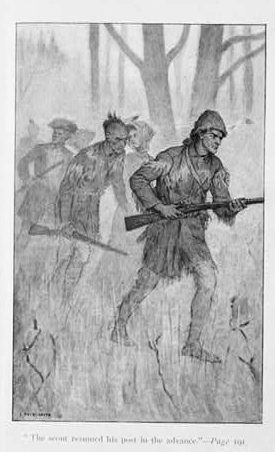
A rare scene in which Natty's mouth is closed.

A rare scene in which Natty’s mouth is closed. (Artist: E. Boyd Smith)

There are a surprising number of upper-class, young women traipsing through Cooper’s wilderness. Natty Bumppo is never tempted by them. Maybe he’s too wise to get tangled up with impulsive women who can’t quell the urge to visit the far side of a border war. More likely, Natty is too pure. Naturally, when a man who has been alone in the forest for ages finds a beautiful woman in his path, it presents a wonderful opportunity to spew his backwoods philosophies at her.

If Natty Bumpo had missed his target once, or at least shut up about how un-noteworthy his “gifts” were, he’d have been a lot more interesting. If he’d entertained one lustful thought, he would have been more believable. In the end, he was just a guy who could get you through the woods, if you didn’t allow yourself to get trapped in a conversation with him.

Having said this, I admit to reading all the Leatherstocking Tales. If lost volumes were discovered, I would read them too. Cooper snared me with his subject matter. His writing frustrates me, but what can I do? There aren’t a bunch of people running around New York during the French and Indian War besides Natty Bumppo.

So here’s to you, James Fenimore Cooper; you may not have done it the best, but you did it the most, and that should be worth something.


He blinded me with science: The Mysterious Island by Jules Verne

The Mysterious Island recounts the adventures of six Yankees who escaped a Confederate prison by stealing a hot air balloon.  They ride the winds of a monster storm until the balloon fails and deposits them on a deserted island in the South Pacific. The castaways have nothing but the clothes on their backs to help them survive.

One of the castaways is an engineer. All the others have man-crushes on him because he knows how to make anything out of dirt and gumption.

Another of them is a teenaged boy, who, despite his tender age, knows everything there is to know about exotic fauna and flora, including the various medicinal uses of the latter.

The third Yankee is a sailor, capable of building a pleasure yacht by himself, on a deserted island, in about four months.

The fourth castaway is a journalist. He is exceptional at making himself appear wise, though he is of less practical use than any of the others.

The fifth castaway is the black “companion” of the engineer. He is under no “obligation” to the engineer, and could have gone his own way at any time during his long “devotion” to the engineer.  Guess who does all the cooking on the island.

The final castaway is a dog, who turns out to be marginally more useful than the journalist.

Don't worry for their safety. Jules Verne only kills bad guys.

Don’t worry for their safety. Jules Verne only kills bad guys.

Remarkably, the island contains every natural resource necessary for five men with clothes on their backs to develop a western industrial society. The castaways, who, for reasons associated with the tourist trade, quickly become colonists, busy themselves in the production of steel, textiles, and other assorted necessities and luxury items.

What makes the island mysterious is the presence of an unknown benefactor who aids the colonists whenever they encounter a difficulty requiring too much effort to plot their way through. When pirates attack, a torpedo is placed in the pirate ship’s path by the unknown protector, destroying the threat without having to bother us with an annoying display of military cleverness by the colonists.

I wanted to dislike this novel from the beginning. The characters are flat. There is no conflict between them. They are great guys who always agree on everything, and anything they touch turns to gold. Verne’s obvious  and overabundant  love for his characters means there is no tension caused by worry that any of them will come to serious harm.

Readers more sciencey and less fictiony than I am might enjoy descriptions of the processes by which the colonists manufactured the many fine products used to build their empire. To me, a recipe book for smelting iron does not make a compelling story.

And then there was the time lost deciding upon names for the island’s various features. They really could have done this while I was at work.

In spite of all this, I could not hate this book. I found myself looking forward to revisiting the island. Even though some the colonists’ improvements were far-fetched, I wanted to see what else they were able to develop. The characters themselves were secondary to me. I wanted to watch progress. Jules Verne may not have been much into character development, but he sure was adept at showing off scientific progress. That’s how he got me; apparently, I’m a sucker for progress.

In the end, this collection of brilliant and amiable men faces catastrophe. With their mysterious protector no longer able to bail them out, they do what all clever, resourceful men do to save themselves: they rely on dumb luck.

It was disappointing that the characters did not concoct some ingenious scheme to save themselves, but I didn’t really care about them anyway. I was more concerned about the island itself. This once-primitive, now paradise, land was the true star of the show. Only Jules Verne could make me feel this way about a chunk of volcanic rock.

The publishing process made me a better storyteller

Maybe I should have kept up my vigorous regimen of procrastination.

Fortunately, I hadn’t given up procrastination cold turkey, I was gradually easing off it as part of a 112 step program.

While I am waiting for my initial beta reader (wife) to list all the things wrong with the first draft of my latest book, I decided to twiddle my thumbs for a good long while before reworking one of the several unpublished novels I keep tucked away for later.

Incidentally, there are a many things wrong with the first draft of the latest book, so it may take her some time to compile them.

Thanks to the fascinating qualities of my twirling thumbs, combined with confluence of youth spring soccer and baseball seasons, and a big project at work, I have rewritten all of 12 pages in the last two months. The manuscript is more than 400 pages, so those dozen pages seem somewhat measly.

Yet, I am a man who can occasionally find sunshine in little things. (My initial beta reader may disagree with this, but she doesn’t always appreciate the subtlety of my understated sunshine.) I am pleased with what I have accomplished.

There’s a lot in those 12 pages. Mostly, there’s a much more engaging beginning to a story than there used to be.

I finished the draft of this novel about 10 years ago. I didn’t publish it because, though I believed it a good story, it wasn’t everything I wanted it to be and I didn’t know why.

Ten years later, I might have figured out why.

My presentation of the story did not measure up to the story itself.

In those 10 years, I could have written 10 novels and still not learned enough about storytelling. As it happens, in those 10 years, I spawned three children, so I may have changed 10,000 diapers but I didn’t write anything near 10 novels.

"How many diapers?"

“How many diapers?”

But it wouldn’t have mattered if I’d written 20. The thing that made me learn most about storytelling was publishing three books.

Publishing wasn’t a financial windfall by any means, but it was a learning experience, and a valuable one. Knowing I would put these stories before the public made me consider them from angles I’d never had to before. It made me focus on readers: how I took hold of them, how I held onto them, and where I led them. It forced me to act like a professional: to analyze my own work and that of competing writers with new attention to detail. It didn’t mean I was going to attempt to copy the successful ones, but it did make me think about the elements that made them a success.

The act of publishing made me more aware of many things about my books, but more than anything else, it made me constantly reevaluate how I present a story. There’s more to learn, but I’m better than I used to be.

If I can keep up this breakneck pace of rewriting, I may actually turn this old novel into a well-presented story to share in about five years or so.

Learned from Jules Verne: A successful hero knows when to cry

Michael Strogoff by Jules Verne is a 19th century adventure novel. It’s less well-known than Twenty Thousand Leagues Under the Sea or A Journey to the Center of the Earth, but I liked it better. I don’t remember much about those novels.

Michael Strogoff is a special courier for the Czar. The Tartar hordes are invading Siberia, and the Czar needs to get a message to Irkutsk warning of a traitor plotting to sabotage that city’s defenses.

The Czar's man in Irkutsk.

The Czar’s man in Irkutsk.

Michael Strogoff would be a typical adventure, with its prerequisite, larger-than-life hero, except for two characteristics. First, it made me root for a Czar and his military forces. I’m no expert on Russia, but I have a notion Czars where not the most sympathetic characters. Nor does the image of Cossack cavalry inspire me with warm fuzzies.

Second, Michael Strogoff is not your typical action hero. In my youth I read 24 Tarzan novels, and I don’t recall Tarzan ever shedding a tear. Mr. Verne never comes right out and admits Michael was crying, but there was clearly something in his eye when he was under duress at the hands of his enemies.

Here’s the situation: the Tartars have captured Michael and his mother. They might decide to do some bad stuff to his mom at any moment. Meanwhile, they are going to make Michael go blind, which, I guess, is what Tartars do sometimes. They pass a red-hot blade before Michael’s eyes, in the Tartar custom of blinding prisoners.

In the tradition of bad guys everywhere, the Tartars grossly underestimate the hero and eventually let him go (because he’s helpless, right?). The blinded Michael, and some girl he hooks up with, struggle across the steppe just in time to save Irkutsk. There, Michael kills the traitor in a sword fight. That’s right, a sword fight. How is blind Michael able to do this? Guess what? Michael’s not blind! He never was.

Everybody (except the reader) is shocked to discover this. Even his girlfriend, who led him across versts and versts (old Russian kilometers) of countryside, was hoodwinked by his blindness scam. It’s anybody’s guess why he couldn’t let her know, in a private moment, he wasn’t really blind. Maybe he was using her pity to coax back rubs out of her.

Anyway, here is the inspirational reason Michael was able to escape being blinded by the hot blade passed over his eyes: he was crying at the time. Mr. Verne doesn’t use the word crying; that might be unbecoming a classic hero. Michael was upset with worry about what the Tartars might do to his mom (they ended up letting her run free too) and there was just a little layer of water covering his eyes when the hot blade passed by. This little bit of water insulated his optic nerves from the heat, or something like that. Consult Dr. Verne for the technical explanation.

Paging Dr. Verne.

Paging Dr. Verne.

This series of events is a great comfort to me, because if Tartars ever come after me with a red-hot blade, I guarantee, even lacking endangered relatives, I will be bawling my eyes out. My optic nerves will remain cool and calm under my pool of tears. I just have to make sure to walk into some stuff afterward so they’ll think the procedure a success and let me go.

Even if he didn’t cry us a river, Michael certainly got teary-eyed. I’d have preferred it if he saved his vision through some more clever means, and then, after wreaking his terrible wrath upon the Tartars, took a moment to get misty-eyed about his poor mama. I don’t mind heroes having a sensitive side, but I don’t like them to cry their way out of trouble; toddlers shouldn’t even be allowed to do that. I want great heroes of literature to hold their tears until some serious bad-guy ass has been kicked. Is that too much to ask?

I shouldn’t make too much of the crying. I did enjoy the adventure. Besides, if shedding a few tears would have helped me defend Irkutsk, when I played Risk as a boy, I would have let them flow in a heartbeat.